Showing posts with label Checkpoints. Show all posts

It’s inhumane - They treat us like animals - Every morning I feel like an animal in a cage.

PHOTO ESSAY ~~ MORNING BLUES AT THE CHECKPOINT

The morning commute (through the checkpoint)Philip Weiss
VIA http://desertpeace.wordpress.com


Bethlehem
Bethlehem1
Bethlehem
Bethlehem3
Bethlehem
Bethlehem4
Bethlehem
Bethlehem5
Bethlehem
Bethlehem6
Bethlehem
Bethlehem7
Bethlehem
Bethlehem8
Bethlehem
Bethlehem9
Bethlehem
Bethlehem10
Bethlehem
Recently a Finnish photographer who had worked in the region sent us these photographs that were posted at his/her blog Ubuntifada. They were taken in late June, at the Bethlehem checkpoint to enter Israel. They depict the everyday experience of hundreds of Palestinians who go to work in Israel. I am respecting the photographer’s desire for anonymity because of employment/funding issues. He/she wrote the following at that site to explain the photos: 
Morning blues in the checkpoint
5:00 in the morning in Bethlehem. The rising sun is replacing the blue morning mist with its first warm rays. Hundreds of men are standing in a cage, holding the metal bars like prisoners and anxiously waiting. The atmosphere is as blue as the air.
Actually, it could be just a crossing between two countries – though a very disturbing one with its iron gates and cages, bars and burrows, loud PA systems and shouting, soldiers and police and private security guards all armed to the teeth. But instead of being in the border, checkpoint 300 stands 2 kilometers south of the green line, deep inside of the occupied West Bank.
Every working day from 4:00 to 7:00 around 4000 Palestinians cross this illegal checkpoint on their way to work in East Jerusalem or in Israel. And the ones standing in line are actually the lucky ones – they have been able to even get a permit.
It’s inhumane. They treat us like animals. Every morning I feel like an animal in a cage.
Adel, who crosses the CP five mornings a week


Share:

Israeli troops kill Palestinian at checkpoint


Israeli soldiers have shot dead one Palestinian and wounded two others after 
opening fire on a car at
 a checkpoint in the occupied West Bank.
Palestinian medical and security sources said Akram Dair, 40, was driving in a car before dawn 
on Monday when border guards near Ramallah opened fire on him and the two other Palestinian
 passengers in the car.

The three Palestinians, said to be heading to Occupied Jerusalem for prayers, were taken 

to a hospital in Ramallah.
It was unclear why the Israelis fired at the car as it approached the checkpoint.
An Israeli army spokesman confirmed an "incident" had occurred on the road leading 
from the West Bank to Occupied Jerusalem, but could not provide further details,
 the AFP news agency reported.

West Bank Palestinians do not have the right to enter occupied territories, including

 East Jerusalem, without a permit from Israeli authorities.
Share:

Checkpoint jitters


Raja Shehadeh

EVERY DAY, at hundreds of checkpoints throughout the West Bank, Palestinians are stopped and made to wait, often for a long while, before they are let through. Last week I was halted at the Jabaa checkpoint on my way from my home in Ramallah to dinner at a friend’s house in Bethlehem.

I was by myself, listening to a Beethoven string quartet, one of the most beautiful of his later works. The weather was good; the moon was out. I was in a meditative mood. I wanted to feel the beauty of the moment and not let it be determined, defined or in any way affected by the bored Israeli soldiers blocking my way.
At first, I seemed to be succeeding. As time stretched I began to wonder how long the wait was going to last, but I coached myself into staying calm : ‘’What does it matter? I have time.’’
Half an hour later, I began to feel that my composure was under threat. I started to simultaneously fear my temper (What might I do if I got upset because of this continuing wait?) and my cool (Would not reacting confirm I was becoming submissive and allowing these soldiers to step all over me?). Doubt set in.
Perhaps I wasn’t truly self-composed. Perhaps I was deluding myself and justifying my cowardice and my failure to assert myself and my rights.
I turned off the music. Then I waited, nursing my anger. I considered the different ways I could rebel. Should I get out of the car and yell? Should I honk? Should I rally the other drivers in the queue to start a rebellion?
I looked around. The drivers were silent and seemed to be taking all this meekly, without any visible manifestation of anger. How docile people have become, I thought.
Before the Oslo Accords we would challenge the Israelis, all of us would, each in our own way. We were not submissive then. Today we are subdued. No one in the cars around me was pounding on the steering wheel or even cursing. These are new times. It seems that as soon as those accords were signed in 1993, as soon as our leaders shook hands with the enemy on that White House lawn, the struggle was called off. That illusory peace has achieved little except to dampen people’s appetite for struggle. Now we endure our ordeal at checkpoints, as docile as too-well-mannered children.
“Whoever does not believe in our ultimate victory can go drink the waters of the sea,’’ Yasser Arafat was fond of saying. In his bravado he was no different from other leaders: the world over they try to appear victorious in the face of any reality. But I wasn’t fooled.
However the Oslo Accords are presented I know they mark a defeat for Palestinians. I will not accept to be deceived. I will face this calamity with open eyes.
In the past I did all that I could to expose the ways of our Israeli occupiers and the legal transformations that have taken place in the West Bank, robbing Palestinians of their land to allow for Jewish settlements. These were the subjects I wrote about. The ‘’peace’’ symbolised by the Oslo Accords has reversed none of Israel’s illegal actions. It has only made matters worse by obfuscating everything.
I must rebel against this, too, and against these new quiescent times. I must refuse to be beguiled, confused, mystified. If I’m not careful, I might end up like many around me: puny, a bit ridiculous, blabbering away to hide my inability to stand up to the occupiers. Reduced. My rebellion will take the form of seeking out the truth about our situation. I will subject my investigation to the highest standards, to safeguard myself against mediocrity and deception. In this way I will resist the lies of our enemy.
As these thoughts passed through my mind, a soldier’s hand waved me through the checkpoint. He was smiling. I started the engine, turned the music back on and in the company of Beethoven’s quartet drove the rest of the way to dinner on the moonlit road.
Share:

At God's Promised Check Point you always get tortured, go to jail, and fined as well

BETHLEHEM (Ma’an) — Israeli authorities tortured a 42-year-old Palestinian woman after she was detained at a checkpoint in October 2010, a prisoners’ center said Monday.
Hanan Hamouz was detained in Beit Jala, near her home in Bethlehem’s Al-Azza refugee camp in the southern West Bank.
On Monday March 28 - 2011, an Israeli court sentenced Hamouz to two years and a half years in prison and ordered her to pay a 3,000 shekel ($850) fine. The Prisoners Society in Bethlehem said in a statement that she was charged with trying to stab an Israeli soldier, and had been tortured in detention.
Source

The views expressed in this article are the sole responsibility of the author and do not necessarily reflect those of this Blog!
Share:

Israel turns back 250 tons of truckloads of food

Israeli troops manning the land Al-Ojah checkpoint in Central Sinai sent back 13 truckloads of 250 tons of flour dispatched by the Egyptian Red Crescent to Gaza Strip on Thursday.
The official Egyptian news agency, the Middle East News Agency, quoted a source in the association as saying that the Israeli authorities have hampered dispatch of aid to the Palestinians in Gaza Strip through this checkpoint.

The source indicated that Egyptian authorities, had in the past, coordinated with the Israeli side for the dispatch of the humanitarian aid to the Palestinians. Up to 315 tons of food aid were sent to the strip through the land passageways on Monday.
He indicated that the quality of returned food materials would be affected due to hard weather conditions.

About 10,000 tons of food dispatched by Egyptians, Arabs and foreigners, have been kept in warehouses in Egypt since they were dispatched last December. He warned that they would expire soon, before delivery to the Gazans
Share:

As if Palestine Needs Another Israeli Check Point

Israeli authorities confiscate land from Deir Sharaf to build new checkpoint
Israeli authorities have recently removed Beit Iba checkpoint, north of the city of Nablus, only to build a new checkpoint 2km away on the same road. This new checkpoint is located west of the village of Deir Sharaf, closer to the illegal Israeli settlement of Shave Shomeron. The new checkpoint is being built on at least 70 dunums of confiscated village land. Most of this land consists of agricultural fields belonging to 23 families from Deir Sharaf. Dozens of olive trees are to be cut down or confiscated when the new checkpoint is implemented.
http://palsolidarity.org/2009/04/5769
Share:

How Many Pitas Should One Person Be Allowed?

Picture yourselves coming one day back home from the supermarket with your groceries, and at the entrance of your building a policeman asks you to see what you have. “Pitas?” he says while counting them, “you’re only allowed 5.” “But we’re 4 people at home, 5 pitas won’t be enough.” But he pulls out the bag 5 pitas and puts them aside. “Sorry, only 5.” From another bag he takes out potatoes, measures the bag with his eyes and takes out half, pulls out a few tomatoes from another bag, and 6 eggs from the box: “you’re only allowed 6.” You watch stunned – is someone actually going to tell you how many eggs to eat? How many tomatoes to put in your salad? Yes!! Well, perhaps not to you personally, but if you were a Palestinian, this situation would not be unthinkable.


Azun Atme is a village locked within the separation wall between the settlements, Oranit, Elkana and Sha’arei Tikva. In order to leave these settlements within the Israeli area, this village is locked by the wall from all its sides. A prison within a prison, that’s the right word for it, and not the “clean” term used for it: Green Line Seam Exclave.


On the northern side, leading to the West Bank, the checkpoint is manned by the army. A hard checkpoint. Lots of soldiers, male and female, a room for metal detectors, a guardhouse and the carousels. Everyone, including pregnant women and infants, has to go through the metal detector room. On the southern side, leading towards the settlement road 505, a new checkpoint is being constructed these days.


Both checkpoints close down at 9pm. An entire village, a few thousand people, children, elderly, women about to give birth, people with heart condition – all are well-locked behind walls, fences, barbed wire, armed soldiers and guard-posts. Not terrorists, unarmed. Farmers (Azun-Atme had free passage to Israel for over two years and did not produce a single attempt for a terrorist attack). Like Qalqilya, and like many other villages that the Separation Wall has separated between them and the most fundamental right there is – the right to freedom. And as if all that is not enough, ten households of the village are on the other side of road 505, on the other side of the wall.


But, every exception is supplied with its proper oppression. Each resident of those ten households is examined on its way home, including its belongings and anything purchased in the village. The army has allocated rations that a person is allowed to bring home. 10 pitas, a kilo of potatoes, etc. Even if it’s a person with 9 children, a grandfather and grandchildren. Even if it’s a person with a household of 20 people. Maybe if he goes to Qalqilya at the office of the DCO (District Coordination Office), stands in line for a whole day, he will get a special permit for some extra rations. But in the name of all the people, of members of my family, who are haunted to this day by the shadows of days behind barbed wire and armed soldiers, I want to ask: what has become of us?

Sourced from http://draykcab.wordpress.com
Share:

A Kitten with no permit!

By: Mayadah Tarazi


This morning, I decided to leave home a bit earlier to make extra time to get through the checkpoint, but as soon as I reached it, there was a very long line of cars.

While waiting for my turn, I heard a voice of a small kitten, crying in its tiny voice “Meaw…. Meaw” my first thought was that it is stuck somewhere in my car, but as I checked my rearview mirror, I saw this tiny little gray kitten trying to jump on the Wall! I didn’t know if I wanted to laugh or cry at this amazing sight, it was really struggling to jump on the Wall and cross over to the other side of the street, it would jump with all its might and try to climb, only to fall back down, and try again. But after several attempts it just gave up, and went back to the place where it came from.

Unfortunately, it seems that not just human beings can’t cross the check points but also animals. Maybe Israel should create a permit system for animals too. Not sure though if this kitten will figure out how to apply!

I wish I had camera to take picture or video for the scene, but I am sure it’s something I will not forget.
Share:

Chutzpah: West Bank Settlers Complain That Checkpoints Make Them Late For Work

M.J. Rosenberg -

Thank you, Mitch Plitnick, who represents B'tselem, the Israeli human right organization in Washington for bringing this insanity to my attention.

A group of Israeli settlers have filed a suit against Israeli authorities because the so-called security checkpoints -- designed to prevent terrorists from getting into Jerusalem -- are making them late for work, school, the gym, whatever.

There are some 600 checkpoints; more are added all the time. A tiny minority of that number are on the border between Israeli and Palestine (a few dozen or so). These are designed to protect Israel against terrorists who might cross into Israel. The rest are internal checkpoints designed to impede Palestinian movement from one Palestinian town to another. The checkpoints -- along with the "settlers only" superhighways -- divide and dice the West Bank into small pieces, giving the settlers a viable homeland while preventing the Palestinians from reclaiming the economic and social viability that they had before the occupation.

How ironic is it that the settlers, for whom Israel has constructed an entire system of internal barriers to Palestinian movement, now are filing suit because sometimes the border checkpoints (designed to deter terrorism) inconvenience them!

Palestinians are not just inconvenienced by the checkpoints. The checkpoints have caused thousands to lose their jobs (they can't get to them). They prevent kids getting to school. And they have caused innocent people (including women in labor and babies) to die because they were prevented from getting to the hospital. See this from Israel's Yedioth Achronoth. Or this list of victims (and their testimonies from Btselem).

On the other hand, think of those settlers who were so late to work that they lost a good parking space..

Share:

Israeli soldiers shoot Palestinian at Huwwara checkpoint

author by Saed Bannoura - IMEMC News

Late Monday evening, Israeli forces shot and wounded a 20-year old Palestinian man who attempted to cross the Huwwara checkpoint, which is one of the largest checkpoints maintained by the Israeli army in the West Bank. Israeli forces controlling the checkpoint had kept it closed for two hours straight in the midst of rush hour, with hundreds of Palestinians pressed up to the Wall, hoping to get home past the checkpoint.

Palestinians waiting at Huwwara checkpoint

According to local sources, Adham Shihadeh, 20, began walking through the crossing, and did not stop when Israeli soldiers shouted at him. The soldiers then began firing live rounds at the young man, injuring him in the foot. He was taken by car to Rafidia government hospital in Nablus, where medical personnel described his injuries as 'light to medium'.

Shihadeh had apparently become frustrated with the daily hours-long wait at the checkpoint, which is located deep in the middle of Palestinian territory, far from the Israeli state. In addition, on Monday afternoon, Israeli authorities arbitrarily closed the checkpoint for no apparent reason.

The arbitrary closures of checkpoints is a common occurrence as well – not just at the Huwwara checkpoint, but at all of the 700 Israeli checkpoints that cut up the Palestinian territory known as the 'West Bank' into hundreds of separated enclaves under complete Israeli military control.

Share:

Twilight Zone / Dead on arrival

Nothing helped. Not the pleas, not the cries of the woman in labor, not the father's explanations in excellent Hebrew, nor the blood that flowed in the car. The commander of the checkpoint, a fine Israeli who had completed an officers' course, heard the cries, saw the women writhing in pain in the back seat of the car, listened to the father's heartrending pleas and was unmoved. The heart of the Israeli officer was indifferent and cruel. For over an hour, he would not let the car with the young woman in labor pass through the Hawara checkpoint on the way to the hospital in Nablus. Not to Tel Aviv; but to Nablus; not for shopping, not for work; but to get to the hospital in an emergency. Nothing helped.

Nahil Abu-Rada is not the first woman to lose her baby this way because of the occupation, and she won't be the last. At least a half-dozen checkpoint births that ended in death have been documented here over the years, and nothing has changed. No punishments, no lessons, not even a request for forgiveness from parents who lose their children because of the coldheartedness of soldiers.
The occupation kills - never has this slogan sounded so true as on that night, two weeks ago, at the Hawara checkpoint south of Nablus. No convoluted excuse or explanation from the Israel Defense Forces spokesman (military sources were quoted the day after the incident, making this outrageous comment: "This baby would have died anyway") can erase the simple, chilling fact that for officers and soldiers in the occupation army we have established, human feeling has become alien, at least when it comes to Palestinians. Or the fact that there are still officers and soldiers in the IDF who behave with such lack of feeling toward a woman in labor who is about to lose her child.

What went through the mind of the officer who refused to let Nahil pass? He saw her in agony, he heard her husband's desperate pleas, and he surely knows how children come into this world and how they can leave it just as easily, without lifesaving medical treatment.

The couple had gone to bed at nine. They woke up after midnight when Nahil, 21, suddenly went into labor; she was at the beginning of her seventh month of pregnancy. This was on the night between September 5 and 6, at their home in Qusra, a quiet and relatively well-off village east of the Tapuah Junction, at the foot of the Migdalim settlement in the northern West Bank. The closest hospital was in Nablus, a 15-minute drive at night to the Hawara checkpoint, and then another 10 minutes from there to Rafidia Hospital, if all goes smoothly. But that night, nothing went smoothly.

The husband, Mu'ayyad, 29, called his brother Uday to come quickly with his car. The two brothers work in different industrial plants on the Ma'ale Ephraim settlement. They speak Hebrew well. Their father works as a gardener in Ma'ale Ephraim. They come from a family of 16 siblings, most of whom attended university; they had never been in any trouble. Uday's phone's ring tone is the Hebrew song "Hayal mishmar hagvul" (Border Police Officer), with the lyrics: "We were a pair of lovebirds, innocent and shy, suddenly it all ended, my heart is broken ... You went to the army and love went with you, now I'm lonely and sad." Now, Uday's cell phone also carries a horrifying photograph of his brother's dead baby.

Uday arrived within minutes and they carried Nahil to his red Opel and lay her down in the back seat. There is no ambulance in the village. Had they called for one to come from Nablus, it would take much longer, they thought. Uday drove quickly, using flashing red lights in the back, while Nahil lay moaning with her husband by her side. The brothers' mother joined them in the car, too.

Shortly before 1 A.M., they reached the Tapuah checkpoint and after a delay of a few minutes, they were allowed to continue on their way. Nahil's cries grew stronger. Every so often, she would anxiously ask her husband: Where are we? How much longer? Mu'ayyad reassured her: We're almost at the hospital, just a few more minutes. Some minutes later, they reached Hawara.

The checkpoint was deserted. They stopped where cars are supposed to stop. "It's the army: If you don't stop the right way, they can shoot you and you can be killed," Mu'ayyad explains later.

A soldier stood 25 meters away. Mu'ayyad began walking toward him carrying the identity cards of all the passengers in the car. "Come here a second; it's an emergency. My wife is in labor and I have to take her to the hospital, to Rafidia," Mu'ayyad said. The soldier said he'd have to consult his superior officer. "He walked really slowly, not in any hurry," as Mu'ayyad describes it.

Adds Uday: "They're working very quietly, very slowly, it's all quiet. She's yelling and they're quiet. Moving very slowly."

The soldier disappeared into the building next to the checkpoint. The two brothers say it was 15-20 minutes until he returned, accompanied by the officer. Meanwhile, Nahil had started bleeding in the car. "What's the problem?" asked the officer. "My wife is suffering, she's bleeding in the car. Please, do me a favor, check the car quickly and let us go." The officer: "You need a permit."

Mu'ayyad pulled out a work permit that's good for Judea and Samaria, 24 hours a day, but the officer didn't even bother to look at it. "I started to plead with him. I told him: The situation is serious. I told him: Keep all the IDs with you and keep me with you, and my brother will just bring her to the hospital and come back." It didn't help. Nothing helped.

The cries of agony from the car grew louder and more frequent, the officer must have heard them quite well. He heard, but closed his ears. "I opened all the doors so they would hear my wife's cries," says Mu'ayyad. "I was not asking to go into Tel Aviv. I was asking to go to Nablus, and not so I could stroll around at one in the morning, but so I could bring my wife to the hospital."

After all his pleas fell on deaf ears, Mu'ayyad tried one last request: "Help me. Maybe you have the phone number of an ambulance? I'm from the villages and I don't know it. Could you help me in this situation? Look, my wife is screaming in pain, she's bleeding, help me, please." Nothing. A heart of stone. "He didn't want to help me, the officer," Mu'ayyad recalls dryly.

Desperate and terrified, he phoned his brother who lives in Nablus and asked him to call an ambulance to rush to the checkpoint. But by the time the ambulance arrived, the birth had begun. The tiny head was emerging; Mu'ayyad is sure he saw the baby move its head. He quickly grabbed hold of either side of the head to protect it.

"I said to them: Look, the baby is starting to come out! I show the soldiers my wife in this condition. It's no easy thing for me to show them my wife in this condition, but I wanted to save my son. I'm ashamed, but out of fear for my wife and child, I showed her to them. We need oxygen, you have to do something, I say. He didn't listen to me. In the end, the baby started to come out, my wife was lying in the car, her legs sticking out. I grabbled hold of the baby so he wouldn't fall between the seats. I thought I could feel his heart pounding. I felt that my son was still alive. He moved his head to the side two or three times; he needed someone to take care of him right away to get him out and save him."

But the birth stopped, with the baby half out and half in. Mu'ayyad and Nahil were desperate, frantic. The officer and the soldier outside didn't lift a finger to help. "We needed someone to take care of him. He's a neonate. He needs to be taken right away to an incubator with oxygen," Mu'ayyad yelled. He tried to get help, but no one at the checkpoint responded.

Meanwhile, the ambulance from Nablus arrived. Mu'ayyad says that precious minutes passed before it was allowed to cross to the other side, where Nahil was. He says he screamed at the soldiers: "You didn't help me! Now I think my son is dead! Help me save my wife's life, at least. I lost a child, but my wife has to be saved! I started yelling like a madman until they let the ambulance approach."

The paramedic put on gloves and entered the car. The baby was still only halfway out; the paramedic pronounced him dead.

Mu'ayyad: "He said to me: "I have to take the child out, before we take your wife to the ambulance. I think he's dead." He removed the baby and cut the umbilical cord. We took the bag with the clothes that we'd brought for the baby, dumped them out and put my son inside. We tore out the upholstery from the car and carried my wife to the ambulance. Then the medic removed the placenta and put it in the bag with my baby."


A while later, the couple arrived at Rafidia with the bag holding their dead son. The doctor started shouting: "What happened? Why is she bleeding this way?" Mu'ayyad explained: "An hour and a quarter at the checkpoint."

"Actually, I felt like it had been a year, but we left home at 12:40 A.M. and arrived at Rafidia at 2:45 A.M.," he recalls now.

It also pains him that no one at the hospital opened the bag to examine his dead son: "I heard they gave the soldier a 14-day sentence. This is a person who not only killed my son, he killed me and my wife. What kind of punishment is that? This is something horrific, what happened to us. I don't wish it upon anyone, not even the soldier. He killed my son. With a cold heart, he killed my son. Everyone should try to put himself in my place. What would happen if something like this happened to the soldier's wife? He'd kill 100 people. My son died and I couldn't help him. What kind of father am I?"

They were thinking of calling their son Zaid. They have another baby, a girl, at home. On the way back, the couple placed the baby's body in a cardboard box. At the Hawara checkpoint, the soldiers asked to see what was in the box.

"It's my son, who died yesterday at the checkpoint when you wouldn't let me get to the hospital," Mu?ayyad told the soldier.

The response from the IDF Spokesman's Office: "This is a difficult and unfortunate incident, following which a comprehensive investigation was carried out by the battalion commander of the soldiers at the checkpoint. The Coordination and Liaison Office also clarified the circumstances with the woman in question. The findings were presented to the head of the Samaria brigade, and the officer in charge of the checkpoint sentenced the squad commander to imprisonment in a military facility and dismissed him from his position."

"From the investigation it appears that on September 4, a civilian vehicle arrived at the Hawara checkpoint at about midnight with a resident of Qusra, his pregnant wife, his brother and mother. The soldiers on duty did not allow the Palestinian to enter Nablus, as he did not have an entry permit for the vehicle. An ambulance was ordered and the woman was treated on the spot; the infant was stillborn. The woman was evacuated by ambulance for continued medical treatment in Nablus."

"In light of the fact that this was a humanitarian incident, it would have been proper if it had been dealt with differently, and the IDF regrets this."

Nahil is not willing to talk or have her photograph taken now. For two weeks, she hasn't spoken, and has hardly eaten or slept. Signs of trauma are obvious in the slim, pale woman in traditional garb. Mu'ayyad says he also has trouble sleeping.

On the day we met this week, the couple had spent about six hours waiting in the Coordination and Liaison Office in Hawara until their testimony was taken down by an investigator. Six hours, during the Ramadan fast, after giving birth at a checkpoint. That's how it works.

Attorney Michael Sfard of the Yesh Din human rights organization has written an urgent letter to the military advocate general, requesting a postponement of the disciplinary sentence imposed on one of the soldiers involved - two weeks of military detention - so as to allow a possible criminal proceeding.
Share:

Shades of Checkpoint Charlie at Rafah Crossing


Haidar Eid writing from the occupied Gaza Strip, Live from Palestine.

On Monday 30 June, Gaza was abuzz with the sudden announcement that Egypt would open Rafah Crossing -- the only gateway for 1.5 million Palestinians who have been imprisoned here for almost two years -- for three short days. Although I had good reasons to use the crossing to leave Gaza, I was unsure about pressing my luck to escape, if only for a short while. Past experience has made me graphically and painfully aware that thousands of my fellow Gazans would also try to capitalize on this very rare opportunity suddenly available to us.

On the one hand, I had also already asked my university to add my name to the list of academics who intended to travel to Egypt to further their studies as I had accepted an invitation to a conference -- to be held at University of Brighton -- in London in September. Moreover, I wanted to be with my wife who is in South Africa, and whom I have not seen for almost two years as a result of the siege. On the other hand, the story of failed attempts to leave Gaza through Rafah Crossing is an agonizingly familiar one to every family in Gaza.

Nevertheless, the temptation was too great and hope triumphed over experience. At 2pm, on Monday, I called the university's public relations officer. I was told in two short sentences to be at the Rafah crossing at 2am on Tuesday morning. The reason for this strange departure hour was not explained and I did not question it. If one wants to leave Gaza after two years, one simply follows orders.

My mind went immediately to the myriad tasks that must be completed in preparation for a journey: money, packing, goodbyes, tickets -- how would all this happen in less than 12 hours? I was not prepared at all and the banks were closed. I allowed myself 10 minutes to think about the steps I should take to ensure that I would be at Rafah Crossing -- 40 kilometers from my home at the end of badly damaged and unlit roads at 2am the next morning.

I then remembered that the bank manager is my neighbor; when I called with my unusual request outside of normal banking hours, he was so helpful that getting the money I needed turned out to be the easiest step. I then called my niece to help me pack and prepare for my unexpected journey. Dozens of phone calls were made, but I did not call my wife because I did not want to raise her hopes only to have them dashed as has happened so many times during this siege of Gaza. I, myself, did not have high expectations but I wanted to try because in Gaza one never knows for sure. It could go either way.

I made another call to our public relations officer just to find out what I was supposed to do on arrival at the crossing. "Wait with the other academics," was the answer. At around 11pm on Monday night, a colleague called to tell me to delay my departure until morning. His sources at the crossing had informed him that our names were not on the list sent to them by the Egyptians. He suggested I wait for more instructions in the morning. I did not sleep that night. In the morning, I got a call from another colleague, who was also leaving Gaza with me as he had to attend a conference in London. He suggested, on the advice of the public relations officer and another colleague who has contacts on the Palestinian side of the crossing, that we go to Rafah and wait for someone to help us enter the crossing because "our names are on the list."

We left Gaza City at about noon and drove straight to Rafah. Our taxi was stopped by Palestinian policemen at a mobile checkpoint five kilometers before the crossing. We were asked to leave the taxi and wait along with other people. I was encouraged to see only a few people -- perhaps the list was being used and we would be able to leave after all.

As it is almost impossible to go anywhere in Gaza without bumping into familiar faces, true to form, I immediately saw my cousin, whose wife has cancer, waving at me. He said he had been at this checkpoint since the night before! Needless to say, this was not good news. My colleague and I then called our friend who has contacts on the Palestinian side. He told us to wait there because one of the policemen at the checkpoint would be informed by his senior to allow us to walk to the crossing. That call never came.

Our contact himself then called to get our exact location because he was on his way to fetch us. What relief! Three hours later, we were still waiting and the mobile checkpoint was disbanded. We decided to drive to the crossing itself.

That is when reality hit us: tens of thousands of people were waiting there, children, old people, women, and worst of all, terminally ill people, all sitting under the baking hot sun of this semi-desert area. My heart sank! But we had to try our contact again -- how could we not, when the crossing itself was so tantalizingly mere meters away now? And if we passed, what freedoms awaited us: bookshops, movies, theatre, chocolate, friends, fuel, food, fruits and of course, in my case, my long-suffering partner. Our contact gave us more hope by asking us to move closer to the electronic gate and ask a policeman named Bassam to let us in.

The next problem on this long journey was trying to reach the gate through the masses of people jealously guarding their spots on the way to the gate. Finally we got to the gate which is where we realized that it would not open for us. The authorities would not open to let a small group of academics through -- list or no list -- simply because the waiting crowd would surge through the gate en masse. In any event we never did find Bassam to open the gate for us.

But we waited. The heat became even worse, children cried, and the sick and the elderly sat desperately on the ground -- they could no longer stand and would have to sit on the ground to wait for the gate to open. I decided to join them because it was clear that the wait would be a long one.

Worse news was to follow: our names were not on the list -- and the crossing was, in fact, closed! We had to wait outside until somebody allowed us to go inside the Palestinian hall to spend the night there. I was so tired and felt ill. I was also desperate for a toilet as none had been made available to us for all these hours.

Next to me was an old woman talking on her cellphone about the pain she was in. Next to her was the family with seven daughters, all on their way to Jordan. Opposite me was an ambulance with a cancer patient -- they had been waiting there for 12 hours. The place was so hot and sticky. After three hours I felt a sudden sharp pain in my stomach; I stood up to lean against the wall while yellow circles danced in front of me and a humming began in my ear. Then, everything went blank. I must have fainted. When I opened my eyes, people were giving me water, chocolate, cheese and asking me to eat and drink. Some pronounced it a diabetic episode, others were convinced it was low blood pressure. I was sure it was sunstroke. Whatever it was, I resolved to go back home right away.

On my return home, I was so relieved to see my bed -- and my flat felt like Paradise! That night I wanted to cry; cry for myself, for my dignity; cry for the old woman sitting next to me; cry for my cousin's wife; cry for the patient in the ambulance and for the 50,000 desperate people at the gates of Rafah Crossing.

The horror at the crossing continued after I left. Many people spent the entire night there, only to be told the following day that the crossing was still closed and that they should leave. It took me almost two days to feel physically better, but every single muscle of my body still hurts. I am angry and sad and do not have the words to express the depth of my feelings about this experience.

The situation that the tens of thousands of Palestinian men, women and children faced at the Rafah border crossing this week was inhumane and unconscionable. Nothing can justify this. Most rushed to Rafah Crossing in as short a time as I did with similar stories of frenzied activity and hope. More than 3,500 of them are terminally ill patients in urgent need of medical treatment in Egyptian hospitals. Others hold residency permits in other countries and have been trapped in Gaza for at least a year. Some are academics and students, traveling abroad to attend conferences or further their studies.

So, instead of giving them a chance to do these very ordinary things: go to a hospital, study, go to a conference or work, go back to other homes and other loved ones, the failure to open the Rafah Crossing, instead, increased their misery. Many of them spent three sleepless nights hoping to be allowed to cross into Egypt. Like me, many fainted, or suffered from dehydration and sun stroke. The failure to open Rafah Crossing reminded them of their imprisonment and their lack of human rights; it reminded them that they move at the whim of others and it reminded them that the siege of the Gaza Strip has still not been broken.

All the people who were at the Rafah border are civilians. Under the Geneva Conventions they are entitled to freedom of movement and protection from
collective punishment.

During the Cold War, much was made of Checkpoint Charlie as the dividing line: we have a new Checkpoint Charlie today and it is called Rafah Crossing.

Haidar Eid is an Associate Professor in Cultural Studies at Al-Aqsa University-Palestine.
Share:

Americans Fund Israel To Let Their Own Die

Yet just another example how United States Funds Not Only The Killing of Palestinians but the murder of their own. U.S. Consulate employee dies of heart attack at Israeli checkpoint

Mohammed Mousa, 63, who has worked for forty years at the US Consulate in Jerusalem and is an American citizen, died of a heart attack when Israeli soldiers refused to allow him to pass through the checkpoint to work this week.

The incident took place on Tuesday, and the IMEMC has confirmed that the heart attack was directly correlated to the stress of being held at the checkpoint.

Mousa's family stated that he has recently suffered at the hands of the young Israeli soldiers stationed at the Beit Hanina checkpoint. Although he has worked in Jerusalem for 40 years, soldiers have been giving him difficulty in passing to work in recent weeks.

Israeli soldiers stationed at checkpoints in the Jerusalem area regularly deny entry to Palestinians holding foreign citizenship and holding all necessary permits to pass. In addition, there have been multiple incidents of soldiers humiliating and harassing elderly Palestinians, on a nearly daily basis at many checkpoints.

There are currently 750 Israeli military checkpoints throughout the West Bank. Those at the entrance to Jerusalem have, in the past three years, been turned into full-fledged border crossings, with multiple buildings, turnstiles, metal detectors and full military staff.

Share:

Instead of removing checkpoints, Israeli forces increase maltreatment

ImageNajib Farrag / exclusive / PNN – Palestinians living east of Bethlehem in Za’tara describe the actions of Israeli soldiers at the local checkpoint as “humiliating” and “provocative.”
All Palestinians within the West Bank have to pass through military checkpoints, but some are known to be worse than others. And it is widely spoken of that often the treatment doled out “depends on the mood of the soldiers.”

Soldiers use the checkpoints as “sport,” according to many, but suppress freedom of movement and engage in acts of humiliation.

While a PNN editor was being held at Container Checkpoint, soldiers were jumping to the ground and pointing their machine guns at people and cars as if they were going to shoot. It was a game, they were laughing, but those who thought they were about to be shot could not see the fun.

Abu Ramy, Director of the Office of Jerusalem Media and three of his colleagues were pulled from their car in Al Eizariya, north of Jerusalem. At gunpoint they were “asked” to take off their clothes. Abu Ramy was beaten with rifle butts and kicks on his arms, legs and torso. He suffered bruises and contusions on his face and eyes, while his three colleagues were bruised and bleeding. All were treated in medical centers. Besides the degradation and humiliation of such treatment, it can be life threatening.

In another incident on Friday a bus carrying children between the ages of six and 10 years old was detained. They were from Beit Jala and were held for two hours without any action. “Security reasons,” the soldiers told teachers who were protesting this detention of small children. But this was “the mood of the soldiers” that day in that place. There is no “access to freedom of movement” which international law protects as a Palestinian right.

Regarding the Za’tara checkpoint, the town mayor told PNN that the “barrier constitutes a source of humiliation and infringement of the dignity of the citizens who are subjected to humiliating inspection procedures. Long lines of cars are forced to wait as the soldiers take their time, stand around. They force students, children, women and men to disembark” and wait for nothing other than the nod of a soldier. This comes in minutes or hours. Sometimes it does not come at all. “Several days ago a woman was in car enroute to the hospital in Bethlehem to give birth. But the soldiers forced her to turn around. It was nighttime and her only hope became a road used by settlers and soldiers from Takua and Har Homa. This was incredibly dangerous for her.”

The Israeli military sniper tower is 300 meters from the Municipality of Za’tara. All of the eastern Bethlehem villages need to pass through this area in order to move. Rolls of barbed wire often cut the road from Beit Umar and no one can pass. They must go around, which is a three kilometer detour, instead of the half kilometer that is straight in front of them.

The Za’tara mayor also told PNN on Monday that any talk by the Israelis of “removing checkpoints” or “roadblocks” in the West Bank is for the sake of the media only. “There are more than ever now, and in strange places. And you can be assured that the measures will be particularly oppressive.”
Share:

Reality check

Despite the rhetoric of peace, on the ground
the lives of Palestinians are being made worse
by countless checkpoints

As Bush arrives in Israel, I remember a moment when the gulf between the language of the official "peace process" and the reality on the ground hit me. It was the summer of 2004, and before leaving my house in the morning, I watched then secretary of state, Colin Powell, make all the familiar noises about Israel, the Palestinians and peacemaking. I then walked to work through the Bethlehem checkpoint while over to my left, Har Homa settlement was growing unchecked.

Fast forward to May 2008. Har Homa is even bigger, and the disparity between the language and approach of the international community's peace process and the situation in the occupied territories is even starker.

Bush is in Israel this week as part of a wider Middle East tour, and while here, will participate in Shimon Peres's Facing Tomorrow conference, intended to be part of Israel's 60th anniversary celebrations.

Superficially at least, there have been striking contradictions in the Bush presidency's approach to Israel-Palestine. On the one hand, he has been one of the most pro-Israeli presidents in history, and the first to ever publicly endorse illegal settlement blocs. On the other hand, he is also the first US president to call for a Palestinian state.

What seem like irreconcilably different positions become easier to understand if one decodes the language of the peace process in recent years. It has now become par for the course to verbally support the idea of Palestinian statehood, from Ariel Sharon and Ehud Olmert, to Condoleezza Rice and Tony Blair. What it all hinges on, of course, is what that would actually mean.

Furthermore, the Bush administration's approach to peace, which has been typical of the Quartet in general, has been to view the conflict through an almost exclusively Israeli perspective, while making a nod towards Palestinian humanitarian or economic suffering. A good example is the notorious checkpoints.

Media coverage of the peace process in recent months has been littered with references to the checkpoints, with the likes of Condoleezza Rice making them one of the main issues she has pressed when meeting Israeli officials. Firstly, it is important to note that the fragmentation of the West Bank through checkpoints, closures and the permit system has actually worsened since Annapolis, while Israel plays games with checkpoint removal for PR purposes. Secondly the language used to talk about checkpoints is often supportive of the Israeli security pretence.

It is as if all that is being discussed is an annoyingly time-consuming airport security measure, rather than one component in Israel's matrix of control in the West Bank and East Jerusalem. It is a system, moreover, specifically designed to colonise land and enforce a separation between Israelis and settlers, and Palestinians. Even Ha'aretz described a UN report in January as noting that:

" ... almost all of the obstacles that create the regime of restricted movement are located along the length of a vast road network reserved first and foremost for the Israeli residents. This is a result of the fact that around 40% of the West Bank is covered by settlements, outposts, military infrastructure, nature reserves and closed areas west of the fence."

The checkpoints, then, are just one way in which the Palestinians are stripped of their individual and collective independence, a humiliation and enforced subordination that affects everything from water access and where you can plant trees, to getting to work and planning a wedding.

Yesterday, I met Jad Isaac, director general of the Applied Research Institute of Jerusalem (ARIJ), an organisation that, among other things, tirelessly documents Israeli colonisation in the occupied territories. He watches as neighbouring settlements grow, and as post-Annapolis, Israel continues to consolidate its grip on its colonies (an assessment corroborated by other organisations, like Peace Now).

One area of the West Bank, vital for any potential Palestinian state, is the Jordan valley. Now, however, the valley is closed to non-resident Palestinians, and local villages face difficulties in marketing agricultural products even to other West Bank cities. These are not, like the separation wall, "temporary security measures"; in April, there was a report that the Israeli foreign minister, Tzipi Livni, presented a map to the Palestinians "in which any future agreement would see Israel retaining control of the larger settlement blocs in the West Bank as well as the Jordan river valley and Jerusalem".

Perhaps the key to understanding Bush's approach is contained in a throwaway remark he made to Israeli journalists this week. Speaking of the proposed Palestinian state, Bush noted that such a state "won't exist until certain obligations are met". It continues to be the Palestinians who must meet "obligations"; to rein in the militants, to recognise a Jewish state, to soothe and assuage their occupiers' security needs.

Even if a Palestinian leadership is able to jump through the hoops, what can they expect to gain in return? A rump statelet, the crumbs thrown from the table after Israel has annexed its major colonies and ringed off major Palestinian population centres into ghettoes. Sadly, on what could be Bush's last visit to Israel-Palestine during his time in office, he is not even visiting Ramallah, let alone the hundreds of Palestinian communities whose very existence is threatened by a colonising occupation that amounts to a lot more than some inconvenient checkpoints.
Share:

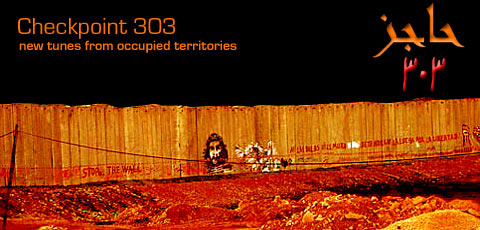
Check Point 303


checkpoint 303 is inspired by the sounds that pace
the daily lives of millions of people in the middle
east. screeching sounds of bullets. echoing injustice.
uproar. revolt. dispair and sadness. and still amidst
all this the soothing sounds. of hope. of normality.
trivial acts. life like everywhere else. this is not
a video game. violence is not a moving image on tv.
it's the daily nightmare of millions...

Project

the electronic experiment kicked off in 2004 when
tunisian sound cutter SC MoCha teamed up with
Bethlehem based palestinian sound catcher SC
Yosh to form Checkpoint 303. the idea was to
cut, track, fragment and reconstruct the audio
soundscape from daily lives in the middle east.
new audio reporting on injustice. Paris-based SC
MoCha reworks the field recordings made by SC
Yosh in the occupied territories into rhythmical
transcriptions that range from raw acoustic
aggression to synthetic soothing tunes with
everything in between.

Several artists and friends from around the globe
contribute to Checkpoint 303's recordings. recent
collaborations include Cheikh Julian, Noise
Generator SoM, VL MonaLisa, Ms K. SuShi, Mehdi
Douss, Melski & Damski.

http://checkpoint303.free.fr/audio_303.html
Click the above link to check out checkpoint 303
hear the tunes and read all about them.
Share:

The latest from The Palestine Blogs

Palestine Blogs

Click on the Headline for Full Story!


Desecrating Hala Maksoud’s Memory

I really began to embrace my Arab identity during
the formative years of my life, while a student at the
University of Michigan. This was a turbulent time for
Arab-Americans after the terrorist...

FACEBOOK DOES AN ABOUT FACE
~~ TURNS IT’S BACK ON PALESTINE

(Ben Heine © Cartoons) Facebook face-off: Settlers
win right to list country as Israel, not Palestine By Reuters
Complaints by Israeli settlers angry at Facebook for listing
them as residents of...

CTL: Interview with Ali Abunimah

Presidential hopefulls are traveling across the US
addressing issues like the economy, abortion, taxes
and the war on Iraq. While John McCain is running on
a platform similar to the policies of the...

This posting includes an audio/video/photo media file: Download Now

CTL: Interview with Ali Abunimah

Presidential hopefulls are traveling across the US addressing
issues like the economy, abortion, taxes and the war on Iraq.
While John McCain is running on a platform similar to the policies of the...

This posting includes an audio/video/photo media file: Download Now

Demonstration at Beit Furik
checkpoint calling for its removal

At 10am on Saturday 15th March 2008 approximately 50
Palestinians and internationals gathered at the Beit Furik
checkpoint near Nablus to protest against the checkpoint.
Internationals and...

Demonstration at Beit Furik
checkpoint calling for its removal

At 10am on Saturday 15th March 2008 approximately
50 Palestinians and internationals gathered at the Beit
Furik checkpoint near Nablus to protest against the checkpoint.
Internationals and...

Checkpoint 303: Gaza Calling

A selection of tunes from Checkpoint 303. Gaza Calling
Download MP3 | Watch Video Needle Stuck on
Lebanon Download MP3

Checkpoint 303: Gaza Calling

A selection of tunes from Checkpoint 303. Gaza Calling
Download MP3 | Watch Video Needle Stuck on Lebanon Download MP3

PALESTINIAN NEWS ROUNDUP .. March 17th

(Ben Heine © Cartoons) Israel: Israel is testing a system
to intercept rockets fired from Gaza (AFP, Reuters). Israeli
and Palestinian Authority negotiators are to meet this week (AFP,...

PALESTINIAN NEWS ROUNDUP .. March 17th

(Ben Heine © Cartoons) Israel: Israel is testing a system to
intercept rockets fired from Gaza (AFP, Reuters). Israeli and
Palestinian Authority negotiators are to meet this week (AFP,...

Settler Violence Report for February 2008

Settlers in Hebron are known as some of the most
notoriously aggressive. Hebron and south of West Bank
On January 1st, settlers from Efrat, Navi Daniel, Ele’azer
and other settlements...

Israeli army invade Nablus and occupy house

At approximately 8:30am on Sunday morning Israeli
army forces again invaded the northern West Bank city
of Nablus. Israeli soldiers surrounded an apartment building
in Al Ein refugee camp, before...

“In the Spider´s Web” …

~ ... or "WELCOME TO REALITY"! Added: February
04, 2008 In the Spider's Web is a 47-minute long
documentary produced in 2004 by Al-Haq and directed
by Hannah Musleh. The film is part of Al-Haq's...

“In the Spider´s Web” …

~ ... or "WELCOME TO REALITY"! Added: February
04, 2008 In the Spider's Web is a 47-minute long
documentary produced in 2004 by Al-Haq and directed
by Hannah Musleh. The film is part of Al-Haq's...

Bringing down the new Berlin Walls

John Pilger At the time of writing, Israel has killed
more than 120 Palestinians in Gaza in just more than a
week, including 63 on one day. One-third of the dead were
children and babies. On...

Bringing down the new Berlin Walls

John Pilger At the time of writing, Israel has killed more
than 120 Palestinians in Gaza in just more than a week,
including 63 on one day. One-third of the dead were children
and babies. On...


‘JEWS SHOULD REFRAIN FROM EMPLOYING
ANY NON-JEWS’

(Ben Heine © Cartoons) So declared a ‘top Torah Sage’ in
Israel this week. New laws are being written as I write this,
laws which not only permit the slaughter of Palestinians, but also...

‘JEWS SHOULD REFRAIN FROM
EMPLOYING ANY NON-JEWS’

(Ben Heine © Cartoons) So declared a ‘top Torah Sage’ in
Israel this week. New laws are being written as I write this,
laws which not only permit the slaughter of Palestinians, but also...
Share: