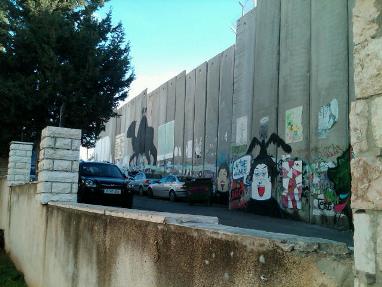
Palestinian Activist barred from entering Palestine from Jordon Thanks to Israel
Ratib al-Jbour told Ma'an: "I was heading to Jordan, and then to France to participate in solidarity campaigns with our people and show the true image of how we suffer as a result of the occupation and settlers."
Israeli forces cited "security reasons" for preventing him from crossing to Jordan, al-Jbour said.
But he said the limitations on his freedom of travel were due to the impact Palestinian solidarity campaigns were making around the world.
Al-Jbour coordinates popular committees against settlements and the Israeli separation wall in areas south of Hebron and east of Yatta.
Palestinians and pro-Palestinian activists are often held up or denied entry at borders controlled by Israel.
Max Blumenthal in Ramallah Market: The Fruits of Occupation
He describes the ways that the Palestinian agricultural sector has been almost completely destroyed, by occupation and by the Oslo process, which kept Palestinians from developing an independent economic base.
And he says that one of the best ways to resist occupation is by generating your own economy and boycotting. Palestinians have been unable to do this. Gaza and the West Bank are treated as captive markets.
He Never Had A Chance.. Most Palestinian Children Never Do Under Occupation!
Only in Palestine. According to the recent statistics, almost 12% of the imprisoned children are under the age of 16. Israeli occupation entity has been targeting arresting children to ask parents for thousands of shekels as a price for their children's freedom, which is just another ugly face of ransom. Palestinian kids face this act of racism on a daily basis, on their way to school, home, and while they are trespassing the Israeli racist checkpoints near each city.
Stephen Hawking's message to Israeli elites: The occupation has a price
By choosing to avoid the Presidential Conference – an annual meeting of Israeli generals, politicians and business elites with their international fans, Prof. Hawking reminds that the occupation cannot be forgotten or avoided. A response to Haaretz’s Carlo Strenger.
The British Guardian on Wednesday reported that Prof. Stephen Hawking has cancelled his appearance at the fifth Presidential Conference due to take place this June, in protest of Israel’s treatment of the Palestinians. The report was later confirmed by Cambridge University. A spokeperson for the Jerusalem-based conference called Hawking’s decision “outrageous and improper.”
One of Haaretz’s leading lefty columnists, Carlo Strenger, wrote an open letter to Hawking echoing these feelings. After expressing pride in his own opposition to the occupation, Strenger accuses Hawking of hypocrisy and applying a double standard; he claims that Israel’s human rights violations are “negligible” compared to those of other countries in the world, and notes that the Israeli academia is for the most part liberal and therefore can’t be blamed for the occupation.
I would like to respond to some of the points he makes, since they represent a larger problem with the Israeli left.______________
While Hawking responded to the call for academic boycott, it should be noted that the Presidential Conference is not an academic event: it’s an annual celebration of the Israeli business, political and military elites, whose purpose is unclear at best, and which has little importance in Israeli life (it didn’t exist until five years ago). The pro-occupation Right has a heavy presence at the conference – or at least it felt that way last year, when I attended. I will get back to the notion of “the liberal academia” and the Presidential Conference later.
Personally, I think we should put the “double standards” line of defense to rest, since it’s simply an excuse against any form of action. The genocide in Cambodia was taking place at the same time as the boycott effort against South Africa. According to Prof. Strenger’s logic, anti-Apartheid activists were guilty of double standards; they should have concentrated their efforts on many other, and “much worse” regimes.
Click the link below to continue reading
http://972mag.com/stephen-
Related:
by Patrick Martin
British physicist Stephen Hawking has announced he is withdrawing from a leading Israeli conference in deference to a Palestinian call to boycott this and other Israeli events.
The decision by Prof. Hawking, who was to have been a key speaker at the Israeli Presidential Conference next month in Jerusalem, has infuriated conference organizers and delivered one of the biggest names yet to the ranks of the growing international campaign to boycott Israel.
It also has drawn the enormous attention of Israelis themselves. By the end of the day Wednesday in Israel, items related to Prof. Hawking’s announcement were the number one, three and six of the most widely read pieces on the Haaretz newspaper’s website.
The annual Presidential Conference, now in its fifth year, is hosted by Shimon Peres, a Nobel Peace Prize winner for his efforts to bring peace between Israelis and Palestinians.
According to its website, the conference brings together “world leaders, international scholars, activists, poets and scientists, artists and clergy, entrepreneurs, economists and industrialists, as well as representatives of the next generation of leaders” in order to discuss issues of geopolitics, economics, environment, culture and more. This year’s conference also is a celebration of Mr. Peres’s 90th birthday.
In his letter to conference organizers, Prof. Hawking stated he had reconsidered his earlier agreement to participate in the event. “I have received a number of e-mails from Palestinian academics,” he wrote. “They are unanimous that I should respect the boycott. In view of this, I must withdraw from the conference. Had I attended I would have stated my opinion that the policy of the present Israeli government is likely to lead to disaster.”
The Israeli chairman of the conference, Israel Maimon, denounced Prof. Hawking’s decision to boycott the event as “outrageous and inappropriate, especially for one so fundamentally associated with the spirit of independence as a person and an academic.”
The British physicist, who has visited Israel on at least four occasions in the past, has been a frequent critic of Israeli policy. During the three-week-long conflict between Israel and Hamas in the Gaza Strip in 2008-09, he described Israel’s bombardment of Gaza in retaliation to frequent rocket attacks as “plain out of proportion.”
“If Israel wants peace, it will have to talk to Hamas,” he said at the time. “Hamas are the democratically elected leaders of the Palestinian people and cannot be ignored.”
Click the link below to continue reading
http://www.theglobeandmail.
Visualizing Occupation: Palestinian and Israeli children under Israel's legal regime
Visualizing Occupation: Palestinian and Israeli children under Israel's legal regime (Michal Vexler)
Between security reform and occupation in the West Bank
Analysis:
(IRIN) - “I have never seen such brutality in my life, except from the Israeli forces,” says Aliya,* still shocked a day after her protest march through the West Bank town of Ramallah was violently attacked by Palestinian security officers. “They just kept on beating us.”Aliya was one of a few hundred young people who had marched on Sunday 1 July to protest against police brutality which had broken up an earlier demonstration.
As the protesters started to call for the resignation of Abdul Latif al-Qadumi, the head of the Ramallah police force, the reaction of the police grew more violent. “No to Dayton’s police! Stop the coordination!” was one of the protesters’ cries.
Lt-Gen Keith Dayton, the former US Security Coordinator for Israel and the Palestinian Authority (USSC), ended his term overseeing US assistance in restructuring Palestinian security forces in 2010, but his legacy - newly trained and equipped Palestinian police and intelligence forces - remains. Others have also helped reform the Palestinian police: the European Union’s Police Advisory Mission EUPOL COPPS (EU Police Coordinating Office for Palestinian Police Support) and more than 17 different states.
Created in 2005 as part of the Roadmap to Peace agreement, donors agreed to provide assistance to the Palestinian Authority (PA) to re-establish functioning security forces in the West Bank and Gaza Strip. Since the Hamas takeover of Gaza in 2007, the assistance of the USSC and the EUPOL COPPS mission has been limited to the West Bank. The mandate of these missions is to reform the six different, often competing, Palestinian security services - a legacy of Arafat’s divide and rule days - and train and equip them so that they can keep order.
Most of the Palestinian security forces were only officially established during the years of the Oslo II Agreement of 1995 together with the new PA. As the second Intifada beginning in 2000 grew violent and many of the freshly equipped recruits took part in battles against Israeli forces, the latter made sure that both infrastructure and operational capacities were destroyed. Lawlessness and the rule of armed gangs - many of them connected to armed party militias - were the result.
Security with a twist
Today the situation in most of Area A - the 17.5 percent of land controlled by PA forces in the West Bank - is different. Palestinian security forces patrol the streets while militiamen with guns are only seen on posters celebrating killed “martyrs”.
A 2010 UN Development Programme survey in the area showed that 52 percent of respondents felt the security services ensured a safe environment. But this new security comes with a twist: the police and intelligence services are also protecting the security of Israel.
Coordination with Israeli security services is a pillar of the reforms. Forces are trained and equipped to react to the demand of Israeli agencies in quelling armed groups. During the month of Ramadan, when many Palestinians try to cross the checkpoints into East Jerusalem for religious reasons, it is now the Palestinian police which screens people, checking to see if they fit set Israeli criteria for a crossing permit.
Many Palestinians and external experts say the developments inside the PA and its security services are worrying. “For sure,” one international security expert based in Ramallah and who preferred anonymity told IRIN, “what we have here is nothing compared to the situation in Egypt or Syria, but there are strong authoritarian tendencies within both the PA and the security services.”
This view is reflected in a recent poll among 1,200 Palestinians. Only 29 percent of respondents in the West Bank felt they could criticize their government without fear.
For now, most of the repression has been directed against political opponents and their armed militias: Hamas, the Islamic Jihad and even president Abbas’s Fatah party armed group, the Al-Aqsa Martyr Brigades.
The recent demonstration in Ramallah, however, is an indication that things could be changing. The protesters were young Palestinians, many of them sons and daughters of Ramallah’s elite. The expert interviewed by IRIN said it was no secret that both equipment and training for anti-riot operations comes from EUPOL COPPS and bilateral donors.
Support role for EU police
“EUPOL COPPS supports the Palestinian Special Police Forces (SPF) in matters of specialized equipment and training. The SPF has several duties among the Palestinian Civil Police and crowd control management is one of these… The SPF has covered hundreds of public order events without any problems and that happened in full respect of human rights and police ethics standards,” EUPOL COPPS told IRIN.
According to Aliya, the specialized SPF only arrived late on the scene of the demonstration; it was plain clothes security officers and uniformed members of the Palestinian Civil Police who attacked the protesters.
A spokesperson for EUPOL COPPS provided information to IRIN showing that the mission is investing heavily in programmes designed to secure greater accountability from the police and mainstream human rights in all its work.
Shirin Abu-Fannouna, who works for the Palestinian human rights organization al-Haq, told IRIN there was a trend among security forces to target political dissenters protesting against the PA.
Providing advice to the security sector under such circumstances is difficult. While EUPOL COPPS has been upgraded with a rule of law component in recent years, most donors have a hard time monitoring that their equipment and training are not used to oppress legitimate protest.
Officially the six PA security services employ a total of 29,500 people in the West Bank. But the PA also continues to pay the salaries of 36,500 security personnel who have been inactive since the Hamas takeover of Gaza in 2007. In such a context security sector reform, rather than just being technical assistance, becomes a highly “political exercise” as the International Crisis Group noted in a 2010 report. This is especially the case as legal oversight over the different services is weak. The Palestinian Legislative Council (parliament) has been inactive since 2007 and President Abbas rules by decree.
Jobs provided
The security services provide one of the few job opportunities for Palestinian men without higher education, and political leverage can be obtained by determining who gets such a job in the bleak economic situation in the West Bank. Political affiliations still play a major role, and most of the security services are staffed with members of Abbas’s Fatah movement.
But “identities are shifting”, said the security expert. “It is no longer just a Fatah militia that acts against political opponents. They are willing to act against other Fatah members as well, if needed. We have a strange mixture now, where the security services have become much more professional and technocratic, but where self-interest plays a much larger role.”
The rationale for the Palestinian leadership’s reform of the security services was two-fold: first to regain control over the different feuding militias, and second, to take any security argument away from the Israeli government that could have been used to postpone peace negotiations.
However, as the Palestinian leadership comes to realize that the international community is not able to deliver on the peace negotiations, keeping the current situation stable seems to be the PA’s strategy.
"The big question is, what impact can security sector reform have under such circumstances? How sustainable can it be?” asked the security expert.
*not her real name
kb/cb/oa
Israeli Supreme court legalising the illicit in the Occupied Territories!

Israeli companies can profit from West Bank resources, court rules
The supreme court rejected a petition brought by an Israeli human rights organisation against the quarrying of stone by Israeli companies in the West Bank. Yesh Din claimed that the quarrying was illegal under international law because it exploited the natural resources of the occupied territory for the benefit of the occupying power.
But the court ruled last week that in a prolonged occupation the economic development of the occupied territory could not be frozen indefinitely. It added that the quarrying firms were not destroying the "capital" of the West Bank's natural resources, and were providing employment to Palestinians.
Existing Israeli-owned quarries should be allowed to continue operating, but no new ones should open, the court ruled, reflecting the Israeli government's position.
Yesh Din said the ruling could be applied to other economic aspects of the occupation, such as water resources and the appropriation of archeological artefacts.
Michael Sfard, Yesh Din's legal adviser, said: "Quarrying natural resources in an occupied territory for the benefit of the occupying state is pillage, and the court's reasoning that a long-term occupation should be treated differently cannot legalise an economic activity that harms the occupied residents."
Hanna Barag of Yesh Din said the ruling was "dangerous". The judgment was based on the assumption that the length of the occupation meant that Israel could adapt international law. "It allows Israel to literally steal the land," she said. Israel has occupied the West Bank for more than 44 years.
At a quarry close to the Israeli settlement of Kochav HaShacher, deep in the West Bank, director Ami Soshani dismissed Yesh Din's arguments, saying Palestinians benefited from the company's operations.
The land on which the quarry is sited was taken over by Israel. Owned by the settlement and managed by a separate company, the quarry is overlooked by the Palestinian village of Kfar Malek.
It extracts around half a million tonnes of dolomite each year, and 20 of its 25 employees are Palestinians. Soshani says that most of its output stays in the West Bank, sold either to settlements or Palestinian concrete factories.
"For the Palestinians, this is an important centre. Palestinian construction companies know they are not cheated and get a good product. The Palestinian workers here did not support the court action because they knew it could affect their livelihoods," he said.
The land itself, he said, had been promised to the Jews. "This is our inheritance, we got this land from God." There was no reason why Jews and Palestinians couldn't "stay together and live together" on the land, he added.
Shoshani said his major concern was for the environment. "This kind of quarrying is damaging. It is an ugly wound on the landscape." A geological survey found there was potential for a further 20 years of quarrying at the site.
In response to the ruling, Yesh Din said "manipulation of the rule prohibiting the harming of property in occupied territory creates a legal basis for irreparable economic exploitation of occupied territory … On its face, the new rule allows the occupier (in a long-term occupation) to make endless use of the variety of objects found in the occupied territory: to pump its water sources, to transfer its archeological artefacts to elsewhere outside the territory, to use areas within it for garbage disposal, to sell public real estate, and more."
Response to HCJ ruling legalizing quarry activity in the West Bank by Israeli Companies
The court dismissed the petition basing its judgment on the notion that laws of occupation must be interpreted to accommodate long-term occupation, in such a way which accords the occupying forces greater powers. The court also noted that Israel's quarry activity in the West Bank benefits the Palestinian residents, since they can enjoy the employment opportunities they offer. The court based its judgment on the Israeli-Palestinian interim agreement which leaves the quarries in Area C under Israeli control, as a proof that the PA has consented to the quarries' operation.
The court did recommend, however, that Israel not open new quarries in the West Bank: "The State announced that the political echelon received recommendations according to which no new quarries, whose main purpose is to produce quarry materials for sale in Israel, should be built in the West Bank. These recommendations reflect an appropriate position, which to a certain extent addresses the issue in dispute…".
Yesh Din expressed surprise over the assertion by Chief Justice Beinisch, that the Palestinian Authority (PA) supposedly consented to the operation of the quarries, both because the wording of the relevant clause in the interim agreements does not indicate consent – just as the clauses which mention the settlements do not indicate consent to their legality – and because the PA does not have the right to consent to the violation of the Palestinians' human rights. Yesh Din noted that protecting the human rights of the occupied people is an Israeli interest, as is preventing violations of international law.
Yesh Din's legal advisor, Attorney Michael Sfard, said: "Quarrying natural resources in an occupied territory for the economic benefit of the occupying state is pillage, and the court's reasoning that a long-term occupation should be treated differently cannot legalize an economic activity that harms the occupied residents."
Response to HCJ ruling legalizing quarry activity in the West Bank by Israeli Companies
It is Yesh Din's position that the court has handed down an erroneous and dangerous judgment that is likely to implicate Israel in the commission of grave violations of the provisions of international humanitarian law applicable to the occupied territories.
The Full Yesh Din Response to the HCJ Ruling
The views expressed in this article are the sole responsibility of the author and do not necessarily reflect those of this Blog!
Holocaust Survivor: We had a better life under Occupation then Palestinians do
Dutch-German Holocaust survivor promoting boycott of Israel
German firm helps Israel cement occupation with light rail
Last month, the German company TÜV NORD Group announced that it will test the technical safety of the first line of the controversial Jerusalem light rail project that critics say is being built in violation of Palestinian rights. The light rail project will connect West Jerusalem with several illegal settlements in the occupied West Bank and is expected to enter into operation next spring.
The TÜV NORD Group is one of the world's largest technical service providers and employs nearly 10,000 workers in more than seventy countries. In a 15 September press release, the company expressed its enthusiasm about its involvement in the light rail project and that it hopes to test the safety of future lines ("TUeV NORD Group gets Jerusalem's trams on track").
TÜV NORD Group's involvement in the project will likely find it in hot water as has its French counterparts, the construction giants Veolia and Alstom. Activists and human rights observers say that the companies involved in the light rail project are directly implicated in maintaining Israel's occupation of and settlement infrastructure in the occupied Palestinian West Bank, including East Jerusalem.
Israel's settlements in the occupied West Bank and its annexation of East Jerusalem are illegal under international law. This status has been affirmed by numerous UN resolutions and a 2004 advisory opinion of the International Court of Justice.
In addition to normalizing the occupation, TÜV NORD Group's involvement in the light rail project is also contrary to its own principles against discrimination and racism, as the route is designed mainly to serve the needs of Israeli settlers. According to the spokesperson of CityPass Consortium, which is contracted with overseeing the light rail project, Palestinians and Jewish Israelis will not be integrated on the train.
"If Palestinians would want to make use of the light rail, both groups will not meet on the train, because of their different life patterns," spokesperson Ammon Elian told Belgian researcher Karolien van Dyck in 2009. He added that the network of buses used by Palestinians made their integration into the tram line "redundant."
CityPass general director Yair Naveh also stated to the Israeli daily Haaretz his support for segregated cars on the rail. Naveh, who took his post in 2008 after retiring as Major General in the Israeli army, said in August: "It is not a problem to declare every third or fourth car a mehadrin [kosher] car" ("Jerusalem light rail may have segregated men-only/women-only cars," Nir Hasson, 23 August 2010).
Moreover, Palestinians in East Jerusalem -- who suffer widespread, systematic discrimination in virtually all sectors -- will not be able to access and use the light rail because ticket prices will be significantly higher than that for local bus routes. Mahmoud al-Mashni, a resident of the East Jerusalem neighborhood of Shufat whose land was confiscated for the project, told The Electronic Intifada, "It is not good for us, it is good for the Jewish settlements. We cannot afford to pay the fees."
The Electronic Intifada has also previously reported on the CityPass consortium's opinion poll which queried Jerusalem residents about whether they would be bothered by both Jews and Palestinians entering the rail freely "without undergoing a security check." Even Israeli officials described the questionairre as "racist."
Qualification requirements for jobs related to the construction of the light rail also discriminate against the Palestinian population. Veolia's job postings for new staff require having completed Israeli military service, as well as knowledge of Hebrew and English. These criteria mean that Palestinian job seekers are virtually excluded, because Palestinian citizens of Israel and residents of East Jerusalem generally do not serve in the Israeli army. And although Arabic is an official language in Israel, it is not listed by Veoila as a requirement ("Veolia pubilshes discriminatory ad for Jerusalem light rail," Diakonia, via The Alternative Information Center).
The discriminatory policies call into question the TÜV NORD Group's commitment to equality, as spelled out on its website: "The respect and appreciation of different culture, races, and experiences. Our employees have a right to be treated equally and to work in an atmosphere that is free of discrimination and/or racism. We achieve this by respecting the rights of others."
When contacted by The Electronic Intifada, TÜV NORD Group attempted to evade responsibility for its involvement in the project, telling this reporter: "In Jerusalem we were involved as consultant for technical safety issues. We have and seek no other role."
However, it is only a matter of time before the company comes under the same scrutiny given to Veolia and Alstom and will feel the impact of the growing boycott, divestment and sanctions movement against Israel's occupation and apartheid policies.
Adri Nieuwhof is a consultant and human rights advocate based in Switzerland.
http://electronicintifada.net/v2/article11572.shtml
'Israel preparing to occupy Lebanon'
Israeli soldiers, file photo |
Israel is conducting drills at its Elyakim training base, near Haifa, to simulate attacks on Hezbollah targets in southern Lebanon, Haaretz reported.
An Israeli colonel told Haaretz that the US military officers had advised Israel to deploy its soldiers in Lebanon during the 33-day war in 2006, hinting that Israel will do so in any offensive on Lebanon in the future.
The Elyakim base is covered with many simulated minefields and camouflaged bunkers. Israeli troops are exercising to pass those spots and find "rocket sites," the report added.
According to the plan, Israeli troops will then be transported to Golan Heights by helicopters to be trained conducting other operations.
Israel: Occupation or Apartheid?
Jamal Dajani
The dreaded "A-Word" has once again made its way into Israeli media, not by a leftist "self-hating Jew", but by a prominent Israeli politician, the Minister of Defense, who is a decorated soldier and a former prime minister as well. "A" is for Apartheid.
An awful word that evokes awful memories, presumably left behind in the annals of history in places such as Soweto and Cape Town. A word that has invited rage, insults, and attacks against a former US president who received a Nobel Peace Prize.
This past Tuesday, however, Defense Minister Ehud Barak warned that if Israel does not achieve a peace deal with the Palestinians, it will have to become a binational state or be an undemocratic apartheid one if it remains as it is."The simple truth is, if there is one state" including Israel, the West Bank and Gaza, "it will have to be either binational or undemocratic. ... if this bloc of millions of Palestinians cannot vote, that will be an apartheid state," Barak said at the Herzliya Conference north of Tel Aviv.
Though rarely used by Israeli leaders in connection to the Palestinians, the term "apartheid" is becoming more common to describe the current reality on the land between the Jordan River and the Mediterranean Sea.
More than two years ago, on the anniversary of the 1947 UN partition plan that would have divided British mandate Palestine into a Jewish and an Arab state, then Prime Minister Ehud Olmert warned of this same scenario. In an interview with the Israeli newspaper Ha'aretz, Ehud Olmert said Israel was "finished" if it forced the Palestinians into a struggle for equal rights.
If the two-state solution collapsed, he said, Israel would "face a South African-style struggle for equal voting rights, and as soon as that happens, the state of Israel is finished".
But veteran Israeli journalist David Michaelis believes that a South African-style apartheid system has already emerged due to Israel's prolonged occupation of Palestinian territories.
"What Ehud Barak intended to do is to send a stark warning that Israel is heading towards a binational situation; however, we are already in a binational situation, and an apartheid system that's working very well for the Israeli military and government."
Five years ago David Michaelis and I jointly interviewed Palestinians and Israelis about the prospect of a binational state. Most Palestinians we spoke to then were thinking of independence and most Israelis were thinking of separation. At the time, the Israeli government was frantically building the Separation Wall, and only a handful of Israelis entertained the idea of binational coexistence. One such person we interviewed who predicted what Ehud Barak is currently cautioning of was Meron Benvenisti, a former Deputy Mayor of Jerusalem.
Benvenisti has recently published an elaborate article in Ha'aretz chronicling how Israel became a de facto binational regime.
"The attempt to mark the settlements, and the settlers, as the major impediment to peace is a convenient alibi, obfuscating the involvement of the entire Israeli body politic in maintaining and expanding the regime of coercion and discrimination in the occupied territories, and benefiting from it," he argued.
According to him, the violent events of the (second) intifada brought the Jewish-Israeli public to a crossroads in relation to their neighbors-enemies. Benvenisti argues that Israeli-Jews turned their backs on the Palestinians, erasing them from their consciousness and imprisoning them behind impenetrable walls, and became willing to congregate in a ghetto and pray that the Mediterranean might dry up or a bridge be built to connect them with Europe.
This mentality is manifested in two, recently constructed, architectural monuments whose symbolism transcends their functional value: The gigantic Separation Wall and the colossal Ben Gurion air terminal. The former is meant to hide the Palestinians and erase them from Israeli consciousness and the latter serves as an escape gateway.
David Michaelis concurs and believes that most Israelis prefer to live in denial and avoid the subject of apartheid.
"The peace process is a misnomer, and the word occupation is misleading because it's really about systematic control."
How long can Israelis live in this denial and pretend that apartheid-like conditions do not exist?
Well you've heard the expression, "If it walks like a duck and quacks like a duck.
Israel 'outsourcing' the occupation
The private firms are being used to help patrol checkpoints and protect illegal settlements in what has become a multi-billion dollar business for Israeli security companies.
But as Al Jazeera's Nicole Johnston reports, some Palestinians are concerned that the private companies are using a different set of rules than the army, and this has raised new legal issues.
Israeli occupation a 'sin against God' says global churches' leader
The general secretary of the World Council of Churches has said that Israel's occupation of Palestinian territories should be declared a "sin against God."Occupation along with the concomitant humiliation of a whole people for over six decades constitutes not just economic and political crimes but, like anti-Semitism, it is a sin against God," said WCC General Secretary Samuel Kobia, in a report on August 26 to a meeting of the church grouping's main governing body, its central committee.
He noted that at its founding assembly in Amsterdam in 1948, the WCC declared that anti-Semitism is a "sin against God," Kobia said, "Are we ready to say that occupation is also a sin against God?"
In his speech, Kobia, a Methodist from Kenya, referred to areas he visited during his tenure and noted the need for urgency in seeking peace for the Middle East region. "In the context of war and violence in the region, people are desperately searching for security for themselves and their families," Kobia said.
He was giving his final report to the main governing body of the WCC as its general secretary before he steps down at the end of 2009. The August 26 to September 2 meeting of the WCC central committee will on August 27 elect a new general secretary.
Kobia was elected to a five-year term that began in 2004 and announced in February 2008 that for "personal reasons" he would not seek a second term.
The WCC groups 349 churches, principally Protestant, Anglican and Orthodox. The Roman Catholic Church does not belong to the WCC but has members on some of its committees.
Speaking to journalists after delivering his report, Kobia referred to the "dehumanization" of both the occupied and the occupiers in the Palestinian territories. "The concern is not only for the victims but also the perpetrators," he stated, referring to Israel.
Kobia recalled that former South African president Nelson Mandela had once said that a condemnation by the WCC of apartheid as "sin" had helped undermine the system of minority white rule.
In his report to the WCC governing body, Kobia said that the "the ongoing construction of Israeli settlements in the occupied Palestinian territories" needed to be seen "within the broader historical context of ethnic upheaval in Palestine (that) paved the way for the creation of the modern state of Israel."
While he said Israelis recalled "The War of Independence" that led to the foundation of the State of Israel, for Palestinians the period would always be known as the "Nakba" or "catastrophe." Many Palestinians would remember this as "a form of 'ethnic cleansing' that saw the largest forced migration in modern history," Kobia said.
"It is estimated that no less than a million people were expelled from their homes at gunpoint, civilians were massacred, hundreds of Palestinian villages deliberately destroyed, mosques and churches profaned, and convents and schools vandalized.
"What in 1948 was described by Palestinians leaders as 'racism and ghettoizing the Palestinians in Haifa" has by the beginning of the 21st century in the West Bank, East Jerusalem and Gaza become a full-blown apartheid system complete with its brand of 'Bantustans'," argued Kobia, referring to the nominally black-ruled territories in South Africa during the apartheid era.
He said that hundreds of church-owned properties were at risk in current evictions of Palestinian families and demolition of their homes in East Jerusalem, and that the Israeli actions hobbled efforts by the new U.S. administration to reach out to the Middle East.
Kobia also referred to visiting Damascus with the heads of the Middle East Council of Churches, and of the Christian Conference of Asia. There they met, "Iraqi Christians who had been forced to leave their country simply because they were Christians and the occupation of their country was seen as a form of modern day Christian crusade."
"This issue requires, at the least, close co-operation with churches in the receiving countries but, even more, a common commitment for peaceful solutions to the conflicts in the region," asserted Kobia. "We must all play a part in finding solutions. The Middle East needs peace and needs it today, for tomorrow is too late.
Full Report: 'Occupation, Colonialism, Apartheid?' - Now Avavailable
Dear All,
I am pleased to announce that the full report of the much anticipated law study is now available
You can download the report here:
Occupation, Colonialism, Apartheid, Executive Summary [950KB]
or Full Study [3.5MB]
From here you will also be able to navigate your way to view some more information about our upcoming conference taking place in Cape Town, South Africa, “Re-Envisioning Israel / Palestine ‘.
Regards
Tania Fraser
Middle East Project
Democracy and Governance, HSRC
Palestine: What it's all about
Now here is an email that I ask you to treat as a chain mail, based on the "why not" logic. You may not consider this clip good, you may have some reservations on the content, but if you agree with the general message, please forward it to at least 8 people you know (preferably who support the Palestinian Cause).
This will not make you rich, it will not bring you good luck, nor will it save the world or secure funding for treating a sick child. The only thing it will get you is the knowledge that you participated in something worthy, that you are part of a worthy cause.
Please view, rate, post and digg the clip:
The Palestinian Cause in 2 Minutes:
http://www.youtube.com/watch?v=Frm8xv5wuvs
Also, again, I appreciate any feedback on this clip
In the midst of the struggle, and the dust of battle, many people still don't realize what this is all about... It is not only about land and rights.
A Palestinian Woman
Terry Boulatta, mother, teacher and community activist, shows how the 27 foot high wall surrounds her neighborhood in East Jerusalem, dividing it from the adjacent community of Abu Dis, severing the historical bonds of the two communities. The wall contributes to the suffocation of life, the latest reality for Palestinians under occupation.
Terry takes us on a half hour drive to get from one side of the wall to the other, a trip that previously took only four minutes. We learn of the terminals and checkpoints through which Palestinians must pass to travel within their own territory.
Terry speaks of the illegal settlements and land confiscations as elements of apartheid, making the settlers "the masters of the land."
Pope Benedict XVI fails to condemn Israeli crimes
The pontiff walked out, a spokesman noted, because Sheikh Tayseer Tamimi’s speech was a “direct negation” of dialogue and damaged the Pope’s efforts at “promoting peace”.
Before he arrived in the region, the Pope declared that he was coming as a “pilgrim of peace”, with his staff accentuating that his role would be spiritual rather than political.
In truth, however, Pope Benedict’s visit was mired in politics the moment he agreed, at the invitation of Shimon Peres, the Israeli president, to step into this conflict-torn region.
The two popes who preceded him to the Holy Land appear to have better appreciated that point.
The first, Paul VI, made a hurried 12-hour stop in 1964, before the Vatican and Israel had established diplomatic relations, to conduct a Mass in Nazareth. During that time he did not utter the word “Israel” or formally meet with an Israeli official.
The second, John Paul II, came to the Holy Land in radically different circumstances: for the millennium, when hopes were still bright for the peace process. The Vatican had recognized Israel a few years earlier and the pontiff worked hard to soothe long-standing Jewish grievances against the Catholic church.
But he is also remembered by Palestinians for his bold move in joining Yasser Arafat, the Palestinian leader, on a visit to the Deheisheh refugee camp near Bethlehem, where he cited UN resolutions against Israel and graphically described the “degrading conditions” under which Palestinians lived.
A decade on, the degrading conditions of occupation have worsened considerably and hopes of peace have vanished. In the circumstances, some Palestinians question what point a papal visit has served.
“The very act of coming here is a political act that works to the benefit of Israel,” observed Mazin Qumsiyeh, a prominent peace activist who teaches at the West Bank’s only Catholic university, in Bethlehem.
“This Pope’s visit, unlike his predecessor’s, offers no novelty – apart from his decision to stand next to [Israeli Prime Minister] Benjamin Netanyahu and legitimize an extreme right-wing government.”
Israeli officials too are unpersuaded by the Pope’s claim that he can avoid being dragged into local politics. Or as one government adviser told the Haaretz newspaper: “We have become pariahs in so many places around the globe. Promoting the Pope’s visit to the state is part of changing that.”
Israel has established the largest press centre in the country’s history for this visit, while police have broken up attempts by Palestinian organizations in Jerusalem to present a rival picture to journalists.
The attempts at careful stage management began from the moment the Pope’s plane touched down in Tel Aviv on Monday. At the reception, Pope Benedict stood between Mr Netanyahu and Mr Peres to listen not only to the Israeli national anthem, but also to Jerusalem of Gold, a song popularized by soldiers during the capture of East Jerusalem in the 1967 war.
The lyrics – offensive to Palestinians – describe an empty and neglected city before the arrival of Jews.
Similarly, Jerusalem’s mayor, Nir Barkat, made a point of welcoming him to the “capital of Israel and the Jewish people”, a description of Jerusalem not recognized in international law.
After the Pope failed to object, the Israeli media happily concluded that the country’s occupation of Jerusalem had papal blessing.
In addition, Palestinians, including the 100,000 with ties to Rome, have been angered by the Pope’s official meeting with the parents of the captured Israeli soldier Gilad Shalit, a humanitarian gesture made political for them by the fact that he has not extended the same courtesy to the parents of any of the thousands of Palestinians in Israeli captivity.
Many Palestinians appreciate that the Pope – with his unfortunate, if apparently involuntary, connections to Nazi Germany – has been especially careful not to offend Israeli sensitivities, even if his speech at Yad Vashem failed to live up to the country’s high expectations.
But some also conclude that he has done too little to let the world know of their own plight.
Under pressure from Israel he has refused to visit Gaza, even at the beseeching of the tiny and besieged community of Catholics there.
Yesterday, to minimize Israel’s embarrassment, Vatican officials tried as best they could to keep him out of view of the oppressive wall that encircles Bethlehem. But he did speak to the press outside a UN school at a refugee camp within metres of the wall.
And today [14 May], as he headed to Nazareth to celebrate mass, he will not meet Mazin Ghanaim, mayor of the Galilee town of Sakhnin, after Israel labelled Mr Ghanaim a “supporter of terror” for criticizing its offensive in Gaza.
In private at least, some Palestinian Christian leaders admit that there are pressures on the Pope other than his own personal history that may make him wary of antagonizing Israel.
Most importantly, the Vatican desperately needs exemption from Israeli taxes levied on the Church’s extensive land holdings. Unpaid property taxes are reported to amount to 70 million US dollars.
The Holy See also wants a reprieve from Israeli policies that deny visas to many church officials and block clerics’ movement in the occupied territories.
As the Latin patriarch of Jerusalem, Fouad Twal, recently complained: “At the roadblocks, even priestly garb doesn’t help.”
And finally, the Vatican has been seeking Israel’s agreement for more than a decade to return to its control major sites of pilgrimage, including Mount Tabor and the Basilica of the Annunciation in Nazareth.
But Israel has not been able to control the message completely. On his one-day trip to Bethlehem and the Aida refugee camp yesterday, the Pope did acknowledge Palestinian suffering and the destruction of Gaza, even if he blamed it vaguely on “the turmoil that has afflicted this land for decades”.
He lamented the difficulties Palestinians face in reaching their holy places in Jerusalem, though he appeared to justify the restrictions on Israel’s “serious security concerns”.
And he criticized the building of a wall around Bethlehem, while attributing its construction to the “stalemate” in relations between Israelis and Palestinians
National Christian Coalition slams Israeli restrictions during Easter
As Greek Orthodox Palestinian Christians were marking the Sabt Al Nour (Holy Saturday, Saturday of light which comes just one day before Easter), Israeli soldiers surrounded the Holy city of Jerusalem and the Church of Holy Sepulcher, which was considered another form of Israeli oppression against the indigenous Palestinian Christians.
FIle - Holy Saturday in Jerusalem
The National Christian Coalition issue a press release slamming the Israeli measures which harm the freedom of religion, and added the while Israel claims to be a democracy, it still occupies the Palestinian people and bar the Palestinian Muslims and Christians from reaching the holy sites in Jerusalem.
Dmitri Diliani, head of the coalition, said that heavily armed Israeli soldiers surrounded the Church of Holy Sepulcher and occupied its yard.
Diliani added that this is another Israeli assault against holy places in Palestine, and another violation against the worshipers who were searched and attacked by the soldiers.
Diliani also said that Palestinian Christians do not recognize “Israel’s authority on Jerusalem”, as the holy city is under Israeli occupation and the Palestinian Christians demand the International Community to ensure freedom of worship in the city, and to ensure Israel ends its occupation to Jerusalem and Palestine.
He added that the Palestinians will keep struggling until achieving their internationally guaranteed rights, including the right of worship.

.jpg)