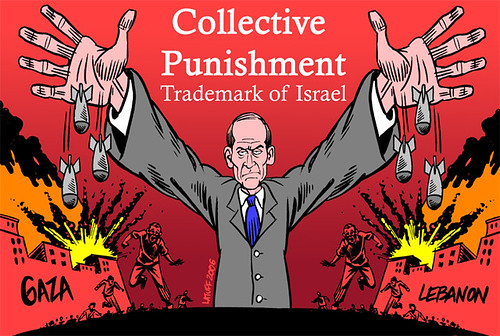
Showing posts with label Collective Punishment. Show all posts

Collective Punishment


This is the same Geneva Convention that Israel signed and endorsed for ratification since 1951. Please (re)read this category of the Convention. It is beholden to respect its own signature. Israel may not use the excuse of Hamas's actions to massacre over one thousand four hundred civilians in Gaza in retaliation of Hamas's actions nor use illegal phosphorus bombs to punish the population at large.

best, Tamzin

No general penalty, pecuniary or otherwise, shall be inflicted upon the population on account of the acts of individuals for which they cannot be regarded as jointly and severally responsible.

Laws and Customs of War on Land (Hague IV); October 18, 1907, Article 50

No protected person may be punished for an offence he or she has not personally committed. Collective penalties and likewise all measures of intimidation or of terrorism are prohibited.

Pillage is prohibited.

Reprisals against protected persons and their property are prohibited.

Convention (IV) relative to the Protection of Civilian Persons in Time of War, Geneva, 12 August 1949, Part III : Status and treatment of protected persons, Section I : Provisions common to the territories of the parties to the conflict and to occupied territories, Article 33

Any destruction by the Occupying Power of real or personal property belonging individually or collectively to private persons, or to the State, or to other public authorities, or to social or cooperative organizations, is prohibited, except where such destruction is rendered absolutely necessary by military operations.

Convention (IV) relative to the Protection of Civilian Persons in Time of War, Geneva, 12 August 1949, Part III : Status and treatment of protected persons, Section III: Occupied Territories, Article 53

International law also prohibits an occupying power from imposing collective punishment on the occupied population.

Amnesty International

For fourteen years, George Qumsieh, a stonecutter, worked to build a three-story stone home in the West Bank town of Beit Sahour. In February 1981, he and his family—his wife, four daughters, and three sons—moved into their new home. Nine months later, Israeli soldiers arrived at the home to arrest their youngest son, Walid, age fifteen. The army accused Walid of having thrown stones at an Israeli military vehicle four days earlier, in which a side window was broken. No soldiers were reported to have been injured in the incident.

The following day, and before the Shin Bet (General Security Service) had completed interrogating Walid, more troops arrived at the Qumsieh home. Ariel Sharon, the newly appointed Likud defense minister had promised an "iron fist" policy against Palestinians. Members of an Israeli engineering brigade placed the explosives and blew up the Qumsieh stone house. Months later, Walid was sentenced to seven years in jail based on the confession of his friends.

Under the 1949 Geneva Conventions, collective punishments are a war crime. Article 33 of the Fourth Convention states: "No protected person may be punished for an offense he or she has not personally committed," and "collective penalties and likewise all measures of intimidation or of terrorism are prohibited." Israel, however, does not accept that the Fourth Geneva Convention or the Additional Protocols apply to the West Bank de jure, but says it abides by the humanitarian provisions without specifying what the humanitarian provisions are.

Daoud Kuttab

Article 33 of the Fourth Geneva Convention forbids collective punishment and states that a person shall not be punished for an offense he or she has not personally committed. This article explicitly relates to administrative punishment imposed on persons or groups because of acts that they did not personally commit. Article 50 of the Hague Regulations states a comparable prohibition.

B'Tselem

On Monday, August 25, early in the morning, Israeli occupation forces demolished the home of the family of Mansour Sharem in Tulkarem. The soldiers forcibly evicted 11 residents of the two-story building. Then they planted explosives in the building and detonating them from a distance. The demolition of the home of the family of Mansour Sharem, who is 'wanted' by Israel, also damaged several neighbouring buildings. Sharem was believed to be the bodyguard of Raed al-Karmi, who was assassinated by Israel in January.

Arjan El Fassed

In their declaration, the Israeli resisters said: "The price of occupation is the loss of the Israeli Defense Forces' semblance of humanity and the corruption of all of Israeli society." They reported firing at Palestinians who hadn't endangered them, stopping ambulances at checkpoints, and stripping areas clean of groves and trees necessary to people's livelihoods. Some fear their treatment of Palestinian civilians constitutes war crimes. Attacks on a civilian population as a form of collective punishment violate Article 50 of the Hague Regulations and Articles 33 and 53 of the Fourth Geneva Convention.

Marjorie Cohn

Demolition or sealing of a house is performed in accordance with a military order signed by the military commander of the region, issued pursuant to regulation 119 of the Defense (Emergency) Regulations, 1945. The regulation empowers the military commander to order the demolition or sealing of a house, and to confiscate the land on which it is built, thus prohibiting the residents of the house from rebuilding or constructing a new house where their home had been sealed. As a result, thousands of Palestinians, among them hundreds of children, are left homeless.

B'Tselem

US Soldiers Bulldoze Farmers' Crops: Americans accused of brutal 'punishment' tactics against villagers (Independent/UK, 12 October 2003)

US soldiers driving bulldozers, with jazz blaring from loudspeakers, have uprooted ancient groves of date palms as well as orange and lemon trees in central Iraq as part of a new policy of collective punishment of farmers who do not give information about guerrillas attacking US troops.

The stumps of palm trees, some 70 years old, protrude from the brown earth scoured by the bulldozers beside the road at Dhuluaya, a small town 50 miles north of Baghdad. Local women were yesterday busily bundling together the branches of the uprooted orange and lemon trees and carrying then back to their homes for firewood.

Nusayef Jassim, one of 32 farmers who saw their fruit trees destroyed, said: "They told us that the resistance fighters hide in our farms, but this is not true. They didn't capture anything. They didn't find any weapons."

Other farmers said that US troops had told them, over a loudspeaker in Arabic, that the fruit groves were being bulldozed to punish the farmers for not informing on the resistance which is very active in this Sunni Muslim district.

"They made a sort of joke against us by playing jazz music while they were cutting down the trees," said one man. Ambushes of US troops have taken place around Dhuluaya. But Sheikh Hussein Ali Saleh al-Jabouri, a member of a delegation that went to the nearby US base to ask for compensation for the loss of the fruit trees, said American officers described what had happened as "a punishment of local people because 'you know who is in the resistance and do not tell us'." What the Israelis had done by way of collective punishment of Palestinians was now happening in Iraq, Sheikh Hussein added.


Share:

Barak: No halt to Gaza holocaust

Israeli war minister Ehud Barak has
vowed to continue raids against the
Gaza Strip despite civilian deaths from
Israeli attacks.


(notice again he said holocaust!)

Barak declared on Monday
that Israeli military forces "is
acting and willcontinue to act
against Hamas, within the Gaza Strip."

Barak claimed that Hamas "is responsible for everything that
happens in the area around Gaza". This response has many in
the world saying that normal citizens should not be suffering in
Gaza because Israel can't work with Hamas who was
democratically elected.

Time to end the collective punishment against Gaza!

Israel has formerly declined to accept the conditions set for a
ceasefire between Hamas and the regime, accusing the resistance
movement of playing for time.

Hamas, however, says any truce agreement should include the
West Bank as well as the Gaza Strip. It also demands that the
blockade on the costal strip be lifted.
Share:

Israeli Occupation exposes Palestinian Women to harassement and abuse

author by Saed Bannoura - IMEMC

The Al Haq Institute, a human rights
center based in Palestine, issued a
statement marking International
Womens' Day yesterday, stating that
Palestinian women are subjected to
continual abuse of their basic human
rights by the 40-year old
Israeli occupation.


The Institute added that Palestinian women are also
denied their basic rights and protection within Palestinian
society. Additionally, it was stated that Israel continuing
occupation of Palestine, including East Jerusalem.
They note that the siege and military assault on the
Gaza Strip is one of the main examples of Israeli policy
of collective punishment of civilians. Collective punishment
is in direct violation of the Geneva Conventions and
International Law.

Ongoing restrictions of movement, the Annexation Wall,
settler-only roads, and more than 500 military roadblocks
are restricting the movement of the residents, according to
the Institute, preventing access to education, employment,
and medical care. The Institute also stated that several
Palestinian women were forced to give birth at Israeli
roadblocks due to the Israel's policy of closures and siege
in the Occupied Territories.

“Palestinian women and girls are, along with the rest of the
Palestinian population, regularly subjected to harassment,
intimidation, and ill-treatment at Israeli checkpoints
scattered throughout the West Bank, including around
East Jerusalem”, the Al Haq Institute stated,
“Such treatment constitutes as an assault on their dignity
and security of person in violation of both international
human rights and humanitarian law. Palestinian women
and girls have also not escaped the violent consequences
of Israel’s repeated military incursions and attacks in the
Occupied Territories”.

The Al Haq Institute added, since last International
Womens' Day, 24 Palestinian women were killed by the
Israeli army, among them were five children. The
Israeli army killed 288 women, including 105 children,
since the beginning of the second Intifada in late
September 2000.

“These killings amount to grave breaches of the Fourth
Geneva Convention, mandating individual criminal
responsibility,” accodring to the Institute. They call for
the protection of Palestinian women under all
circumstances, and for the enforcement equal rights
for all civilians without exceptions.

The Al Haq Institute also expressed grave concern
regarding the issue of “honor killings,” which has
become known as “femocide,” and added that the lack
of law enforcement and pressure within the community
enables all forms of violence against women.

The Institute outlined a list of recommendations as follows:

- for the international community to compel Israel
to immediately cease all acts that violate the
fundamental rights and protections guaranteed to
women and girls under international human rights
and humanitarian law.

- for the international community, in accordance
with Article 146 of the Fourth Geneva Convention,
to prosecute individuals who have committed,
ordered or knowingly failed to prevent, the willful
killing of Palestinian women and girls.

- for the Palestinian National Authority (PNA)
to ensure that all legislation contains provisions for
the protection and promotion of the equality and
fundamental rights of women and girls.

- for the PNA to adopt thorough and effective law
enforcement and judicial procedures, to investigate,
prosecute and punish individuals found to have
committed acts of harassment, violence and/or
femicide against women or girls.

- for the PNA to issue an unconditional formal
declaration that it will adhere to all the provisions
of the International Convention on the Elimination
of All Forms of Discrimination Against Women, and
be held accountable for breaches thereof.

- for Israel, the PNA, the de facto Hamas government,
and the international community to comply with the
provisions of UN Security Council Resolution 1325 on
Women, Peace and Security.
Share:

The Gaza Strip: A humanitarian implosion

Executive summary

The situation for 1.5 million Palestinians in
the Gaza Strip is worse now than it has ever
been since the start of the Israeli military
occupation in 1967. The current situation in
Gaza is man-made, completely avoidable and,
with the necessary political will, can also
be reversed.

Gaza has suffered from a long-term pattern of
economic stagnation and plummeting development
indicators. The severity of the situation has increased
exponentially since Israel imposed extreme
restrictions on the movement of goods and people
in response to the Hamas take over of Gaza and to
indiscriminate rocket attacks against Israel.
This report illustrates the gravity of the current
situation across key sectors.

Humanitarian Access

Movement in and out of Gaza is all but impossible
and supplies of food and water, sewage treatment,
and basic healthcare can no longer be taken for granted.
As a result of the blockade and collapse of the
economy, there is little money to buy food and
limited food to buy. Food prices are rising and
wheat flour, baby milk, and rice, among other
essential goods, are increasingly scarce. During
the period of May-June 2007 alone, these
commodity prices rose 34%, 30% and
20.5% respectively (1).

As the humanitarian crisis intensified,
the number of trucks carrying commercial
and humanitarian supplies into Gaza plummeted.
In the months prior to the tightening of the blockade
around 250 trucks a day entered Gaza with supplies
(2), now the Sufa crossing is only able to deal with a
maximum of 45 trucks a day (3). In most cases,
this number is barely reached.

Poverty and Dependency on Food Aid

The number of people living in absolute poverty in
Gaza has increased sharply. Today, 80% of families
in Gaza currently rely on humanitarian aid compared
to 63% in 2006 (4). This decline exposes unprecedented
levels of poverty and the inability of a large majority of
the population to afford basic food. In 2007, this meant
that on average, households were spending approximately
62% of their total income on food compared
with 37% in 2004(5).

As a result, food aid increased dramatically to meet
the needs of this increasingly impoverished
population. In 2008, there are over 1.1 million people
– some three-quarters of Gaza's population – who are
dependent on food aid. In less than ten years, the number
of families depending on UNRWA food aid increased ten-fold(6).

Unemployment

Unemployment in Gaza is close to 40% and is set
to rise to 50% (7). The private sector – that generates
53% of all jobs in Gaza – has been devastated, businesses
have been bankrupted and 75,000 workers out of 110,000
are now without a job(8). At present, 95% of Gaza's
industrial operations are suspended because they cannot
access inputs for production nor can they export what
they produce (9). In June 2005, there were 3,900
factories in Gaza employing 35,000 people (10). Six
months later there were just 195 left employing only
1,750 people. The construction industry is paralysed
with tens of thousands of labourers out of work (11).
The agriculture sector has also been badly hit and
nearly 40,000 workers who depend on cash crops now
have no income (12). The lack of employment in Gaza
has been compounded by Israel ending its reliance on
cheap labour from Gaza. In September 2000, some
24,000 Palestinians crossed out of Gaza every day to
work in Israel (13). Today that figure is zero.

Basic Services

The blockade is destroying public service
infrastructure in Gaza. The Israeli government
prevents the repair and maintenance of the
electricity and water service infrastructure in Gaza
by prohibiting the import of spare parts. The impact
of this is amplified by Israel's parallel punitive
restrictions on fuel and electricity to Gaza. Hospitals
cannot generate electricity to keep lifesaving equipment
working or to generate oxygen, while 40-50 million
tons of sewage continues to pour into the sea daily (14).

In September 2007, an UNRWA survey in the Gaza
Strip revealed that there was a nearly 80% failure
rate in schools grades four to nine, with up to 90%
failure rates in Mathematics (15). In January 2008,
UNICEF reported that schools in Gaza had been
cancelling classes that are high on energy consumption,
such as IT, science labs and extra curricular activities (16).

Basic Medical Supplies
and Access to Treatment

As a result of fuel and electricity restrictions, hospitals
are currently experiencing power cuts lasting for
8-12 hours a day. There is currently a 60- 70 percent
shortage reported in the diesel required for hospital
power generators.

According to the World Health Organisation, the
proportion of patients given permits to exit Gaza
for medical care decreased from 89.3% in January
2007 to 64.3% in December 2007, an unprecedented
low. It is important to note that even those patients
who are granted permits to exit Gaza are often denied
access at the crossing itself. Twenty-seven such cases
were reported in the month of October alone. WHO
has been monitoring the access of patients to specialized
health services not available within the Gaza Strip.
One main indicator monitored since

October 2007 is the death of patients due to lack
of access to referral services. During the period
October-December 2007, WHO has confirmed the
deaths of 20 patients, including 5 children.

A New Policy for Gaza

The blockade has effectively dismantled the economy
and impoverished the population of Gaza. Israel's
policy affects the civilian population of Gaza
indiscriminately and constitutes a collective
punishment against ordinary men, women and
children. The measures taken are illegal under
international humanitarian law.

Israel has the right and duty to defend itself against
indiscriminate rocket attacks against its civilian
population, but the current policy fails to provide
Israel with increased security and has led to increasing
polarisation. As the head of UNRWA has pointed out,
'Hungry, unhealthy, angry communities do not make
good partners for peace.'

International efforts should be directed towards
securing a swift end to the blockade of Gaza. Israel's
current policy of isolation and refusal to engage with all
elements of the Palestinian leadership only closes doors
to negotiations while reinforcing the political and
humanitarian crisis.

There is an urgent need for Palestinian dialogue and
reconciliation in order to create and sustain a credible
and effective peace process with Israel. The international
community must provide the political support to facilitate
such an undertaking. To date, failure to address the
situation in Gaza has harmed both Palestinians and
Israelis and has been detrimental to the broader
peace process itself.

Share:

10 killed on Sunday, the death toll in Gaza hits 98 since Israel's holocaust began Wednesday.


Palestinian medical sources stated that
10 Palestinians were killed on Sunday
due to ongoing Israeli army attacks of
the Gaza strip, the number of Palestinian
killed by the Israeli army in the Palestinian
costal Region now totals 98.

Two Palestinian resistance fighters,
from the Al Qassam brigades the
armed wing of Hamas, were killed and another injured on
Sunday at midday when Israeli jet fighters targeted
a group of Palestinian fighters east of Jabaliya town in
the northern part of Gaza.

Earlier in the day Ahamad Abu Wardah was killed when
Israeli troops opened fire on his house in Jabalyia town.
Medics said that Israeli troops shot Abu Wardah then
prevented the ambulance from reaching him.
Abu Wardah bled to death.

On Sunday morning medics found the bodies of Raja' Attallah,
31 and her sister Ibtesam, 25. Their house is located in
Jabalyia refugee camp and was bombed by Israeli jet fighters
Saturday night. Their parents and two brothers were also
killed in the Saturday's attack.

Sunday morning, Khlaid Rayian, from the Al Qassam
brigades, was pronounced dead from wounds incurred
during Jabalyia clashes with invading Israeli troops.

Another two were also killed on Sunday morning.
Thabet Dardonah, and Wesam Abed Raboh were shot
by Israeli troops in Jabalyia and left to bleed to death,
Medics said, they added that there was also a girl who
shot and killed in her home in Jabalyia but once again
ambulance crews were prevented from reaching her.

Including the ten killed on Sunday the death toll in Gaza
since Wednesday totals 98 dead. On Saturday at dawn
the Israeli army started a ground offensive targeting
Jabalyia town and the nearby refugee camp. By Saturday
night Israeli attack left 56 Palestinians killed, 36 of
whom were civilians.

Today the Palestinian ministry of Health in Gaza
announced that some hospitals in Gaza can not
provide medical care because they have no
electricity or medical supplies.

The Israeli army has kept Gaza under siege since
June 2007, leaving Gaza suffering from severe shortages
of medicine, food, electricity, and fuel supplies.
Share:

The City Los Angeles joins in Israel’s 60th anniversary of murder and mayhem

Have you ever been to LA?
Total blasphemy to
even suggest comparing this city to angels.
Case in point: Zionist controlled
Media have their Hollywood
corporate like whores
including Paula Abdul, Sylvester
Stallone and Jon Voight, participating Tuesday in a charity
and solidarity concert for Sderot in Beverly Hills.

The concert, is entitled Live for Sderot which includes
performances by Ninet Tayeb (who ever the hell that is)
and will be attended by Los Angeles Mayor Antonio Villaraigosa.

This event they say launches the celebrations in the
City of Hell for :

Israel’s 60th anniversary
of murder
and mayhem.

How lucky they are to have Sderot.
Another trump card like the holocaust card?
Oh poor Sderot while over a million and a half
people in Gaza are blocked off from
the rest of the world with
the rest of the population of Palestine suffering daily
along with the displaced Palestinians in limbo all over the globe.
Forgive me if I don't loose any sleep over Sderrot that has problems
that does not even come near to the problems faced by
the people of Palestine that started over 60 years ago.

The Zionist Media machine has gone all out -
They have 10 teenagers from Sderot
who will be the guest of
honour for the concert. They came from Israel with
q cards in hand ready to shed tears.

They are Exploit material for Israel
purposes of trying to win more support for
Israel's continued murder & ethnic cleansing.

Israeli so called Leadership Club (ILC) Chairman,
Eli Tene, surprised each of the teens with $100 in spending
money and a new iPod. The teens were also treated to a tour
of the famous Hollywood Walk of Fame,
as well as to dinner with Ninet Tayeb and Consul General of
Israel in Los Angeles Jacob Dayan.
(while the children of Palestine

especially in Gaza starve and hope they live another day)

The Highlight of the teens’ visit,
it is said to be the benefit
concert for Sderot to be held Tuesday night.
Paula Abdul is hosting the event
during which a videoclip entitled “Color red”,
which tells some tale of the Qassam-weary town,
will be screeened. They should also have people
watch occupation 101, then people there would
have something to talk about.

So there you have it: the
City of Los Angeles
being called the City of Angels for Sderot
by many in the Zionist Israel Camp.
My question is
Who's singing for Gaza?

Share:

'The world has condemned Gaza to death'

Palestinians were forming a human chain the length
of the Gaza Strip on Monday in protest at a
crushing Israeli blockade.

Under a light rain, thousands of schoolchildren were
joined by adults along Salaheddin Road, the main
highway traversing the centre of the
impoverished coastal strip.

Slogans such as "The Siege of Gaza Will Only Strengthen Us",
"The World Has Condemned Gaza to Death" and "Save Gaza"
were among banners brandished by demonstrators,
who were gathering peacefully.

The Popular Committee Against the Siege, a politically
independent group headed by Jamal al-Khudari, an MP
with close links to the Hamas movement, had called for
the demonstration against the months-long siege.

"This is a peaceful and civilised act to let the people express
their rejection of the siege and of collective punishment,"
Khudari told journalists. "We are raising a cry to the
world for it to act."

Hamas, which seized the Gaza Strip in June from
forces loyal to Palestinian president Mahmud Abbas,
backs the demonstration.

"This is a message addressed to the international
community and to the Israeli occupation, and I hope it
will seize the opportunity to lift the siege,"
Hamas spokesperson Fawzi Barhum said.

Hamas MP Ismail al-Ashqar warned that if this does
not happen "there will be a hurricane that will flood
the whole region."

Israel has sealed the territory to all but vital humanitarian
supplies since Hamas seized power, in a bid to put
pressure on them to end all resistance thus amounting
to collective punishment.

Huzeifa al-Masri, 14, said he and his classmates from
the northern border town of Beit Hanun had come
because "there is hardly any food, and the Israeli incursions
are frequent. We want to live in security like
the rest of the world."

Media reports said the army was prepared for any attempt
to storm the border fence around the Gaza Strip aimed at
breaking the blockade. The army and police said they had
beefed up forces in the border area.

According to Israeli army radio, Hamas may stage a
mass march on the border to protest against Israel's
closure of Gaza, where most of the 1,5 million
population depend on aid.

By late morning, demonstrators led by Hamas officials had
begun to march towards the Erez crossing point -
the major one between Gaza and Israel - but had said
nothing about what their intentions were.

Media reports said organisers were planning to place
one person every metre along the roughly 40km road
running from Rafah to Beit Hanun, for a total of around
40 000 people.

Salaheddin Road runs through the centre of the territory
and is never much closer than around three kilometres
from the border.

Reports said the Israelis' main concern was what might
happen at its northern terminus near the Erez crossing.

On January 23, Palestinian militants blasted several
holes in the border barrier between Gaza and Egypt,
sending a tide of hundreds of thousands of people streaming
into the Sinai on a mission to replenish depleted stocks.

Hamas gunmen and Egyptian troops resealed the border on February 3.
Share:

Israeli airstrike in Gaza kills two Freedom Fighters

The Hamas movement ruling the Gaza Strip Friday welcomed
a call by the European parliament on Israel to lift
its tight blockade of the Strip as meanwhile the
Israeli military continued its operations there,
killing two freedom fighters.

But Israeli officials warned any such direct or indirect
expressions of support for Hamas would encourage radicals and
weaken moderate Palestinians seeking a peace deal with Israel.

Israel continued its military operations in Gaza,
killing two and wounding two others in an airstrike
near Maghazi refugee camp, Palestinian security officials said Friday.

They said the Palestinian men confronted an Israeli force
that entered central Gaza to carry out arrests.

An Israeli military spokesman confirmed the Israel Air Force
launched two parallel strikes in the area before dawn.

European lawmakers in Strasbourg voted by a show of hands
Thursday for the resolution, which said Gaza's civilian population
should be 'exempt from any military action and collective punishment.'

The policy of isolating the Strip had failed at both a political
and humanitarian level, said the parliament, which also called
for an 'immediate end to all violent acts in
Gaza and southern Israel.'

'We in Hamas appreciate the call by the European Union to
end the Israeli siege imposed on the Gaza Strip,' Hamas
spokesman Sami Abu Zuchri told the Palestinian Ma'an news agency.

Hamas is ready to study any initiative that will contribute
to 'stopping Israeli aggression against the Palestinian people,'
he added. Israel has thus far rejected Hamas' calls for a ceasefire,
saying it and other militant factions are 'welcome' to stop their
rocket attacks at any time, at which point Israel too
would stop its military actions.

In the West Bank, meanwhile, some 2,000 Palestinian,
foreign and Israeli activists participated in a demonstration
marking three years of struggle against Israel's controversial
West Bank barrier in the village of Bil'in, north-west
of Jerusalem.

Some eight activists were reported injured, including
an Arab- Israeli lawmaker from tear gas inhalation, and a
US activist was struck in the head by a rubber bullet.

Elsewhere in the West Bank, some 14 members of a group
of freedom fighters from the al-Aqsa Martyrs' Brigades,
the armed wing of Abbas' Fatah movement, returned to a
Palestinian Authority (PA) prison in the northern city of
Nablus, a day after breaking out, Palestinian security officials said.

The al-Aqsa Freedom Fighters are being detained in the
Jneid prison as part of an agreement that was made with Israel,
under which they handed themselves over to the PA
for a three-month trial period.

If they do not resist Israel during the trial,
they will be taken off Israel's wanted list.

But the group, which is usually free to move during the day
but must spend the night at the prison, left the compound Thursday
to protest conditions there. The Israeli military had warned that
if the men did not return to the prison within 24 hours,
it would go after them and kill them.
Share:

Palestinians: Ailing woman dies after IDF denies her ambulance


A Palestinian woman who was refused access to an
ambulance at an Israel Defense Forces checkpoint
died in her village in the occupied West Bank on
Thursday, a Palestinian doctor and relatives said.

Local witnesses said the husband of Fawziya Qabb
pleaded with soldiers at the Jarushiya checkpoint
near the town of Tul Karm to let his wife get to
an ambulance waiting to take her to a
Palestinian hospital but they ignored him.


Source said that troops had sealed off the area in the northern
West Bank as they normally do make like hard for Palestinians.

Local witnesses and Palestinian security sources said the Israeli
heightened state of alert soon after the assassination of
Imad Mugniyah had forced thousands of residents
to wait at checkpoints in the pouring rain.

Qabb's relatives from the village of Deir al-Ghosoon close to
Tul Karm said they called the ambulance but soldiers did
not allow it through the checkpoint to pick up the 67-year-old.

"I asked the officer to let us cross but he refused,"
husband Mahmoud Yousef Qabb said.

Mahmoud said that after failing to persuade the soldiers
for 20 minutes, he took his ailing wife back to the
village doctor who failed in his efforts to save her life.

"She had suffered a stroke and needed urgent hospital attention.
She might have lived if she had reached hospital,"
village doctor Abdel-Fattah al-Darak said.

Qabb said his wife, a heart patient, was in good condition
after being discharged from hospital in
Tul Karm earlier on Thursday.

Human rights groups say they have recorded
several cases of Palestinian patients who have
died because of delays at IDF checkpoints since
the start of the Palestinian uprising in 2000.

Israel says it allows humanitarian cases through the checkpoints
but with so many dying that is hardly the case.

Israel says they are needed to protect its citizens against
Palestinian suicide bombers but more and more it's seen for what it is
the checkpoints are apart of the schedule of the collective punishment
imposed on Palestinians by Zionist Israel.
Share:

Internationally Outlawed "Collective Punishment" Policy in the Gaza Strip!

From: Andrew Silvera

Israel put into effect the internationally outlawed "Collective Punishment" Policy against Palestinians in the Gaza Strip
POICA.org

For a country that keeps claiming that it is the only liberal and democratic place in the Middle East, Israel is defiantly going through self-delusional times more than ever, and at the same time deluding the world of that highly exaggerated and misleading piece of information. However, that is not something new to Israel, the country that portrays above the international law and United Nations Security Council resolutions; as dozens of resolutions are in the standby status for Israel to conform to them.

In the occupied Palestinian territory, Israel has broken and violated almost the entire scroll of international law since 1967. Distinctively, 'Collective Punishment,' the internationally abolished decree is operative by the State of Israel as it has always been throughout the past four decades of occupation, and even though the level of implementation varied over the years, certainly it has tuned-up since the year 2000 with the second Palestinian Intifada, still Israel went on with its policy in apathy of the Palestinians and the international community, knowing that its action will go with impunity.

Israel has used collective punishment policy for a long time against members of the Palestinian resistance specifically and the overall general population, in both cases, the Israeli policy greatly manifested in the Houses' demolition policy, uprooting trees, land confiscation, imprisonment of family members as a mean of pressure. Then again, Israel collective punishment policy has taken an entire new level when it started to persecute an entire province using inhumane methods and practices to justify its security needs. The siege Israel is imposing on the Gaza Strip is of such kind, and today the Israeli government and its military institution have decided to punish the 1.5 million Palestinians living in the Gaza Strip for their democratic vote to the 2006 PLC election and manipulate them to inflict political pressure on certain Palestinian groups in the Gaza Strip. What make things worse is that Israel tried to legitimize its action against the people of Gaza using the Israeli law and courts, even though the Israeli judges and legislators are will aware of the fact that they have no jurisdiction over the Israeli Army in the Occupied Palestinian territory and that the latter operate on a different set of codes (military laws) while in the West Bank and the Gaza Strip.

If not 'Collective Punishment,' what else can you call it?

On September 19, 2007, Israel's security cabinet voted to declare the Gaza Strip an 'enemy entity,' as a first step to legalize its plan to induce collective punishments on the residents of the Gaza Strip, and to cut off all vital resource to it (electricity, fuel, and goods), in addition to restricting the movement of people there. The Israeli step allegedly comes inflict pressure on Hamas rule there. Israel proclaimed procedures did not echo well in the world, in fact it was widely condemned world wide, it even drew criticism from the United Nations Secretary-General Ban Ki-moon, who described Israel's plan to cutoff of vital services 'contrary to Israel's obligations towards the civilian population under international humanitarian and human rights law.'

On their part, Israel said that the cutoffs are not designed to induce humanitarian crises. This translates that Israel will keep the Palestinians' lives hanging by a thin rope, and that it will hold the tube of life and they are in control to squeeze at their well.

Like it or not, the so-called Israeli disengagement in 2005 from the Gaza Strip does not relieve Israel from its responsibility as an occupying power, in fact all what Israel did is relieve the Israeli budget from a money drainage liability, yes that what the Israeli settlements and settlers in the Gaza Strip were to the Israeli State, which is why the word 'redeployment' is best to describe the Israeli step back in 2005; hence Israel remain an occupying power in the Gaza Strip as long as it keeps controlling day-to-day life activities of the Palestinians there and more than that as long as it keeps control of vital aspects of life; Gaza's airspace, territorial sea limits, and land borders.

Israeli state prosecutors have refused allegations by the UN and the EU, among others, that the Israeli steps against the Gaza Strip mount-up to a 'collective punishment' act.

Under international humanitarian law and any civilized law, Collective punishment is prohibited, outlawed, and just illegitimate no matter what were the excuses under which it is carried out. It says that it is unlawful to inflict punishment on a group of people in retaliation for offenses that they did not commit in person.

'The price of occupation is the loss of the Israeli Defense Forces' semblance of humanity and the corruption of all of Israeli society.' They reported firing at Palestinians who hadn't endangered them, stopping ambulances at checkpoints, and stripping areas clean of groves and trees necessary to people's livelihoods. Some fear their treatment of Palestinian civilians constitutes war crimes. Attacks on a civilian population as a form of collective punishment violate Article 50[1] of The Hague Regulations and Articles 33[2] and 53 of the Fourth Geneva Convention.

ISRAELI RESISTERS AND PALESTINIAN RIGHTS
Professor Marjorie Cohn
Thomas Jefferson School of Law
JURIST Contributing Editor
http://jurist.law.pitt.edu/forum/forumnew46.php

Source: http://www.uruknet.info/?p=m39438&hd=&size=1&l=e


Share:

Gaza petrol stations shut for lack of fuel

GAZA CITY (AFP) — Petrol stations closed across the Gaza Strip on Sunday as Israel continued to restrict the limited quantities of fuel being delivered to the Hamas-run Palestinian territory.

"Sorry, no fuel, no benzine, no petrol" read a typical sign posted outside one Gaza City filling station.

"All stations in Gaza have been shut down because there is no fuel of any kind," Mahmud al-Khuzudnar, a deputy chief of a Gaza association for petrol stations, told AFP.

The head of emergency services in Gaza, Muawiya Hassanin, warned that "there will be a big problem with hospital generators and ambulances" if the cuts continue.

Israel provides Gaza with all of its fuel but has delivered only restricted supplies since October 28, a month after declaring Gaza a "hostile entity" following its violent takeover by Hamas, a group pledged to Israel's destruction.

Last week Israel scaled back deliveries even further, officials said.

A Palestinian petrol authority official at the Nahal-Oz crossing, through which all fuel enters Gaza, told AFP that Israel has delivered around 190,000 litres of diesel a day since late October instead of the 350,000 litres needed.

But last Thursday it delivered only 60,000 litres and on Sunday only 90,000 litres, he said.

Shady Yassin, a spokesman for the Israeli military liaison office with Gaza, said "the reduction was because of Palestinian Authority (PA) debts to Dor," the Israeli company that supplies the fuel.

In Ramallah, Palestinian economic minister Mohammed Kamal Hassuneh told AFP that the the PA has honoured all of its debts and that the sudden decrease in fuel was because of a broken pipeline.

"The crisis today is not related to money," he said. "There is a broken pipe near Shujaiya (near Gaza City) and they are trying to fix it."

The limited fuel quantities reaching Gaza would not be released for sale in protest at the cuts, Khuzudnar said earlier, adding that it would go into storage instead.

Hardened by a year of economic hardship, Gazans have for weeks been stocking up on fuel supplies, but worry about when stocks run out.

"I have about two weeks' worth of fuel for my car in my garage, but after that I'll have to stop using it," said Abed Lubad, who works in a hospital east of Gaza City.

Since Hamas seized control of Gaza in mid-June, Israel has sought to isolate the Islamists running the tiny coastal strip in response to continuing rocket fire from the territory.

It has further tightened restrictions on the movement of goods and people in and out of the territory, one of the world's most densely-populated places, and imposed sanctions including fuel and electricity cuts.

The dismissed Hamas government in the Gaza Strip slammed the fuel cutbacks, warning it put hundreds of lives in danger.

The move "will affect all aspects of civilian life and threatens to delay and to paralyse transport, ambulances and factories, thus putting hundreds of people in danger," government spokesman Taher al-Nono said in a statement.

He called on Arab and Muslim states to intervene to stop the punitive measures.

Israeli and Palestinian human rights groups had appealed to Israel's supreme court to halt the fuel cuts, calling them an act of illegal collective punishment that endangered civilians.

But on Friday the court said the state could continue with the restrictions, saying it was possible to do so without affecting the humanitarian situation in the territory where 1.5 million Palestinians live.

The court ordered the state to provide additional information on Gaza's humanitarian situation before it ruled on an appeal against planned cuts in electricity supplies, however.

The final court decision on the planned power cuts is not expected for another three weeks.

Share:

Collective Punishmnet by Israel See's 70% of the Strip’s Fuel Stations Shutdown and the Humanitarian Crisis in Gaza Deepens


Press Releases

Ref: 171/2007

Date: 29 November 2007

Time: 15:30 GMT

IOF Impose additional Collective Punishment Measures and Reduce Gaza’s Fuel Supply

70% of the Strip’s Fuel Stations Shutdown and the Humanitarian Crisis Deepens

PCHR strongly condemns the decision by Israeli Occupation Forces (IOF) on Wednesday (28 November)
for a new reduction in the supply of fuel to the Gaza Strip, which already suffers from serious shortages in fuel.
The Centre calls upon the international community, especially the High Contracting Parties of the Fourth
Geneva Convention, as well as UN organizations and international humanitarian organizations to
intervene immediately to force IOF to stop this decision. This intervention is necessary to avert a humanitarian
crisis threatening all aspects of civilian life including the functioning of healthcare facilities, drinking water wells,
and sewage disposal. The fuel cuts threaten to impact the operation of several sectors including health
services, environmental services, transportation, education, commerce, industrial production, and agriculture.

It is noted that this decision is preempted a pending decision by the Israeli High Court on a petition
submitted by PCHR and several human rights organizations against the IOF decision on 25 October 2007
to reduce the fuel and electricity supplies to the Strip. The Israeli High Court held a session today
to review the petition. However, the decision was delayed.

Sources in the Association of Owners of Petrol and Gas Companies and Fuel Stations” indicated that
the Association rejected receipt of the fuel amounts delivered on Wednesday, 28 November 2007,
due to the new reductions implemented by the Israeli supplier, Dor Alon Co. The Israeli company
informed the Association of reducing the daily fuel supply to Gaza to 90,000 liters of kerosene,
25,000 liters of benzene, and 100 tons of natural gas. The Association’s board held a meeting yesterday,
and replied to the Israeli supplier that it rejects receipt of such amounts, citing that the reduction
will result in a humanitarian crisis on all aspects of civilian life.

As a result, nearly 70% of the Strips fuel stations (approximately 100 out of 145) shutdown on this
afternoon after their stock of fuel ran out. The remaining stations are expected to close tomorrow evening.

Statistics indicate that the Strip’s fuel supply was reduced by more than 50% since the IOF decision
was issued on 25 October 2007. Kerosene supplies dropped from 333,000 liters to 170,000
liters a day (49% decrease); benzene supplies dropped from 76,000 liters to 46,000 liters a day
(40% decrease); whereas natural gas supplies increased by 27% from 228 tons to 290 tons.

It is noted that the daily fuel needs of the Gaza Strip are 350,000 liters of kerosene, 120,000 liters
of benzene, and 350 tons of natural gas.

PCHR is extremely concerned by the deterioration of the economic and social situation resulting from
the complete closure imposed by IOF on the OPT in general and the Gaza Strip in particular.
The Centre is concerned that the food and health conditions of the civilian population will
deteriorate further if the reduction of fuel supplies is enforced.

The Centre reminds the High Contracting Parties of the Fourth Geneva Convention,
including Israeli authorities, of their responsibilities, especially:

- Responsibility under Article 1 to ensure that the Convention is respected under all circumstances;

- Responsibility to ensure that first article of the First Optional Protocol to protect victims
of international armed conflicts;

- Responsibility under Article 54 of the Protocol Additional to the Geneva Conventions (1949) to ensure:

o Starvation of civilians as a method of warfare is prohibited.

o It is prohibited to attack, destroy, remove or render useless objects indispensable to the
survival of the civilian population, such as foodstuffs, agricultural areas for the production
of foodstuffs, crops, livestock, drinking water installations and supplies and irrigation works,
for the specific purpose of denying them for their sustenance value to the civilian population or
to the adverse Party, whatever the motive, whether in order to starve out civilians, to cause
them to move away, or for any other motive.

- Responsibility under Article 33 stating, “No protected person may be punished for an offence
he or she has not personally committed. Collective penalties and likewise all measures of intimidation
or of terrorism are prohibited. Pillage is prohibited. Reprisals against protected persons and their
property are prohibited.”

- Responsibility under Article 55 stating, “To the fullest extent of the means available to it the
Occupying Power has the duty of ensuring the food and medical supplies of the population;
it should, in particular, bring in the necessary foodstuffs, medical stores and other articles if the
resources of the occupied territory are inadequate. The Occupying Power may not requisition
foodstuffs, articles or medical supplies available in the occupied territory, except for use by the
occupation forces and administration personnel, and then only if the requirements of the civilian
population have been taken into account.”

- Reminds the High Contracting Parties of the right of every individual to Everyone has
the right to a standard of living adequate for the health and well-being of himself and of his family,
including food, clothing, housing and medical care and necessary social services, and the right
to security in the event of unemployment, sickness, disability, widowhood, old age or other lack
of livelihood in circumstances beyond his control.

Share: