Showing posts with label International Law. Show all posts

Israel is imprisoning African Children who wound up illegally in Israel through no fault of their own

Unflipping believable, but thoroughly predictable.

African children, whose parents bring them to Israel illegally, will now be held in Givon Prison in Ramle, rather than a special facility for migrant youth, in violation of international law concerning the treatment of children and a 2011 Israeli High Court ruling. 

According to a report in Israeli daily Ha’aretz, the move to place the children in prison came after six boys escaped from the youth facility last week. The children will now be housed in an adult prison according to the Israeli prison service, in order to ensure that no more children escape. 

This decision contravenes a 2011 Israeli High Court ruling that children cannot be held in prisons or with adults. The court cited as justification the Convention on the Rights of the Child (CRC) to which Israel is a signatory. 

The CRC states that at all times, the most important principle regarding the treatment of children is what is in the best interests of the child. The director of the Hotline for Migrant Workers, Reut Michaeli commented, “Givon Prison is a prison in every sense of the word. Once again we're learning that the good of the child is not the main thing on the state's mind." 

Although children are being housed in a separate wing from adults, the facility is still a prison designed for adults. The Israeli prison service claims that the situation is temporary. 

However, Israel routinely detains Palestinian children in Israeli military prisons with adults. Numerous international organizations including Defence For Children International have documented this practice which Israel’s own courts have found to be illegal. 

Given the fact that this inhumane violation of the rights of Palestinian children continues with several hundred Palestinian children currently incarcerated in Israeli military prisons, as well as the increasing xenophobia of the Israeli population, it is unlikely that migrant children will escape this same fate unless the institutional structures within Israel begin to support human rights for all, not only Jewish Israelis. 
Share:

This is Why Palestine Matters

While lying in his bed at night, a Palestinian man is ordered to step outside his house so that it can be demolished (illegally) by the Israeli army to make way for Jewish-only villages on Palestinian land.

His wife and children are also ordered to leave; they’ve been given no warning and are now left homeless with no way of finding shelter. Evicted families aren’t entitled to alternative housing or compensation; many would face homelessness and destitution were it not for relatives, friends and charities.

The conflict in the Middle East between the Palestinians and Israelis transcends politics because it’s a humanitarian conflict. As a condition of the Oslo Accords, the Palestinian Liberation Organization (PLO) recognized Israel as a state and renounced violence.

Israel for its part entered into peace negotiations that were aimed at providing Palestinians an independent homeland on the West Bank, the Gaza Strip and East Jerusalem . This goal was never realized, despite more than seven years of peace talks (1993 to 2000).

During this period, Israel doubled the number of Jewish settlements and continues to build illegal settlements on Palestinian land. These settlements are illegal under international law, and they are seen as a serious obstacle on the road to peace by most Palestinians and a large portion of the international community. Israel cannot continue to rely on the right to self-defense or a state of necessity to build Jewish-only homes on Palestinian land.

According to the UN, in 2009, more than 600 Palestinians — more than half of them children — lost their homes after they were demolished on order from the Israeli  authorities.

These demolitions are done without warning, leaving no time for the Palestinians to seek shelter elsewhere. According to Amnesty International, Israeli authorities have also issued demolition orders against Palestinian schools, clinics, roads, water cisterns, electricity pylons, sheds and animal shelters.

Not to belabor this point, but peace is not just talk — it’s action.

But in Gaza, it’s not the settlements the Palestinians are worried about, it’s the hopelessness that their freedom will never be reached because Israel has declared a blockade of goods and resources from entering the Gaza strip. Israel maintains that the blockade prevents countries such as Iran from handing nuclear weapons to a group such as Hamas.

But the blockade also sets up unnecessary obstacles to essentials such as food and medical supplies from entering the Gaza Strip. And while Israel does allow certain foods and medical supplies, building materials and cleaning supplies are not allowed into Gaza, where missiles from Israeli attacks have put holes into many of the  existing buildings.

And while Israel does indeed have a right to defend itself from attacks, so too do the Palestinians. Israel cannot continue to use religious texts and archaic laws to justify a hostile blockade of their neighbors.

The blockade is not only depriving Palestinians of their right to life, it’s also a contesting point in justifying Hamas’ attacks on Israel. One of the tragedies of this conflict is that Hamas was actually supported and encouraged in its early years by Israel.

It’s about time that Israel recognizes the human rights of the Palestinians. They, too, should be allowed to pursue economic prosperity and psychological stability.
By LUBNA SAFI IDS
 
It’s necessary that both sides concede, but what’s due in fairness transcends political gain. This is a humanitarian dilemma, and as citizens of the United States (and the world), we mustn’t let war between extremes ruin the lives of those caught in the middle.

This collective punishment of the Palestinians needs to be lifted if peace is to be taken seriously. Palestinians, similar to other nations, should have the freedom to build their communities, and the United States, with full support of Israel in the form of $3 billion annually in military aid, has an important role to play in ensuring that justice is done not only to the Israelis, but also to the Palestinians.
Share:

'Israeli commander admits Gaza crimes'

Colonel Ilan Malka, the former commander of Israel's Givati Brigade
 
An Israeli commander has confessed to crimes committed by the Israeli army during the 22-day onslaught on the Gaza Strip, a report says.


Colonel Ilan Malka, who headed the Givati Brigade during the December 2008-January 2009 war against Gaza, has admitted to the killing of civilians during the Israeli incursion into the coastal sliver, the Arabic-language Al-Alam television network reported on Saturday.


Malka had earlier told Israeli investigators that he did not know there were civilians in a building that came under attack on January 5, 2009 after he ordered the strike.


Eyewitnesses, however, say Israeli military razed the building after the attack in order to obliterate traces of their crimes.


The deadly attack, which was denounced by the United Nations as "one of the gravest" of the offensives of the war, claimed the lives of 22 members of the Samuni family, ten of whom were minors.


Twenty-nine members of the family, who lived in Gaza City's Zaitun neighborhood, were killed, and 49 others were injured in the war.


The Samunis suffered more fatalities than any other Gaza family during the conflict, which the Israelis call Operation Cast Lead.


Meanwhile, Salah Abdul Ati, the director of the Independent Human Rights Center told Al-Alam that Tel Aviv had, at the time, rejected the killing of civilians in the attack.


Abdul Ati also stressed the need for the prosecution of Israeli authorities in international tribunals and called for an end to the Israeli occupation.


Israeli officials had previously claimed that the attack was an "operational error," saying the army had intended to attack a nearby weapons stockpile.


According to a UN report issued by veteran war crimes prosecutor Richard Goldstone, Israel used disproportionate force and deliberately targeted civilians in the Gaza war.


The conflict claimed the lives of more than 1,400 Palestinians, including over 900 civilians.


During the 1967 war, Israel occupied the West Bank, including East al-Quds (Jerusalem), a move that has been repeatedly condemned by the international community.
Share:

Iraq’s Secret War Files (WikiLeaks Special on Video)


Iraq's Secret War Files (WikiLeaks Special)In the biggest official files leak in history nearly 400,000 Iraq war logs reveal the massive scale of civilian deaths and new torture allegations following an investigation by Channel 4′s Dispatches.
Channel 4 News has accessed the data in the classified documents via The Bureau of Investigative Journalism and WikiLeaks.
The only TV doc to have advance access to the biggest Wikileaks release ever. This is what really happened during the Iraq war, not what the US PR machine of the time wanted us to believe. The reality behind the civilian death count; al-Qaeda’s fictitious presence; torture, torture and more torture. A wall of truth revealing unprecedented levels of unwarranted aggression.
Dispatches, Channel 4′s flagship current affairs strand, exposes the full and unreported horror of the Iraqi conflict and its aftermath, revealing the true scale of civilian casualties and allegations that even after the scandal of Abu Ghraib, American soldiers continued to abuse prisoners.
And that US forces did not systematically intervene in the torture and murder of detainees by the Iraqi security services. The programme also features previously unreported material of insurgents being killed while trying to surrender.
Watch the full documentary now (playlist)
Warning: You may find some of the details in this video disturbing.

SOURCE FOR THIS POSTING
Share:

The Right to Health A Palestinian Vision


Photo by Shareef Sarhan.


By Dr. Fathi Abumoghli

The World Health Organization defines health as a state of complete physical, mental, and social well-being, and not merely the absence of disease or disability. The enjoyment of the highest attainable standard of health is one of the fundamental rights of every human being, without distinction as to race, religion, belief, or political, economic, or social status.

Article 25 of the Universal Declaration of Human Rights affirms: “Everyone has the right to a standard of living adequate for the health and well-being of himself and his family, including food, clothing, housing and medical care and necessary social services, and the right to security in the event of unemployment, sickness, disability, widowhood, old age or other lack of livelihood in circumstances beyond his control.”

The Arab Charter for Human Rights, signed by ten Arab countries including Palestine, states: The States parties recognize the right of every member of society to the enjoyment of the highest attainable standard of physical and mental health and the right of the citizen to free basic health-care services and to have access to medical facilities without discrimination of any kind. (Article 39)

The Palestinian Public Health Act of 2004 calls for the provision of governmental preventive, diagnostic, therapeutic and rehabilitative health services and the establishment of the relevant health institutions.

In Palestine, the Israeli occupation and its barriers, fences, blockades, and aggressions prevent the exercise of the right to health for our people. The siege on Gaza has seriously infringed on people’s right to health and has resulted in limited access to services - damaged health facilities, scarcity of food, high unemployment rates. Our health indicators, although good, have not improved in the last ten years. The political situation plays a major role as the immediate emergent needs take priority over long-term development.
Our vision for the Palestinian right to health should be on improving the quality of health services and the completion of the service delivery network, while ensuring the sustainability of these high-quality health services. It is important to mention that through the proposed compulsory health insurance law, the sustainability of health services will be guaranteed.

In conclusion, although the occupation remains an obstacle to development in all its forms, including health development, and deprives the Palestinian people of their inalienable rights, including the right to health, we have been successful as a people. We must continue to work to end the occupation and to complete the construction of the health system that will serve our people and ensure their right to health in an independent Palestine. We must work to strengthen and activate laws such as the public health law and the law for the disabled. We must work to complete and pass other laws, such as the compulsory health insurance law and the anti-drug law.

In this issue of This Week in Palestine, readers will find additional information provided by the Ministry of Health regarding the health reform initiatives currently in process, including those in the areas of improved service delivery and health financing through the compulsory health insurance system.

Dr. Fathi Abumoghli has served as the minister of health since 2007. Over the last several years, Dr. Fathi has focused on improving the health system by building the capacity of the health care staff while striving to complete the service-delivery network. In addition, Dr. Fathi, through the proposed mandatory health insurance law, has been advocating for a sustainable health financing mechanism in Palestine. Prior to serving as minister of health, Dr. Fathi worked at the World Bank and the World Health Organization.
Share:

The Illegal Apartheid Wall is mostly built on occupied land

Middle East Monitor

26wall101.jpg
MEMO,
Israel's so-called "Separation Wall" is nearly all built on Palestinian land occupied by the Zionists state since 1967, according to a report produced by the Arab League. The more commonly-called Apartheid Wall is also "an overt violation of the Advisory Opinion of the International Court of Justice", as well as international law which prohibits occupation forces from controlling occupied land by force.

The report demonstrates that the Wall "slices through the [occupied] West Bank, turning it into enclaves and cantons"; the length of this illegal structure will be 810 km (more than twice the length of the armistice Green Line) by the time it is finished. The authors of the report call the Israeli excuses for building the Wall "flimsy arguments". Even the supposed "security" pretext doesn't stand up to close scrutiny, they argue.

"The building of this barrier fits in with Israel's ongoing impediment of Palestinians' movement, using 565 military checkpoints, including 65 which are manned by soldiers permanently and 22 which are not manned on a full-time basis; add to this the 80 gates in the Wall itself and 418 roadblocks, barricades and tunnels, etc., and the situation becomes clear." The Wall, it is claimed, is not about Israeli security, but control of Palestinian lives.

Israel deploys 300+ portable barricades on a monthly basis to control civilians' movement between towns and cities across the occupied West Bank. The route of the Wall means that people are cut off from their schools, workplaces, hospitals and even water supplies.

The report continues: "Israel controls all types of movement for Palestinians in the Jordan Valley's Al-Aghwar district through four roadblocks - Matasir, Al-Hamra, Afrim and Bitaf – which have a permanent and heavy presence of Israeli soldiers. Local residents aside, the people of the West Bank are not allowed to pass through these checkpoints unless they have special permits."

The Arab League claims that the Israeli Occupation Authorities plan to build an apartheid wall on the eastern border of the West Bank, as the first step toward implementing the Allon Plan that was proposed in 1967. The intention is to isolate Al-Aghwar and control the land near the River Jordan and the Dead Sea, cutting off completely the Jordan Valley and Jericho from the rest of Palestine.

The restrictions placed on Palestinians in their own country include the prohibition of travelling to or through areas designated unilaterally by Israel as "military areas", "training areas", shooting ranges" and "nature reserves"; around 26% of the West Bank has been isolated in this way.

Qalqilyah, a town to the north west of Jerusalem close to the old Green Line, has seen at least 3,500 dunums of land damaged by the Israeli closure of gate number 1037 in the Apartheid Wall. The town is completely surrounded by the hated Wall, to a length of 13.6 km, imprisoning its 47,700 residents and cutting it off from four local villages and three Bedouin areas. Most of the 22 gates in the Wall at this point are closed for most of the time. An additional fence construction by Israel will soon annex a large part of Qalqilyah's fertile agricultural land.

Israel continues to confiscate Palestinian land across the West Bank under the guise of "security concerns" in areas adjacent to the Wall including, for example, Beit Gala near Bethlehem and Beit Oula near Hebron. More than 10,000 dunums of land have been thus confiscated in those two districts alone. Meanwhile, Israel fires tear gas and bullets at peaceful demonstrators protesting against the Wall and the shattering effect it has on Palestinian lives, land and the economy.
Share:

Israeli MP cancels visit to Spain fearing arrest

By MOHAMMED MAR'I | ARAB NEWS
RAMALLAH: The Israeli Knesset member Avi Dichter was forced to cancel a trip to Spain for fear of being arrested there, the daily Yediot Ahronot reported on Tuesday.
The report said that Dichter was invited by a Spanish organization called The Madrid Coalition. The organization invited Israeli and Palestinian officials to take part in a summit focusing on the peace process and the Arab initiative.
According to the report, Dichter requested to look into the possibility that he may face legal action in Spain over complaints against him for his involvement in the Salah Shihadeh assassination, which took place when Dichter was head of the Israeli internal spy agency Shin Bet and for his involvement in 2009 offensive on Gaza Strip. Dichter was minister of public security at the time.
After looking into the legal aspects of the situation, Madrid officials told Dichter that Spain did not intend to offer him immunity from arrest or interrogation, after which he cancelled his participation in the event.
Shihadeh, who led Hamas' military wing Izz Ad-Din Al-Qassam Brigades, was targeted in a Gaza Strip operation in the summer of 2002 in which 15 Palestinians, including 11 children, were killed and dozens of other were wounded.
The Gaza war report, conducted by a UN fact-finding mission led by South African judge Richard Goldstone, found that Israel committed war crimes in its offensive which killed 1,400 Palestinians.
A long list of current and former ministers and officers cannot travel to many destinations in the world without first conferring with a special team appointed for assessing threats to senior officials. Among those on this dubious list are former Prime Minister Ehud Olmert, M.K. Shaul Mofaz, Defense Minister Ehud Barak, Minister Binyamin Ben-Eliezer, Ya'alon, and Deputy Defense Minister Matan Vilnai.
Share:

Israel bit the hand that fed it: PLO

Chief Palestinian negotiator Saeb Erekat
The Palestine Liberation Organization (PLO) says Israel has betrayed the United Nations principles, which had enable its occupation-propelled existence.


Saeb Erekat, chief negotiator for the umbrella group, which includes many Palestinian factions said on Monday that, through its numerous violations of UN resolutions, "Israel has undermined the efficacy of and derogated the UN System, the very authority through which it was created," the Palestinian Ma'an news agency reported.

In November 1947, the world body voted in favor of the partition of Palestine, proposing the creation of a "Jewish state."


Israel fabricated its existence a year later during the Six-Day War against the Arab world, forcing 711,000 Palestinians to leave their homeland. Estimates for 2008 put the number of Palestinian refugees at over 4.6 million.


In 1967, Tel Aviv went on to occupy and later annex the Palestinian territories of the West Bank, East al-Quds (Jerusalem), the promised capital of the future Palestinian state in violation of international law.


The operations also led to the occupation of the Gaza Strip. Israel later withdrew from the territory, but has been keeping it under frequent attacks.


The UN Security Council resolutions have demanded that Tel Aviv pull out of the three territories.


"Instead, Israel works diligently to pressure its allies to oppose the creation of a Palestinian state," Erekat added.

Share:

Israel's Visa Rule: If You Visit Palestine, Stay There

When Canadian businessman Sam Ismail brought his wife and five children to visit his brother's family in Ramallah last week, he planned to stay for 10 days and tour both Israel and the Palestinian territories. They had flown into Amman, crossed over to the West Bank. Knowing that Palestinian Authority license plates are banned in Israel, Ismail reserved a car at an Israeli rental company. But, when he got to Israeli border control, he was shocked to discover that his Canadian passport was stamped "Palestinian Authority Only." "Last time they came, they visited Acre, Haifa, Jerusalem — the whole country," Ismail's brother Nedal, who lives in the West Bank, told TIME. "This time they packed up after 96 hours and spent the extra week in Jordan instead."

Ismail had fallen afoul of an Israeli border policy, quietly begun in June, that bars foreigners who say they are visiting the Palestinian Authority from entering Israel. Israel says the visa helps to exclude visitors who threaten security. According to Israeli Interior Ministry spokeswoman Sabine Haddad, the procedure is based on an unpublished 2006 decision by the Israeli interior and defense ministers that "any foreign national who wants to enter the Palestinian Authority must have a permit issued by the army, and entry is permitted only into PA territory." (Read a story about Mike Huckabee's visit to Israeli settlements in the West Bank.)

Palestinians say it violates international law and the promise of unhindered movement for foreign travelers under the 1995 Oslo II Accords. "Israel wishes to strictly regulate travel of visitors who come to the country, especially those curious to see the West Bank," says Toufic Haddad, a Palestinian-American activist. (Read about Ezra Nawi, the Israeli activist jailed for aiding Arabs.)

The policy has affected U.S. citizens. This week, Betty Najjab, an American from Centreville, Virginia and the widow of a Palestinian, was given one of the new visa stamps after visiting in-laws in Jordan. She told TIME she didn’t know if she would be able to fly home: the return leg of her ticket departs from Israel’s Ben-Gurion airport. "We have made it quite known to the Israeli Government... that we expect all American citizens to be treated the same regardless of their national origin," U.S. State Department spokesman Ian Kelly told reporters this week. "These kinds of restrictions we consider unacceptable."

"It is being applied in an arbitrary manner," Salwa Duaibis, Coordinator for the Right to Enter Campaign in Ramallah, told TIME. "It depends on the discretion of the person sitting at the border. If you want to go and visit family in Jerusalem and you get this visa, then your whole plans are thrown out of the window."

The new policy is alienating businessmen like Khaled Sabawi of London, Ontario whose family has for years fostered investment in Palestine and whose father Mohamed was on the board of the Peres Peace Center. Sabawi runs the Ramallah-based MENA Geothermal, one of the first green energy companies in the Middle East. He has spent nearly three years traveling between Canada and Ramallah on three-month Israeli tourist visas. Last January, Sabawi was suddenly turned back at the border crossing from Jordan. Subsequently, he was denied entry twice. Since June, his visa has restricted him to Palestinian territory. Says Sabawi: "I find myself being racially profiled, interrogated by security officials and forced to wait for up to eight hours at the border."

" "I can't meet with Israelis any more and lots of our equipment comes from Israeli manufacturers. I can't buy from them if I can't meet them to negotiate," Sabawi told TIME. "We will withdraw our investments if we can't be here to oversee our businesses. It will simply be too risky for us to invest in Palestine."

Share:

Is Israel Sovereign?

Roy

On Limited Human Sovereignty

"This is another funny term from Political Sciences," I told myself when I began writing this article. After all, no one of the humanly recognized sovereign entities can decide that the sun would rise on the west tomorrow. In theological terms, the only possible sovereign is God. Yet, to make this text clearer, I adopted the definitions used in Political Sciences texts and the media.

Tricky Definition

A short definition of the term says that sovereignty is the right to exercise the highest authority by the law within a specific territory. The key point is the exclusivity of jurisdiction; when a decision is made by a sovereign entity, it cannot generally be overruled by any other authority.

The current notions of state sovereignty were defined in the Treaty of Westphalia of 1648, and include territorial integrity, border inviolability, and supremacy of the state rather than the Church; the sovereign is the supreme lawmaking authority. Another important change occurred by the end of the 18th Century, when the American Constitution of 1787 and the French Revolution of 1789 shifted the possession of sovereignty from the king to the people. However, how can such a power be recognized?

On Internal and External Sovereignty

There are two parameters that allow recognizing the existence of sovereignty: internal and external.

Internal sovereignty refers to the relations between the sovereign and its own subjects; it deals with the question: by what right does the sovereign exercise authority over its subjects? In the past, the most common answer was by divine right, nowadays a social contract (like a Constitution) is the norm.

External sovereignty concerns the relationship between sovereigns. Foreign governments recognize the sovereignty of a state over a territory and its denizens, or not. This parameter is not exact; in the near past the Republic of China and the People's Republic of China claimed sovereignty over the same territory. Different countries adopted different answers on the issue.

External Sovereignty is Secondary

This fluidity in the definition of external sovereignty shows that the internal sovereignty is more important and is – de facto – the defining quality of sovereignty. A state can exist without external sovereignty, but it would fail without internal one.

Sovereignty may be recognized even when the sovereign possesses no territory or its territory is under occupation by another sovereign. It happened to the Holy See during the annexation of the Papal States by Italy in 1870 and the signing of the Lateran Treaties in 1929, when it was recognized as sovereign and was granted the Vatican City. After it lost Malta to Napoleon, the Sovereign Military Order of Malta rules only over two properties in Rome, but is widely recognized and even is an observer at the UN. Occupied European countries during WWII were still recognized as sovereign.

Even under these strained condition, these entities kept their sovereignty because their subjects recognized it and fought for it. If having lose the people's support during the occupation period, they would have been effectively terminated, as it did happen with many political entities during human history; under this test, the sovereignty awarded by the people had been proved as being more stable than the one relying on a king. The last disappears more easily, especially if the king and his heirs are killed in a war against other sovereign.

Thus, the key issue while testing sovereignty is its support by the people comprising it.

Acquisition of Sovereignty

In modern states – those defined by popularly invested sovereignty – the acquisition of sovereignty by the state is defined by a social contract, often based on a single document – called constitution – which is ratified by the people and later expanded into laws by a legislative body. This is the case with countries defined as democracies; the UK doesn't have a constitution but it did replace it with a legal tradition spanning many centuries.

Thus, the people are the source of all political power. Benjamin Franklin expressed the concept when he wrote, "In free governments the rulers are the servants and the people their superiors and sovereigns." Thomas Jefferson – in a similar statement – said in 1799: "The whole body of the nation is the sovereign legislative, judiciary, and executive power for itself" (both quotations from http://etext.virginia.edu/jefferson/quotations/jeff0300.htm).

Did the State of Israel Sign a Social Contract with Its Subjects?

On November 29, 1947, Resolution 181 of the UN General Assembly decided to divide Palestine between Jews and Palestinians and became the base of the external recognition of the State of Israel by other sovereign entities.

On May 15, 1948, Israel's Declaration of Independence was issued by a small group of people – lead by David Ben-Gurion – who did not get popular consent for that. The declaration was never ratified by popular vote, though it was recognized by several other states.

The new state never issued a social contract. Israel has no constitution, and thus never ratified one. That means the State of Israel never got its people's consent to be a sovereign entity – in other words, a state. The recent Base Laws legislated by the Knesset – the Israeli Parliament – are a fig leaf. The state claims they are the base for a future Constitution, but they do not cover key issues like human rights, are subject to arbitrary changes due to special needs of the coalition governments and – most important of all – were never ratified by the people. In a secondary issue, the entity doesn't have a defined territory; there are neither internal nor external resolutions awarding the Stateof Israel a well defined territory. A problem deriving from the last is: Who are the sovereign's subjects? Again, the State of Israel fails to fulfill the basic requisits to become a sovereign entity.

Is Israel Sovereign?

Under these circumstances, the external recognition of Israel is baseless; the recognition of other sovereigns – especially those defining themselves as democracies – of a non-ratified entity which has obviously not been invested by God contradicts their own social contracts and thus would not stand a serious test. The internal recognition of Israel is not an issue since it has never been ratified by its subjects.

State propaganda over the local and international media cannot change the simple fact that the State of Israel is not a sovereign entity.

Share:

'Law must thwart' Israeli barrier

Palestinians wait at checkpoint to cross Israeli barrier in Bethlehem

Oxfam says thousands of Palestinians are stopped from leading normal lives

International aid and advocacy group Oxfam is demanding the "triumph of the rule of law" over Israel's barrier inside the West Bank.

The campaign marks five years since an International Court of Justice advisory opinion found its construction was illegal and it should be dismantled.

Since then, Oxfam says, the view of the "most distinguished international legal body has been met by inaction".

Israel says the barrier for security; Palestinians view it as a land grab.

In the report, entitled Five Years of Illegality, Oxfam details the situations of 13 Palestinian communities affected by the barrier and its associated security system of gates, buffer zones and passes.

It says displacement and exclusion caused by the barrier entails family break-up, the loss of livelihood and removal of social welfare, and "wide-ranging physical and psychological impacts, including trauma and anxiety for children".

'Dangerous'

Jeremy Hobbs, Executive Director of Oxfam International, says the testimonies are just a small insight into the "labyrinth of bans and restrictions" faced by Palestinians because of the Israeli occupation of the West Bank.


READ OXFAM'S REPORT IN FULL


Most computers will open this document automatically, but you may need Adobe Reader

The barrier was started in 2002 and when completed will be up to 790km (490 miles) in length, with only 14% of it will running along the Green Line between Israel and the territory it has occupied since 1967. About 57% has already been completed, with 9% under construction, Oxfam says, but when completed it will divide the West Bank into three sections and completely cut off East Jerusalem, which Palestinians want as a future capital.

"No one feels safe here, especially the families living close to the Wall," says Salah Ajarma, of Aida refugee camp in Bethlehem,

enclosed by a nine-metre-high concrete section of the barrier, complete with watchtowers and sniper positions.

"Our children don't have their playground any more, as it is now on the other side of the Wall. So the children play in the streets of the camp, which creates noise and prevents the older ones from studying.

"And playing in the streets is dangerous because the soldiers can fire at any moment."

Temporary

The ICJ advisory opinion of 9 July 2004 calling the barrier illegal where built on occupied land was considered a landmark by Israel's critics and received the overwhelming support in the UN General Assembly.

Section of Israel's separation barrier in al-Ram on the outskirts of Jerusalem

Israel, however, dismissed the ICJ judgement and General Assembly vote as "non-binding" and looked to its own High Court ruling that the ICJ view was flawed as it did not consider Israel's security needs.

It argues the barrier, which it calls the "security fence" is a just and necessary answer to the threat of militant attacks on its territory, such as suicide bombings.

And it says it has contributed to the virtual eradication of that threat, which took more than 200 Israeli lives in 2002.

"Since the completion of the security fence in the northern and central regions of the country, the number of successful terror attacks inside Israel has dropped almost to zero," an Israeli military spokesman said.

Oxfam, and other critics, have given little credence to Israel's assertion that the barrier is a temporary measure.

They argue that too much has already been invested in it by the government, and the pattern of settlements Israel wants to keep permanently over the Green Line reveals the barrier's purpose, they say.

It incorporates about 90% of the Israeli settler population in the occupied West Bank and East Jerusalem as well as "valuable agricultural and substantial water resources", according to Oxfam.

Share:

Canadian ambassador to Israel honoured at illegal park

By Jonathan Cook in Canada Park

Canada’s chief diplomat in Israel has been honoured at an Israeli public park – built on occupied Palestinian land in violation of international law – as one of the donors who helped establish the park on the ruins of three Palestinian villages, writes Jonathan Cook.

Jon Allen, Canada’s ambassador to Israel, is among several hundred Canadian Jews who have been commemorated at a dedication site. A plaque bearing Mr Allen’s name is attached to a stone wall constructed from the rubble of Palestinian homes razed by the Israeli army.

Mr Allen, who is identified as a donor along with his parents and siblings, has refused to talk about his involvement with the park.

Rodney Moore, a Canadian government spokesman, said the 58-year-old ambassador had not made a personal donation and that his name had been included as a benefactor when his parents gave their contribution. It is unclear whether he or they knew that the park was to be built on Palestinian land.

Canada Park, which is in an area of the West Bank that juts into Israel north of Jerusalem, was founded in the early 1970s following Israel’s occupation of the West Bank in the 1967 war. It is hugely popular for walks and picnics with the Israeli public, most of whom are unaware they are in Palestinian territory that is officially a “closed military zone”.

Uri Avnery, a former Israeli parliamentarian who is today a peace activist, has described the park’s creation as an act of complicity in “ethnic cleansing” and Canada’s involvement as “cover to a war crime”.

About 5,000 Palestinians were expelled from the area during the war, whose 42nd anniversary is being marked this month.

Israel’s subsequent occupation of the West Bank, as well as East Jerusalem and Gaza, is regarded as illegal by the international community, including by Canada. The country has become increasingly identified as a close ally of Israel under the current government of Stephen Harper, who appointed Mr Allen as ambassador.

About 15 million dollars – or 80m dollars in today’s values – was raised in tax-exempt donations by the Canadian branch of a Zionist organisation, the Jewish National Fund (JNF), to establish the 1,700-acre open space following the 1967 war.

The Canadian government spokesman declined to say whether an objection had been lodged with the fund over its naming of Mr Allen as a donor, or whether Mr Allen’s diplomatic role had been compromised by his public association with the park. The spokesman added that the park was a private initiative between Israel and the JNF in Canada.

That view was challenged by Uri Davis, an Israeli scholar and human rights activist who has co-authored a book on the Jewish National Fund.

“Canada Park is a crime against humanity that has been financed by and implicates not only the Canadian government but every taxpayer in Canada,” he said. “The JNF’s charitable status means that each donation receives a tax reduction paid for from the pockets of Canadian taxpayers.”

Dr Davis and a Canadian citizen are scheduled to submit a joint application to the Canadian tax authorities next week to overturn the JNF’s charitable status. He said they would pursue the matter through the courts if necessary.

Dr Davis said attempts to rename Canada Park “Ayalon Park” over the past decade suggested that the Canadian authorities were already concerned about the prospect of the country’s involvement in the park coming under scrutiny.

Joe Rabinowitz, the executive vice-president of the JNF in Canada, said ceramic plaques to Canada Park’s donors – including Mr Allen – had been erected a couple of years ago. Previous metal dedication signs were stolen many years ago, he said.

He refused to comment on the circumstances of the park’s creation, saying details about the park were available on the JNF’s website. A search, however, found only passing references to Canada Park.

The JNF is a major landowner in Israel, with duties that include establishing and managing parks and forests on behalf of the Jewish people worldwide. Most of the parks have been created over the remains of more than 400 Palestinian villages destroyed after the foundation of Israel in 1948.

Canada Park is believed to be the only example, outside East Jerusalem, of the JNF becoming directly involved in managing land in the occupied territories. JNF operations in the West Bank are run by a subsidiary, Himanuta. The formal division between the two companies is designed to protect the charitable status of contributions to the JNF.

Donations are often used to plant forests of pine trees over destroyed villages, including at Canada Park. The organization boasts it has helped plant more than 240 million trees in Israel.

According to Ilan Pappe, an Israeli historian, only a tenth of local indigenous tree species survived the JNF’s reforesting programme with pines.

He said that fast-growing pine was preferred because it was a rapid way to ensure expelled Palestinians could not return to their land and year-round foliage also helped to conceal the rubble of the destroyed villages.

At Canada Park, scattered stones from the three villages are still visible, and one building, a mosque misleadingly labelled a Roman bathhouse, stands near its entrance.

One of the villages, Imwas, is believed to be the Biblical site of Emmaus, where Jesus supposedly appeared to two disciples after his resurrection.

Among non-Canadian donors mentioned on the plaques in Canada Park is “Martin Luther King, USA”. It is believed the donation was made on behalf of the human rights leader after his assassination.

In an interview with Canadian TV in 1991, Yitzhak Rabin, who headed the army during the 1967 war and later became prime minister, said he had personally ordered the destruction of the three villages within what became Canada Park. He justified the decision on the grounds that Egyptian commandos were hiding there.

However, photographs by Amos Keenan, who entered the villages with the army as an official photographer, confirm Palestinian testimony that the Israeli soldiers faced no resistance as they advanced.

Uzi Narkiss, the Israeli general who led the assault on the villages, has said their destruction was “revenge” for the army’s failure to capture this much-prized section of West Bank land – then known as the Latrun Salient – in the earlier, 1948 war.

Today most of the Palestinian families expelled from the three villages are living in the West Bank or Jordan, unable to visit their former lands.
Share:

The Laws Of The Land

In response to my latest article, a comment was posted by "Jack Shattuck" (probably a shill, but whatever) on OpEd News. Naturally, I replied.

Posted below is first his comment, followed by my own response. Enjoy.

*****

Israeli right to settle in Palestine under international lawposted by Jack Shattuck

The San Remo Resolution of April 25, 1920, the Mandate for Palestine conferred on Britain by the Principal Allied Powers and confirmed by the League of Nations unanimously on July 24, 1922, the Franco-British Boundary Convention of December 23, 1920, and the Anglo-American Convention of December 3, 1924 respecting the Mandate for Palestine all authorized the entire area of Palestine as ripe for settlement as the Jewish National Home. The Mandate for Palestine was subsequently incorporated as still binding under Article 80 of the UN Charter.

The San Remo Resolution on Palestine became Article 95 of the Treaty of Sevres which was intended to end the war with Turkey, but though this treaty was never ratified by the Turkish National Government of Kemal Ataturk, the Resolution retained its validity as an independent act of international law when it was inserted into the Preamble of the Mandate for Palestine and confirmed by 52 states.

The phrase “in Palestine”, another expression found in the Balfour Declaration that generated much controversy, referred to the whole country, including both Cisjordan and Transjordan (today's state of Jordan). It was absurd to imagine that this phrase could be used to indicate that only a part of Palestine was reserved for the future Jewish National Home, since both were created simultaneously and used interchangeably, with the term “Palestine” pointing out the geographical location of the future independent Jewish state. Had “Palestine” meant a partitioned country with certain areas of it set aside for Jews and others for Arabs, that intention would have been stated explicitly at the time the Balfour Declaration was drafted and approved and later adopted by the Principal Allied Powers. No such allusion was ever made in the prolonged discussions that took place in fashioning the Declaration and ensuring it international approval.

The decisive moment of change came on May 14, 1948 when the representatives of the Jewish people in Palestine and of the Zionist Organization proclaimed the independence of a Jewish state whose military forces held only a small portion of the territory originally allocated for the Jewish National Home. The rest of the country was in the illegal possession of neighboring Arab states who had no sovereign rights over the areas they illegally occupied, that were historically a part of Palestine and the Land of Israel and were not meant for Arab independence or the creation of another Arab state. It is for this reason that Israel, which inherited the sovereign rights of the Jewish people over Palestine, has the legal right to keep all the lands it liberated in the Six Day War that were either included in the Jewish National Home during the time of the Mandate or formed integral parts of the Land of Israel that were illegally detached from the Jewish National Home when the boundaries of Palestine were fixed in 1920 and 1923. For the same reason, Israel cannot be accused by anyone of “occupying” lands under international law that were clearly part of the Jewish National Home or the Land of Israel. Thus the whole debate today that centers on the question of whether Israel must return “occupied territories” to their alleged Arab owners in order to obtain peace is one of the greatest falsehoods of international law and diplomacy.

In the Anglo-American Convention of 1924, the United States recognized all the rights granted to the Jewish people under the Mandate, in particular the right of Jewish settlement anywhere in Palestine or the Land of Israel. The 1924 Convention was ratified by the US Senate and proclaimed by President Calvin Coolidge on December 5, 1925. This convention has terminated, but not the rights granted under it to the Jewish people.

That above authentic international law has been replaced by an ersatz international law composed of illegal UN Resolutions. The Fourth Geneva Convention of 1949 and the Hague Regulations of 1907 are acts of genuine international law, but they have no direct application or relevance to the legal status of Judea, Samaria and Gaza which are integral territories of the Jewish National Home and the Land of Israel under the sovereignty of the State of Israel. These acts would apply only to the Arab occupation of Jewish territories, as occurred between 1948 and 1967, and not to the case of Israeli rule over the Jewish homeland. The hoax of the Palestinian people and their alleged rights to the Land of Israel as well as the farce that results from citing pseudo-international law to support their fabricated case must be exposed and brought to an end.

*****

...to which I replied:

Your Unfortunate Decision to Get Involved

My dear Mr. Shattuck,

It's lovely to find supporters of colonialism are alive and well and posting comments on OpEd News. Whereas I could go point by point and dissect your bizarre "legal" justifications for the dispossession, displacement, and disenfranchisement of the Palestinian people, I'm not going to waste my time.

What I will say, however, is that your legal justifications are based solely on the premise that European colonialism and mandate control in the Near and Middle East was legal, valid, and altogether a-okay. You reference declarations, conventions, and resolutions made by one group of people (European and American colonists and imperialists) on behalf of another group of people (Zionist Jews of Europe) to deny an indigenous third group of people (Palestinian Arabs) of their rights to self-determination and sovereignty. Your arcane political proclivities are far better suited for a century ago, in the company of such notable disciplines as eugenics and racial hygiene theory. My sincere condolences about time-travel not yet being possible.

You seem to argue that the European sectioning of foreign lands is somehow justified and legal - that native land can be given away with the flick of a quill in the British Parliament. You fail to mention anything about The Great Game, or even the secret Sykes-Picot Agreement of 1916, which effectively sought to slice up Arab land according to colonial whim and power sharing among European powers, namely Britain and France. Even by your inane standards of international law (which seem to be about as complex as holding a piece of paper signed by some white guy and shrugging your shoulders), the Sykes-Picot Agreement would be of vital importance.

Documents from the British National Archives, later declassified, reveal certain intentions which you leave unmentioned. For example, it becomes clear that promises of Arab independence were made to Hussein bin Ali (Sharif of Mecca) with regards to Palestine, in particular, by British officials such as Lord Kitchener among others. For instance, the minutes of a December 5, 1918 Cabinet Eastern Committee meeting clearly discuss the issue of Palestine. In attendance at the meeting were Foreign Secretary Lord Curzon (chair), General Jan Smuts, Lord Robert Cecil, T. E. Lawrence, General Sir Henry Wilson, Chief of the Imperial General Staff, and representatives of the Foreign Office, the India Office, the Admiralty, the Wax Office, the Treasury, and your beloved Lord Balfour.

(Lord Arthur James Balfour was, of course, a notorious anti-semite. Sponsor of the 1905 Aliens Act intended in part to restrict Jewish immigration to Great Britain, Balfour was widely maligned in the British Jewish community. In fact, Balfour's later pro-Zionist efforts were decried by a Jewish member of the Cabinet as "anti-semitic in result.")

Anyway, during the Cabinet meeting in 1918, Lord Curzon stated:
"The Palestine position is this. If we deal with our commitments, there is first the general pledge to Hussein in October 1915, under which Palestine was included in the areas as to which Great Britain pledged itself that they should be Arab and independent in the future...Great Britain and France - Italy subsequently agreeing - committed themselves to an international administration of Palestine in consultation with Russia, who was an ally at that time...A new feature was brought into the case in November 1917, when Mr Balfour, with the authority of the War Cabinet, issued his famous declaration to the Zionists that Palestine 'should be the national home of the Jewish people, but that nothing should be done - and this, of course, was a most important proviso - to prejudice the civil and religious rights of the existing non-Jewish communities in Palestine.' Those, as far as I know, are the only actual engagements into which we entered with regard to Palestine." [emphasis mine]
Furthermore, an appendix of a secret memorandum, prepared by the Political Intelligence Department of the British Foreign Office and used by the British delegation at the 1919 Paris Peace Conference, clearly held:
"The whole of Palestine...lies within the limits which His Majesty's Government have pledged themselves to Sherif Husain [sic] that they will recognize and uphold the independence of the Arabs."

What you fail to mention in your dubious catalogue of decontextualized European and American accords of the early 20th Century is that, at the time of the Balfour Declaration – which is seen as some sort of legal victory and precedent for the legitimacy of Zionism by Israel apologists – the British government had absolutely no jurisdiction over the region in question. There was no Mandate, no international treaty or law granting the administrative auspices of Palestine to a member of the British government. The Balfour Declaration was not a binding agreement of any kind – it was merely a letter drafted by Lord Alfred Milner, sent to Lord Rothschild, expressing Balfour's pro-Zionist intentions at the bidding of future Israeli president Chaim Weizmann. On its own, it has no place in international law.

Not only this, but it directly contradicts (and does not take precedence over) the Anglo-French Declaration of November 1918, which pledged Great Britain's and France's commitment to "the complete and final liberation of the peoples who have for so long been oppressed" under the Ottoman rule and assistance in "the setting up of national governments and administrations deriving their authority from the free exercise of the initiative and choice of the indigenous populations." The Declaration agreed to "to further and assist in the establishment of indigenous Governments and administrations in Syria and Mesopotamia which have already been liberated by the Allies, as well as in those territories which they are engaged in securing and recognising these as soon as they are actually established."

The document continues:
"In pursuit of those intentions, France and Great Britain agree Far from wishing to impose on the populations of those regions any particular institutions they are only concerned to ensure by their support and by adequate assistance the regular working of Governments and administrations freely chosen by the populations themselves; to secure impartial and equal justice for all; to facilitate the economic development of the country by promoting and encouraging local initiative; to foster the spread of education..." [emphasis mine]
Your argument rests on the assumption that Zionism had the legal support required to disenfranchise an entire people, a native population, and transfer sovereignty rights over to newly-arrived European immigrants of Jewish descent. This is patently ridiculous as can easily be surmised by the above documentation. Self-determination for the Arab populations of the Near and Middle East were secured in legal documentation; the "Jewish National Home" was suggested in personal correspondence.

Even Balfour himself understood the problematic incongruity his own Declaration created. As he wrote to Lord Curzon:
"The contradiction between the letters of the Covenant [of the League of Nations] and the policy of the Allies is even more flagrant in the case of the 'independent nation' of Palestine than in that of the 'independent nation' of Syria. For in Palestine we do not propose to even go through the form of consulting the wishes of the present inhabitants of the country though the American Commission is going through the form of asking what they are.

The Four Great Powers [Britain, France, Italy and the United States] are committed to Zionism. And Zionism, be it right or wrong, good or bad, is rooted in age-long traditions, in present needs, and future hopes, of far profounder import than the desires and prejudices of the 700,000 Arabs who now inhabit that ancient land. In my opinion that is right." [emphasis mine]
Clearly, those who favor colonialism, racial supremacy, and ethnic cleansing can stand over there with Balfour, Jabotinsky, and Shattuck. I'll be over here with the supporters of self-determination, equality, human rights such as Albert Einstein, Martin Buber, and Hannah Arendt.

Jack, you cite the precedent of the 1920 San Remo Conference and the resulting resolution, and yet you completely fail to actually look at the stipulations of said resolution, namely the specific references to the indigenous population of Palestine. The document agreed,
"To accept the terms of the Mandates Article...with reference to Palestine, on the understanding that there was inserted in the process-verbal an undertaking by the Mandatory Power that this would not involve the surrender of the rights hitherto enjoyed by the non-Jewish communities in Palestine..." [emphasis mine]
And also that:
"The Mandatory will be responsible for putting into effect the declaration originally made on November 8, 1917, by the British Government, and adopted by the other Allied Powers, in favour of the establishment in Palestine of a national home for the Jewish people, it being clearly understood that nothing shall be done which may prejudice the civil and religious rights of existing non-Jewish communities in Palestine, or the rights and political status enjoyed by Jews in any other country." [emphasis mine]


By no stretch of the imagination or the English language can these documents, arrogantly put forth by imperial and colonial powers in the attempt to divvy up the Near and Middle East between them, be regarded as the legal justification for denying the population of their own human, civil, and religious rights in deference to the Zionist project. Your clear misunderstanding, or deliberately selective reading, of these resolutions reveals your racist agenda and determination to falsify information in order to promote the ethnic cleansing, aggressive land grabs, and cultural supremacy essential to the Zionist cause. (This is clearly evident when you claim the 1920 Franco-British Boundary Agreement and subsequent 1923 caveats to be universally accepted and unchanged delineations of national borders – they are not. The boundaries established were based on colonial Mandate administration and have nothing to do with the recognized borders of future, independent states. Accordingly, you should always remember that the state of Israel was unilaterally declared independent in 1948 by a minority, immigrant population and still has no internationally recognized borders.)

Your prejudice is made even more obvious with your purposeful omission of the 1919 King-Crane Commission from your absurd analysis. The Commission, an officially US government-sponsored investigation into the desire of the indigenous Arab population of the Near East for self-determination and sovereignty following the fall of the Ottoman Empire, was conducted in Palestine, Syria, Lebanon, and what was then Anatolia. The Commission was created directly by President Woodrow Wilson, who was unsatisfied by the backroom dealings of the European powers. The resulting report concluded, beyond a shadow of a doubt, that the Arab majority preferred an American mandate (as opposed to British or French, due to the well-known hegemonic intentions and nefarious colonialism of those European powers) with a democratically elected constituent assembly. Those interviewed believed that, in order to achieve self-sufficiency and independence, the United States was their best bet given the circumstances.

The Commission, in hopes of finding the most equitable and moral solution to the Near Eastern power vacuum, found that securing egalitarian self-determination for the native populations of what it regarded as "Greater Syria" (namely, Syria, Israel, Jordan, the West Bank and Gaza in today's terms) was of utmost importance and based its recommendations with that in mind.

With specific regards to the Zionist enterprise, already well underway, the report candidly emphasized that the only possible way to establish a Jewish state – a colonial entity reliant on enforcing a political ideology of ethnic supremacy and cultural dominance – would be through violent and military means. As a result, the Commission dismissed the moral and peaceful viability of a Jewish state, stating clearly what everyone knows: that the Zionist project demanded and anticipated "a practically complete dispossession of the present non-Jewish inhabitants to Palestine".

To be clear, the Commission found nothing problematic with continued, or even increased, legal Jewish immigration to Palestine (as part of "Greater Syria") as long as the new immigrants would regard themselves as equal citizens living alongside the native population. Still, to avoid all misunderstanding, it warned that "the erection of such a Jewish State" could in never "be accomplished without the gravest trespass upon the civil and religious rights of existing non-Jewish communities in Palestine."

The European colonial powers heeded none of the warnings, recommendations, or desires of the indigenous populations it hoped to rule. Consequently, British Prime Minister David Lloyd George – who later, in 1936, referred to Adolph Hitler as "the greatest living German" - and French Prime Minister Georges Clemenceau, drafted the provisions of the San Remo Resolution and the Treaty of Sèvres, enabling Britain to seize mandated control over Palestine and Iraq, while "giving" Syria to France (it had already ruled Lebanon since 1918).

The findings of the King-Crane Commission were deliberately suppressed and kept from the public after its completion. In 1922, the United States Congress passed a joint resolution supporting the establishment of a "Jewish National Home" in Palestine, echoing the sentiment of the Balfour Declaration. Two months later, the Commission report was released.

At the time, Edward Mandell House, President Wilson's aid, in a letter that predicted the result of the pending implementation of the Balfour Declaration, wrote: "It is all bad and I told Balfour so. They [the British] are making [the Middle East] a breeding place for future war."

Balfour himself knew his Declaration didn't jive with the formal treaties and resolutions that followed. He even wrote to Curzon:
"What I have never been able to understand is how [the Balfour Declaration] can be harmonized with the [Anglo-French] declaration, the Covenant [of the League of Nations], or the instruction to the [King-Crane] Commission of Enquiry."
It should also be noted that, even though you claim the Balfour Declaration gave full settlement rights to Jewish immigrants in all of Cisjordan (Palestine) and Transjordan (modern day Jordan), you are wrong. The area East of the Jordan River had long been included in the area promised to Sharif Hussein as early as 1915. Whereas Palestine and Transjordan remained a single administrative unit under British control until 1946, this was a matter of administrative convenience for the Mandate and in no way indicated any recognition of Zionist claims to the East Bank of the Jordan. In 1922, Transjordan became an autonomous political entity, formalized by an new clause added to the governing charter of the Mandate of Palestine. It subsequently became independent in 1928.

Your willful and intentional distortion of the truth is even more apparent in your refusal to include the vital 1922 White Paper in your analysis. The Paper served to clarify the British view and interpretation of the Balfour Declaration. The results are perfectly clear to anyone who takes the time to read them. Among its findings, the Paper states:
"Unauthorized statements have been made to the effect that the purpose in view is to create a wholly Jewish Palestine. Phrases have been used such as that Palestine is to become "as Jewish as England is English." His Majesty's Government regard any such expectation as impracticable and have no such aim in view. They would draw attention to the fact that the terms of the Declaration referred to do not contemplate that Palestine as a whole should be converted into a Jewish National Home, but that such a Home should be founded 'in Palestine.' In this connection it has been observed with satisfaction that at a meeting of the Zionist Congress, the supreme governing body of the Zionist Organization, held at Carlsbad in September, 1921, a resolution was passed expressing as the official statement of Zionist aims 'the determination of the Jewish people to live with the Arab people on terms of unity and mutual respect, and together with them to make the common home into a flourishing community, the upbuilding of which may assure to each of its peoples an undisturbed national development.'" [emphasis mine]
Therefore, Jack, your assertion that it would be "absurd to imagine that this phrase could be used to indicate that only a part of Palestine was reserved for the future Jewish National Home" is wholly contrary to the British government's own determination.

The White Paper also states that "the status of all citizens of Palestine in the eyes of the law shall be Palestinian, and it has never been intended that they, or any section of them, should possess any other juridical status." [emphasis mine] As such, when you claim that the state of Israel "inherited the sovereign rights of the Jewish people over Palestine," you are, quite simply, lying.

Using these arguments not only undermines your own ethnocentric motivation, but also reveals your supporting materials to be insufficient at best and totally disingenuous at worst.

(Incidentally, you should really try compiling your own research in the future, rather than cutting and pasting the bigoted writing of hacks like the laughably propagandistic Ariel Center for Policy Research's Howard Grief, who endorse racist policies in order to erase the well-established historical and cultural narratives of the Palestinian people in their ugly attempt to make reality disappear altogether so that Zionist apologists can feel less guilty about promoting and justifying ethnic cleansing and the aggressive, illegal, and immoral seizure of Eretz Yisrael. To pass off numerous paragraphs of Grief's unfortunate Policy Paper No. 147 as your own writing isn't just embarrassing, it's straight–up plagiarism. Cool it.)

Amazingly, you also attempt to use the Anglo-American Convention in defense of Zionist expansionism and land theft. Ratified by the US Senate and approved by President Calvin Coolidge, the Convention, you say, reaffirmed American support for the stipulations of the Mandate and encouraged Jewish colonization of Palestinian land. Again, you fail to provide any sort of context for your documentation. The Convention was approved the year following the passing of the Immigration Act of 1924 which placed severe limitations on foreign immigration to America and established quotas based on national and ethnic origin. Widely regarded as legislation put forth due to the growing nativism, xenophobia, and anti-semitism in the US at the time, the Act was vehemently opposed by most American Jews. Do you not find it curious that the same administration that attempted to resist the increasing Jewish immigration to this country was more than happy to support immigration to a land it had absolutely no control over, half-way across the world? Your consistent use of citing racist legislation for your own propagandistic purposes is quite unimpressive.

Israel remains an unjust and expansionist remnant of aggressive colonialism in a largely post-colonial modern world. It is people like you, Mr. Shattuck, that stymie any advancement toward justice and actively seek to thwart the promotion of human rights and equality for all people. You spread lies and falsified historical references in order to proliferate disinformation and deflect reasonable criticism of the Zionist project and its horrific consequences.

Unfortunately for you and people like you, there are facts to back up the most basic truths in this world. And those facts will never be in your favor.

Hmm, I guess I did wind up dissecting your awful justifications. Go figure.

http://www.wideasleepinamerica.com
Share:

"Israel must see that there are consequences to its actions"

Israel prides itself on being part of "the family of nations" (the phrase is used in its Declaration of Independence), so the sense that it's excluded from that "family" (a dubious image, I believe!) would have immense symbolic power. Israel thrives on the sense that its crimes have no consequences for it: BDS attempts to show that, yes, they DO have consequences, even if only on a symbolic level.The following is an interview with Raymond Deane, an Irish composer, author and former chairperson of the Ireland Palestine Solidarity Campaign (IPSC). He has been a remarkably active member of the IPSC for years, he is also a very knowledgable person on the Middle East conflict and is a committed supporter of the Boycott Campaign in Ireland. His opinions in this interview on the campaign are given in a personal capacity.


1. The recent brutal Israeli onslaught on Gaza generated a massive wave of public opinion which renewed the energy of the international solidarity movement... Ireland seems to be a key actor in the growing international solidarity movement against the Palestinian oppression, can you tell us in what concrete ways this solidarity has been expressed?

I'm not sure that Ireland is "a key actor" - it's flattering, but an exaggeration. However, Ireland SHOULD and COULD be a key actor if its government paid attention to public opinion (you and I know that governments only do that when it suits them). For historical reasons, the Palestinian cause is perhaps more widely supported here than elsewhere at a gut level. Were our government to reflect this more forcefully within the European Union and develop the courage to oppose the EU's support for Israel, I believe it would set an example that would be followed by certain other EU countries (Cyprus, Greece, Finland, Denmark, Sweden, perhaps Spain, Portugal...). Thus the solidarity movement here has to TRY to turn Ireland into "a key actor", into a kind of "rotten apple" within the EU basket. To this extent solidarity with the Palestinians and opposition to the stance of our own government -and, in my view, opposition to the Lisbon Treaty and a common EU foreign policy determined ultimately by countries like Germany, France and the UK - go hand in hand.


2. Tell us in a nutshell what the "Boycott, Divestment and Sanctions" strategy is aiming for?

In a nutshell, one would have to say "the isolation of Israel". Personally, I'm sceptical about the potential such a campaign has for causing actual financial damage to the Zionist regime. Nonetheless, Israel prides itself on being part of "the family of nations" (the phrase is used in its Declaration of Independence), so the sense that it's excluded from that "family" (a dubious image, I believe!) would have immense symbolic power. Israel thrives on the sense that its crimes have no consequences for it: BDS attempts to show that, yes, they DO have consequences, even if only on a symbolic level. As for the "S" factor, I'm sceptical that we're going to get capitalist governments to impose sanctions on Israel, and I'm not even sure it's desirable; however, we can and must focus on the trading privileges from which Israel benefits within the framework of the Euro-Mediterranean Association Agreement, and point out again and again that Israel violates the human rights clause of that Agreement. If nothing else, this clarifies that EU support for Israel violates its own regulations.


3. Some people, even in the left, would argue that this BDS approach could only work in the long term, therefore having little or no impact on the immediate reality... what is your own opinion on this issue? How effective can this campaign be?

Even if that were true, it would be no justification for not adopting it. In the case of South Africa, the campaign beavered away for many years before at last being reinforced when the big banks started withdrawing their backing from the regime. This mightn't happen with Israel, for a variety of reasons, but the point is that short-termism is a hopeless perspective.


4. Can you tell us some of the biggest successes of this campaign at an international level?

Perhaps after all Ireland has been a "key factor" here, because so far ICTU is the only national trade union congress to have advocated a BDS campaign. In general, the fact that individual unions worldwide are coming on board (COSATU in South Africa was exemplary here) is vitally important. The fact that civil society in Canada and the USA - two of Israel's most powerful backers - is gradually coming on board is encouraging, and ominous for Israel. Veolia's loss of a huge contract in Sweden recently was exciting: they are the company that run Dublin's Luas system, but also a system linking illegal Israeli settlements. Also in Sweden recently, a tennis match against Israel had to take place without spectators because of fear of demonstrations. Just as Israel must see that there are consequences to its actions, firms that profit from Israel must see that there are consequences, and those consequences must be extended to representatives of culture and sport, all of whom are regarded as "ambassadors" by Israel.


5. What are the main obstacles faced today by the campaign?

The main obstacle is the canard of antisemitism. In Germany - which, by the way, is the greatest stumbling-block alongside the USA to a just resolution of the Palestine issue - if even the possibility of boycott or sanctions is mentioned, there is immediately a chorus of "the last time Jews were boycotted here was when Hitler was in power", as if this was about boycotting Jews rather than a racist state. Even Naomi Klein, a Canadian Jew, got that treatment recently when she called for BDS. After Gaza, this position is becoming more and more difficult to sustain, which is why those who adopt it are getting more and more desperately strident.


6. A lot of the people supporting the campaign would argue that the Israeli system has significant similarities to the Apartheid regime in South Africa, and would try to draw lessons from the solidarity movement for South Africa.... do you think this comparison is relevant?

Yes, I do. Furthermore, a lot of those drawing such lessons are South African Jews who were involved in the original anti-Apartheid campaign.


7. Some people claim that a major difference between the South African Apartheid regime and the Israeli colonialist-settler regime, is that in the former case, the South African regime depended on the super-exploitation of the black masses while in the latter case, the Israelis would rather get rid of the Palestinians altogether... do you think this difference is valid or does it have any impact on the strategy?

The difference you mention is a real one, and shouldn't be fudged, but I see no reason why any of this should impact on strategy. The important thing is to COMPARE rather than IDENTIFY the two regimes, pointing out that Israel backed South African Apartheid to the bitter end, even when the USA and UK had dropped it. Apartheid, in essence, means devising separate legal systems for separate peoples, which is unacceptable within a democracy, even a "liberal democracy" (a term about which I'm sceptical). Israel goes further: there are two legal systems within "sovereign" Israel (contrary to Jimmy Carter's assertions), and a different system again within the Occupied Territories. It's imperative to stress that there is already a de facto single and brutally unequal state under Israeli sovereignty, thus denying Israel the privilege of washing its hands of what it gets up to in the Occupied Palestinian Territories.


8. How do you think this campaign can be complementary to other forms of resistance and solidarity?

First of all, I believe that the overal campaign must be multi-faceted and not just an anti-Apartheid campaign, although this aspect is central. The campaign to make it impossible for Israeli war criminals to travel abroad, using the legal principle of universal jurisdiction, is itself a kind of boycott campaign, not unrelated to the shutting out of sporting and cultural figures who represent the Israeli state (this latter qualification is necessary - it's not a question of boycotting individuals who represent themselves). The campaigns against the Apartheid Wall, against house demolitions, against the siege of Gaza and against pro-Israeli propaganda in our media are all so closely linked - all being responses to the same anachronistic, atavistic settler-colonial project - that they cannot fail to be complementary. The only mistake would be to concentrate on one to the exclusion of others, and I don't think our campaign does that.
Share:

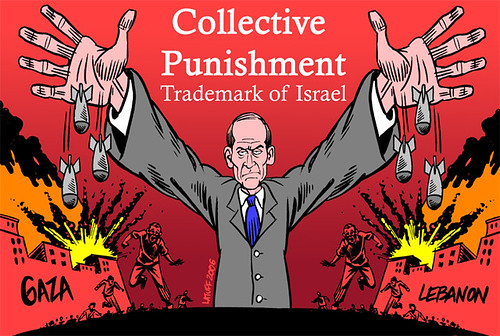
Collective Punishment


This is the same Geneva Convention that Israel signed and endorsed for ratification since 1951. Please (re)read this category of the Convention. It is beholden to respect its own signature. Israel may not use the excuse of Hamas's actions to massacre over one thousand four hundred civilians in Gaza in retaliation of Hamas's actions nor use illegal phosphorus bombs to punish the population at large.

best, Tamzin

No general penalty, pecuniary or otherwise, shall be inflicted upon the population on account of the acts of individuals for which they cannot be regarded as jointly and severally responsible.

Laws and Customs of War on Land (Hague IV); October 18, 1907, Article 50

No protected person may be punished for an offence he or she has not personally committed. Collective penalties and likewise all measures of intimidation or of terrorism are prohibited.

Pillage is prohibited.

Reprisals against protected persons and their property are prohibited.

Convention (IV) relative to the Protection of Civilian Persons in Time of War, Geneva, 12 August 1949, Part III : Status and treatment of protected persons, Section I : Provisions common to the territories of the parties to the conflict and to occupied territories, Article 33

Any destruction by the Occupying Power of real or personal property belonging individually or collectively to private persons, or to the State, or to other public authorities, or to social or cooperative organizations, is prohibited, except where such destruction is rendered absolutely necessary by military operations.

Convention (IV) relative to the Protection of Civilian Persons in Time of War, Geneva, 12 August 1949, Part III : Status and treatment of protected persons, Section III: Occupied Territories, Article 53

International law also prohibits an occupying power from imposing collective punishment on the occupied population.

Amnesty International

For fourteen years, George Qumsieh, a stonecutter, worked to build a three-story stone home in the West Bank town of Beit Sahour. In February 1981, he and his family—his wife, four daughters, and three sons—moved into their new home. Nine months later, Israeli soldiers arrived at the home to arrest their youngest son, Walid, age fifteen. The army accused Walid of having thrown stones at an Israeli military vehicle four days earlier, in which a side window was broken. No soldiers were reported to have been injured in the incident.

The following day, and before the Shin Bet (General Security Service) had completed interrogating Walid, more troops arrived at the Qumsieh home. Ariel Sharon, the newly appointed Likud defense minister had promised an "iron fist" policy against Palestinians. Members of an Israeli engineering brigade placed the explosives and blew up the Qumsieh stone house. Months later, Walid was sentenced to seven years in jail based on the confession of his friends.

Under the 1949 Geneva Conventions, collective punishments are a war crime. Article 33 of the Fourth Convention states: "No protected person may be punished for an offense he or she has not personally committed," and "collective penalties and likewise all measures of intimidation or of terrorism are prohibited." Israel, however, does not accept that the Fourth Geneva Convention or the Additional Protocols apply to the West Bank de jure, but says it abides by the humanitarian provisions without specifying what the humanitarian provisions are.

Daoud Kuttab

Article 33 of the Fourth Geneva Convention forbids collective punishment and states that a person shall not be punished for an offense he or she has not personally committed. This article explicitly relates to administrative punishment imposed on persons or groups because of acts that they did not personally commit. Article 50 of the Hague Regulations states a comparable prohibition.

B'Tselem

On Monday, August 25, early in the morning, Israeli occupation forces demolished the home of the family of Mansour Sharem in Tulkarem. The soldiers forcibly evicted 11 residents of the two-story building. Then they planted explosives in the building and detonating them from a distance. The demolition of the home of the family of Mansour Sharem, who is 'wanted' by Israel, also damaged several neighbouring buildings. Sharem was believed to be the bodyguard of Raed al-Karmi, who was assassinated by Israel in January.

Arjan El Fassed

In their declaration, the Israeli resisters said: "The price of occupation is the loss of the Israeli Defense Forces' semblance of humanity and the corruption of all of Israeli society." They reported firing at Palestinians who hadn't endangered them, stopping ambulances at checkpoints, and stripping areas clean of groves and trees necessary to people's livelihoods. Some fear their treatment of Palestinian civilians constitutes war crimes. Attacks on a civilian population as a form of collective punishment violate Article 50 of the Hague Regulations and Articles 33 and 53 of the Fourth Geneva Convention.

Marjorie Cohn

Demolition or sealing of a house is performed in accordance with a military order signed by the military commander of the region, issued pursuant to regulation 119 of the Defense (Emergency) Regulations, 1945. The regulation empowers the military commander to order the demolition or sealing of a house, and to confiscate the land on which it is built, thus prohibiting the residents of the house from rebuilding or constructing a new house where their home had been sealed. As a result, thousands of Palestinians, among them hundreds of children, are left homeless.

B'Tselem

US Soldiers Bulldoze Farmers' Crops: Americans accused of brutal 'punishment' tactics against villagers (Independent/UK, 12 October 2003)

US soldiers driving bulldozers, with jazz blaring from loudspeakers, have uprooted ancient groves of date palms as well as orange and lemon trees in central Iraq as part of a new policy of collective punishment of farmers who do not give information about guerrillas attacking US troops.

The stumps of palm trees, some 70 years old, protrude from the brown earth scoured by the bulldozers beside the road at Dhuluaya, a small town 50 miles north of Baghdad. Local women were yesterday busily bundling together the branches of the uprooted orange and lemon trees and carrying then back to their homes for firewood.

Nusayef Jassim, one of 32 farmers who saw their fruit trees destroyed, said: "They told us that the resistance fighters hide in our farms, but this is not true. They didn't capture anything. They didn't find any weapons."

Other farmers said that US troops had told them, over a loudspeaker in Arabic, that the fruit groves were being bulldozed to punish the farmers for not informing on the resistance which is very active in this Sunni Muslim district.

"They made a sort of joke against us by playing jazz music while they were cutting down the trees," said one man. Ambushes of US troops have taken place around Dhuluaya. But Sheikh Hussein Ali Saleh al-Jabouri, a member of a delegation that went to the nearby US base to ask for compensation for the loss of the fruit trees, said American officers described what had happened as "a punishment of local people because 'you know who is in the resistance and do not tell us'." What the Israelis had done by way of collective punishment of Palestinians was now happening in Iraq, Sheikh Hussein added.


Share: