Showing posts with label Jimmy Carter. Show all posts

Jimmy Carter: 'Israelis' Policy Is to Confiscate Palestinian Territory'


  Israel and Gaza are again attacking each other, Syria is descending into civil war, four American diplomats killed in Libya: the Middle East is more fragile than ever. "Both sides should cease all hostilities," says former US President Jimmy Carter. "Israel should end its blockade of Gaza, and Western countries should work to facilitate reconciliation between Hamas and their Palestinian rival, Fatah. As long as Gaza remains isolated, the situation in and around Gaza will remain volatile."

By Elisabeth Braw

Israel's leaders don't want a Palestinian state, Carter tells Metro in an exclusive interview with Metro. Carter, who still conducts international negotiations and is now a member The Elders, won the 2002 Nobel Peace Prize. He just returned from a visit to the Middle East.
The chances of a Palestinian state are fading. Whose job is it to fix this situation?
The peace process has been pretty well dormant for the past three years. Of course, in the past we played a key role in being the mediator and conveyer of meetings, but that's not happening either. The first priority would be for the Israelis and Palestinians to take the initiative. But the Israelis have continued with their massive settlement program in the West Bank and East Jerusalem, and the Palestinians say they won't negotiate as long as Israel is continuing to take over their territory, so there's deadlock. The United States is looked upon by the rest of the international community as the primary interlocutor, so the European Union members don't take action. As a result, there's no intermediary who can move things forward and initiate peace talks.
President Obama says he supports a Palestinian state, but even so there's a deadlock. Does it take even more than the support of a US President to get a Palestinian state?
I think the big change is that the Israeli leaders have decided to abandon the two-state solution. Their policy now is to confiscate Palestinian territory, and they've announced publicly that it the Palestinians have to recognize not just Israel but Israel as a Jewish state, even though 20% of the Israeli community are non-Jews. Netanyahu has also decided that even the Jordan valley has to be under Israeli control. So, those factors indicate quite clearly that Netanyahu has decided that the two-state solution is not what he wants. He wants what is being called Greater Israel, Eretz Israel. That's a new development, and I think everyone recognizes this.
The Arab Spring had worldwide support. Now four diplomats have been killed and the region is considered less safe. Are dictators sometimes better than democracy?
A: I don't think so at all. For example, the Egyptian people had a very safe series of elections. As the Carter Center, we monitored several of these elections, and have also monitored the elections in Tunisia and Libya. I don't think there's any doubt that the termination of the dictators has been a major beneficial development. The outside world just tends to be too impatient. The United States declared our independence from Britain in 1776, and it wasn't until 12 years later that we had a constitution. Egypt is going to have a constitution within a year of the President assuming power.
So we're simply too worried about Islamists?
Look at the Muslim Brotherhood. I've known the Muslim Brotherhood leaders for 20 years. They were persecuted by the Mubarak government, imprisoned and so forth, and now they've gone to the people in an honest, fair and safe election. And, of course, they've prevailed because their candidate became President and they have a majority in Parliament. But they're a very moderate group of Islamists, whereas salafists and others are much more radical, at least judging with Western criteria.
The YouTube video defaming Islam caused attacks and huge protests in the Arab world, including possibly the killing of the four American diplomats in Libya. Who's to blame? Is there too much freedom of speech in the US, or are Muslims too sensitive?
First of all, all the evidence now shows that the killings of the four American diplomats in Libya weren't caused by the film but was instead a planned attack by al Qaeda. In the US, Britain, Norway, Sweden and other countries in the West we believe in the right of expression. Western leaders are often criticized in scandalous ways in paintings, words and sculptures, and that criticism is accepted as legitimate. But we deplore when there's a scandalous statement like the ones made in that YouTube film. We regret that it has caused pain to believers in the Islamic faith, but it happens to our own faith as well. But freedom of speech includes freedom of blasphemy.
But isn't it frightening in itself that a deranged YouTube video posted by an obscure individual can undo years of diplomacy?
Yes, it is frightening. I'm a Christian; I teach Bible school every Sunday. I've heard and seen statements made about my own faith that cause me pain. But I don't want the blasphemous person who made the statements put in jail. Yes, it's painful to see the reaction in the Arab world, but I think we have to anticipate it. People in the non-Muslim world who deliberately do this in order to cause Muslims pain underestimate the violence that can erupt from aggrieved Muslims. It's painful and unfortunate, but when you have to choose between that kind of pain and the right of freedom to voice your opinions we come down on the side of freedom.
Speaking of your faith: how do you view the growing role of religion in politics?
In my country, of course, there's a rigid separation of church and state, and our Constitution prohibits religious faith being endorsed by the government. But we have to understand that the governments in Saudi Arabia, Morocco, Jordan and other fairly moderate states are based on sharia law. Then there are some places in certain parts of Sudan, for example, that enforce sharia law with extreme rigidity, like cutting off people's hands and or stoning people to death for adultery. Extreme implementation of sharia law is very bad, but look at Egypt: their constitution says that the principles of sharia law should apply. That's something that we adopt in the United States as well: our money says "in God we trust". We believe in the basic principles of God, and at the same time you can be an atheist if you choose. But in some Muslim countries, if someone says something derogatory about Islam, they can be convicted of blasphemy. That's obviously obnoxious to a Western observer. But each country has a right - depending on whom the voters elect in democratic elections - to impose or not impose the principles of religious law like the sharia.

Share:

Jimmy Carter declares Netanyahu has decided on the one-state option


In Jerusalem, Carter Derides Netanyahu and Obama


JERUSALEM — Three decades after leaving the White House, former President Jimmy Carter still functions inside the trappings of power, cruising through fiercely contested areas of this city on Monday in a 12-car motorcade, with Secret Service agents stationed strategically as he surveyed the view from the Mount of Olives.
But at 88, Mr. Carter, trying to nudge his agenda without an official platform, no longer filters his words for politics or diplomacy. On Monday, he ramped up his years of criticism of Israeli policy by saying that Prime Minister Benjamin Netanyahu lacked the courage of his predecessors and that he had abandoned the two-state solution that has been the accepted framework for resolving the Israeli-Palestinian conflict for decades. And just two weeks before the American election, he was almost as critical of President Obama, saying his administration has shirked the historical role played by the United States in the region.
“I don’t think there’s any doubt that Netanyahu has decided the one-state option is the one he’s going to pursue,” Mr. Carter said, despite Mr. Netanyahu’s professed commitment to two states, notably in a 2009 speech at Bar Ilan University.
As for Mr. Obama, a fellow Democrat, the former president said, “The U.S. government policy the last two to three years has basically been a rapid withdrawal from any kind of controversy.”
He added: “Every president has been a very powerful factor here in advocating this two-state solution. That is now not apparent.”
Mr. Carter was here with the former prime minister of Norway, Gro Harlem Brundtland, and the former president of Ireland, Mary Robinson, on behalf of the Elders, a group of 10 left-leaning éminences grises convened by Nelson Mandela in 2007 that aims to promote human rights and world peace by, according to its Web site, “speaking difficult truths and tackling taboos.” Mr. Carter and Ms. Brundtland met with President Shimon Peres ofIsrael on Sunday, and all three met with President Mahmoud Abbas of the Palestinian Authority on Monday, consulting in between with like-minded Palestinian and Israeli intellectuals. On Wednesday, they are scheduled to see Egypt’s new Islamist president, Mohamed Morsi.
A born-again Christian who served a single term as president from 1977 to 1981, Mr. Carter said he has been to Israel and the Palestinian territories about 30 times. He recalled swimming in the Dead Sea on his first visit, in 1973, and noted that there were then about 1,500 Jewish settlers in the West Bank, compared with the 350,000 living there now. And he has long been an outspoken critic of Israeli policy, particularly in his 2006 book, “Palestine: Peace Not Apartheid.”
But Mr. Carter said Monday that the situation is “worse now than it’s ever been for the Palestinians” because of the expanding settlements and lack of prospects for change. Describing himself as “grieved, disgusted and angry,” he said the two-state solution is “in death throes,” which he called “a tragic new development that the world is kind of ignoring.”
Surveys show Palestinians and Israelis overwhelmingly support a two-state solution, but intellectuals on both sides have increasingly been talking about a binational, single state. But models for such a state generally either imagine Israel losing its Jewish character, or ruling over a Palestinian majority in an undemocratic way. Mr. Carter called the one-state option “a catastrophe — not for the Palestinians, for Israel.”
As Ray Dolphin of the United Nations Office for the Coordination of Humanitarian Affairs pointed out Jewish homes in the Palestinian neighborhood of Sheikh Jarrah, and Hagit Ofran of Peace Now’s Settlement Watch Project described Israel’s tourism development around the Old City, Mr. Carter seemed to have heard it all before. When Ms. Ofran said “there are more powers fighting” against Israel’s policies, he shook his head.
“The United States used to be major obstacle to Israeli expansion — now the United States is quite dormant,” he said. “I don’t really detect the forces. They’re not in Europe. They’re not in the United States. They’re not in the Arab world.”
On Sunday evening, he convened a dinner with Avraham Burg, a former member of Parliament now running a liberal research group; Mahdi Abdul Hadi, the head of a leading Palestinian research group; Nabil Shaath, the Palestinian official in charge of international relations; and Alon Liel, a former Israeli ambassador to Turkey and South Africa.
Mr. Burg said Mr. Carter dominated the three-hour conversation and displayed impeccable knowledge of the intricacies of the situation. Mr. Abdul Hadi said the former president urged the Palestinians to follow through on their bid for statehood at the United Nations — a move the Obama administration opposes — and to reconcile the rift between the Fatah faction, which dominates in the West Bank, and Hamas, which rules the Gaza Strip.
“This is important, to get the Israeli and Palestinian intelligentsia to think out loud and not to carry on the rhetoric and the slogans, to do something,” Mr. Abdul Hadi said. “Call it Carter’s wake-up call in Jerusalem. The question: Is he meeting Netanyahu?”
No. Mr. Carter said the Elders had in the past been turned down for meetings even with members of Mr. Netanyahu’s cabinet. When he last spoke with Mr. Netanyahu — Mr. Carter could not remember whether it was around the 1999 funeral of Jordan’s King Hussein or the 1995 memorial for Yitzhak Rabin, the assassinated Israeli prime minister — “he said I had betrayed Israel by giving Egypt the Sinai Desert,” recalled the former president, who arbitrated the 1979 Camp David accords between Israel and Egypt.
Mark Regev, a spokesman for Mr. Netanyahu, said the prime minister denied that such a conversation took place. Mr. Regev pointed to Mr. Netanyahu’s 2009 speech calling for two states and said he “has repeatedly expressed his readiness for direct Israeli-Palestinian peace talks without any preconditions whatsoever in order to advance that goal.”
“Those who want to see peace advanced should be asking the Palestinian leadership why they continue to boycott the negotiations,” he said in a statement. “The prime minister has consistently initiated confidence-building measures,” he added, citing the reduction of roadblocks, the advancement of funds and the issuance of work permits, among other measures.
But Mr. Carter blamed Mr. Netanyahu for the stalemate.
“I’ve known every prime minister since Golda Meir,” he said, ticking off experiences with Menachem Begin, Ariel Sharon, Ehud Olmert and Ehud Barak. “All the previous prime ministers have been so courageous in their own way. In the past, all committed to the two states.
“It looks to me like a decision has been made,” he added, “to go to the one-state solution but to conceal it from the world.”
This article has been revised to reflect the following correction:
Correction: October 26, 2012
An article on Tuesday about former President Jimmy Carter’s criticism of Prime Minister Benjamin Netanyahu of Israel and of President Obama for what Mr. Carter said was their abandonment of active support for a two-state solution to resolve the differences between Israel and the Palestinians misidentified the year in which Mr. Carter’s book “Palestine: Peace Not Apartheid” was published. It was 2006, not 2007.
Share:

Netanyahu has Abandoned Two-state Solution in Favor of Greater Israel


Former US president, visiting Israel, backs Abbas plan to have the UN accept Palestine as nonmember state

By Raphael Ahren

October 23, 2012 "
The Times of Israel" -- Former US president Jimmy Carter said Monday that Israel’s current government has abandoned the two-state solution, making a “catastrophic” one-state solution increasingly inevitable. Speaking to reporters in Jerusalem, Carter endorsed the Palestinians’ plan to ask the United Nations to accept Palestine as a nonmember state, and said he hoped Israel and the US, who oppose the move, would nonetheless accept the outcome of the UN’s vote.

“We are heading towards a one-state outcome, which will fail to ensure the security and democratic rights of the people of Israel and renege on the promise of self-determination for Palestinians,” Carter said. “The two-state solution is vanishing. We urgently need a fresh approach by all parties if a Palestinian state is to be achieved.”

Carter, who is visiting Israel as the head of a delegation of former statesmen, said that all Israeli prime ministers since Golda Meir supported the two-state solution — until Benjamin Netanyahu.

“Every prime minister I’ve known has been a pursuer of the two-state solution and I don’t know that [US] President [Barack] Obama has found that prime minister Netanyahu is going to go that route,” Carter said in the American Colony Hotel in East Jerusalem. “All indication to us is that the two-state solution has basically been abandoned and we’re now moving toward a 
Greater Israel, or Eretz Israel, taking over all of the land between the Mediterranean and the Jordan River, which I think is contrary to the two-state solution concept.”

“That policy of promoting a two-state solution seems to be abandoned now,” Carter added. “And we’re deeply concerned about this move toward a catastrophic one-state choice — it’s not a solution, it’s a choice. This is a major concern.”

Carter, who sat in the White House from 1977 to 1981, is touring in the Middle East as a member of “The Elders,” a group of former statesmen who seek to promote peace across the globe. Carter is traveling with former Norwegian prime minister Gro Harlem Brundtland and Mary Robinson, the former president of Ireland, who both also spoke very critically of Israel.

Robinson said she had witnessed “so many discriminations and human rights concerns” during her visit to Israel.
“Each time we come, I see a real deterioration in the lives and in the situation of Palestinians,” she said. “The growth of settlements — each time it’s quite remarkable, it takes your breath away.”

Earlier on Monday, the three “Elders” met with Palestinian Authority President Mahmoud Abbas in Ramallah. Abbas told them that he has decided to go ahead with the plan to ask the UN General Assembly to accept Palestine as a nonmember state in November. While Israel and the US fiercely oppose such a move, saying it doesn’t change facts on the ground and would preempt the outcome of future negotiations, Carter, Robinson and Brundtland wholeheartedly endorsed the plan, as it would give the Palestinians “a new stature.”

“My hope is that the Israelis will say: We were opposed to it but we accept it, and the same for the United States,” Carter told The Times of Israel at the press conference. “I’d hope that any country that votes against the Palestinian move or abstains, after the decision is made by the General Assembly will accept the results of the vote.”

The Elders delegation’s next stop is Cairo, where they are expected to meet senior officials, including President Mohammed Morsi. Carter said he has known Morsi for a long time and that Morsi intends to maintain the 1979 peace agreement with Israel.

© 2012 The Times of Israel, All rights reserve

See also - The Death of the Israel-Palestine Two-State Solution Brings Fresh Hope: Op-Ed - With many Palestinians and Israelis coming round to the idea of a bi-national state, it's possible to glimpse a peaceful future
Share:

Carter: Gaza siege one of the worst violations against humanity


altGaza, November 13, (Pal Telegraph - Occupied Palestine) Former U.S. President Jimmy Carter told Al-Jazeera on Friday that Israel and other regional countries were working to strengthen the Fatah party against Hamas, despite the latter having control in Gaza.

Carter condemned the continued blockade on the Gaza Strip as one of the worst violations against humanity.


The U.S. leader said Hamas won the elections, but Israel jailed their politicians and threatened others to be deported, stressing that delivering peace to Israel is impossible without delivering security to the Palestinians first.


He added that it was unfortunate that the world watches the siege on Gaza with acceptance and satisfaction while 40,000 students in the Strip are denied the right to education because of Israel’s block of building materials used to erect schools.
Share:

Jimmy Carter Says Palestinians Live in a "Cage"


Albert Aji
intifada-palestine.com


© Bassem Tellawi
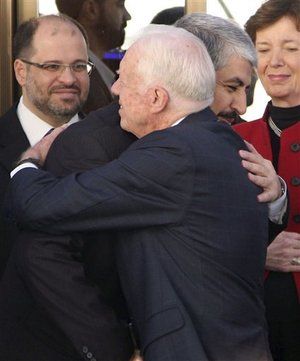
Hamas leader Khaled Mashaal, left, embraces former U.S. President Jimmy Carter as former Irish President Mary Robinson, right, looks on in Damascus, Syria, Tuesday, Oct. 19, 2010.
Former President Jimmy Carter said Tuesday that Palestinians are "living in a cage" in Gaza and that the militant group Hamas must be included in all major efforts for peace.

Carter was in Syria with an international group of veteran statesmen known as the Elders, which includes Ireland's former President Mary Robinson.

"We believe that Hamas should be included in all the major efforts to peace ... It is part of the Palestinian people," Carter said. He added that "1.5 million Palestinians are held in a cage or prison while their human rights are taken away."

Israel imposed its blockade of Gaza, a densely populated coastal strip along Israel's southwest border, following Hamas' violent takeover in June 2007. The rival Palestinian faction Fatah, led by Western-backed Palestinian President Mahmoud Abbas, controls the West Bank.

Carter's remarks came as reconciliation talks between the two Palestinian factions were postponed Tuesday.

Hamas did not give a reason for the postponement but said in a statement that Fatah officials have said they will not attend talks slated for Wednesday.

A Fatah official said they had suggested to Hamas the talks be held in Lebanon but the rivals insisted on Damascus. The Fatah official spoke on condition of anonymity because he was not authorized to speak to the media.
© Bassem Tellawi
Hamas leader Khaled Mashaal, left, shakes hands with former U.S. President Jimmy Carter as former Irish President Mari Robinson, right, looks on in Damascus, Syria, Tuesday, Oct. 19, 2010. Following a meeting with Syrian President Bashar Assad, the Elders, an independent group founded in 2007 to support worldwide peace-making and challenge injustice, headed into a meeting with Mashaal. The Elders, consisting of Carter, Robinson, former Algerian Foreign Minister Lakhdar Brahimi and Indian activist Ela Bhatt, are on a regional tour to promote peace talks between Israel and the Arabs
During a meeting in Syria last month, the factions announced they have agreed on steps to reconcile and they scheduled a meeting for this week in Damascus.

Hamas said a new date will be announced.

Deep divisions among Palestinian groups remain. On Tuesday, nine Damascus-based groups that oppose Abbas denounced his recent comments, which said Palestinians would be willing to end all historic claims against Israel if a Palestinian state is established on lands captured by Israel in the 1967 Mideast war.

The factions, including Hamas and the Islamic Jihad, said such remarks "pose a dangerous violation of all Palestinian rights."
© Unknown
Hamas leader Khaled Mashaal, right, meets with members of the The Elders, the independent group of eminent global leaders, brought together by Nelson Mandela who offer their collective influence and experience to support peace building, help address major causes of human suffering and promote the shared interests of humanity. At centre left is former Irish President Mary Robinson, former U.S. President Jimmy Carter, third left, Indian activist Ela Bhatt, second left and Algerian Foreign Minister Lakhdar Brahimi, in Damascus, Syria, Tuesday, Oct. 19, 2010.
Enhanced by Zemanta
Share:

Jimmy Carter: Gaza must be rebuilt now

Jimmy Carter

It is generally recognised that the Middle East peace process is in the doldrums, almost moribund. Israeli settlement expansion within Palestine continues, and PLO leaders refuse to join in renewed peace talks without a settlement freeze, knowing that no Arab or Islamic nation will accept any comprehensive agreement while Israel retains control of East Jerusalem.

US objections have impeded Egyptian efforts to resolve differences between Hamas and Fatah that could lead to 2010 elections. With this stalemate, PLO leaders have decided that President Mahmoud Abbas will continue in power until elections can be held – a decision condemned by many Palestinians.

Even though Syria and Israel under the Olmert government had almost reached an agreement with Turkey's help, the current prime minister, Benjamin Netanyahu, rejects Turkey as a mediator on the Golan Heights. No apparent alternative is in the offing.

The UN general assembly approved a report issued by its human rights council that called on Israel and the Palestinians to investigate charges of war crimes during the recent Gaza war, but positive responses seem unlikely.

In summary: UN resolutions, Geneva conventions, previous agreements between Israelis and Palestinians, the Arab peace initiative, and official policies of the US and other nations are all being ignored. In the meantime, the demolition of Arab houses, expansion of Israeli settlements in East Jerusalem and the West Bank, and Palestinian recalcitrance threaten any real prospect for peace.

Of more immediate concern, those under siege in Gaza face another winter of intense personal suffering. I visited Gaza after the devastating January war and observed homeless people huddling in makeshift tents, under plastic sheets, or in caves dug into the debris of their former homes. Despite offers by Palestinian leaders and international agencies to guarantee no use of imported materials for even defensive military purposes, cement, lumber, and panes of glass are not being permitted to pass entry points into Gaza. The US and other nations have accepted this abhorrent situation without forceful corrective action.

I have discussed ways to assist the citizens of Gaza with a number of Arab and European leaders and their common response is that the Israeli blockade makes any assistance impossible. Donors point out that they have provided enormous aid funds to build schools, hospitals and factories, only to see them destroyed in a few hours by precision bombs and missiles. Without international guarantees, why risk similar losses in the future?

It is time to face the fact that, for the past 30 years, no one nation has been able or willing to break the impasse and induce the disputing parties to comply with international law. We cannot wait any longer. Israel has long argued that it cannot negotiate with terrorists, yet has had an entire year without terrorism and still could not negotiate. President Obama has promised active involvement of the US government, but no formal peace talks have begun and no comprehensive framework for peace has been proposed. Individually and collectively, the world powers must act.

One recent glimmer of life has been the 8 December decision of EU foreign ministers to restate the long-standing basic requirements for peace commonly accepted within the international community, including that Israel's pre-1967 boundaries will prevail unless modified by a negotiated agreement with the Palestinians. A week later the new EU foreign policy chief, Baroness Catherine Ashton, reiterated this statement in even stronger terms and called for the international Quartet to be "reinvigorated". This is a promising prospect.

President Obama was right to insist on a two-state solution and a complete settlement freeze as the basis for negotiations. Since Israel has rejected the freeze and the Palestinians won't negotiate without it, a logical step is for all Quartet members (the US, EU, Russia and UN) to support the Obama proposal by declaring any further expansion of settlements illegal and refusing to veto UN security council decisions to condemn such settlements. This might restrain Israel and also bring Palestinians to the negotiating table.

At the same time, the Quartet should join with Turkey and invite Syria and Israel to negotiate a solution to the Golan Heights dispute.

Without ascribing blame to any of the disputing parties, the Quartet also should begin rebuilding Gaza by organising relief efforts under the supervision of an active special envoy, overseeing a ceasefire between Israel and Hamas, and mediating an opening of the crossings. The cries of homeless and freezing people demand immediate relief.

This is a time for bold action, and the season for forgiveness, reconciliation and peace.

Share:

FORMER US president Jimmy Carter: Palestinians 'treated like animals'

Agence France-Presse

From correspondents in Gaza City

FORMER US president Jimmy Carter today met Hamas leader Ismail Haniya in the Gaza Strip, where he called for a lifting of Israel's blockade, saying Palestinians are being treated "like animals".

Following the talks, Mr Carter called for an end of "all violence" against both Israelis and Palestinians.

"This is holy land for us all and my hope is that we can have peace... all of us are children of Abraham," he said at [a meeting] with Mr Haniya, prime minister of the Hamas government in the Palestinian enclave.

Mr Haniya in turn said Hamas supported the creation of a Palestinian state in the territories Israel has occupied since the 1967 Six-Day war.

While Hamas has made similar statements in the past, it has more often insisted that the future state should encompass not only the West Bank and the Gaza Strip but also all of Israel.

"If there is a real plan to resolve the Palestinian question on the basis of the creation of a Palestinian state within the borders of June 4, 1967 and with full sovereignty, we are in favour of it," Mr Haniya said.

He also praised US President Barack Obama's June 4 speech in Cairo to the Muslim world.

"We saw a new tone, a new language and a new spirit in the official US rhetoric," he said.

Such praise is rare coming from Hamas, a group pledged to the destruction of the Jewish state and which is listed as a terrorist group by the United States, Israel and the European Union.

The Islamist movement violently seized power in Gaza two years ago, ousting forces loyal to the secular and Western-backed Palestinian president Mahmoud Abbas.

Mr Carter also passed to Hamas a letter from the parents of Gilad Shalit, an Israeli soldier seized by Gaza militants including Hamas in a cross-border raid almost three years ago, and who remains in captivity.

"I met earlier with Noam Shalit. He asked me to ask them (Hamas) to accept a letter from him to his son. They accepted the letter," Mr Carter said in Tel Aviv.

"My conviction at this moment is that he is alive and well," Mr Carter said of the soldier whose father he met in Jerusalem on Friday.

Earlier Mr Carter denounced the Israeli blockade and the destruction wrought by its 22-day military offensive against Gaza in December and January.

"My primary feeling today is one of grief and despair and an element of anger when I see the destruction perpetrated against innocent people," Mr Carter said as he toured the impoverished territory.

"Tragically, the international community too often ignores the cries for help and the citizens of Palestine are treated more like animals than like human beings," he said.

"The starving of 1.5 million human beings of the necessities of life - never before in history has a large community like this been savaged by bombs and missiles and then denied the means to repair itself," Mr Carter said at a UN school graduation ceremony in Gaza City.

The United States and Europe "must try to do all that is necessary to convince Israel and Egypt to allow basic goods into Gaza", he said.

"At same time, there must be no more rockets" from Gaza into Israel, said Mr Carter, who brokered the historic 1979 peace treaty between Israel and Egypt.

"I have to hold back tears when I see the deliberate destruction that has been wracked against your people," he said at a destroyed American school, saying it was "deliberately destroyed by bombs from F16s made in my country".

Israel's offensive killed more than 1400 Palestinians and left large swathes of the coastal strip sandwiched between Israel and Egypt in ruins. Thirteen Israelis also died in the conflict.

"I feel partially responsible for this as must all Americans and Israelis," Mr Carter said.

Israel has insisted that the Gaza blockade, which bars all but essential humanitarian supplies from entering the enclave, is necessary to prevent Hamas from arming, but human rights groups have slammed it as collective punishment.

Share:

Carter: Grief and despair for Gaza

After touring Gaza, Carter said 'my primary feeling today is one of grief and despair'

Jimmy Carter has spoken of his "grief and despair" at seeing the destruction in the Gaza Strip carried out by Israel's 22-day offensive on the territory six months ago.

"This is holy land for us all and my hope is that we can have peace ... all of us are children of Abraham," the former US president said during a joint news conference with Ismail Haniya, the deposed Hamas Palestinian prime minister, in Gaza City.

Following a tour of the area to see the effects of Israel's offensive, Carter said: "My primary feeling today is one of grief and despair and an element of anger when I see the destruction perpetrated against innocent people in January."

He said the Palestinians had been treated "like animals" and the deprivations faced by them in Gaza were unique in history.

Carter said he was trying to persuade Hamas leaders to accept the international community's conditions for ending its boycott of the movement.

Obama briefing

In Depth


Riz Khan: Jimmy Carter
Washington Diary: While Gaza burns
Carter says Hamas must be included
Carter ready to meet Hezbollah
Who will save Israel from itself?
Peace still eludes the Middle East

The former president said two states were the only viable solution for the Israeli-Palestinian conflict and that he would be reporting his findings from his trip to Gaza and the Middle East back to Barack Obama, the US president.

He said he supported the proposition made by Obama in his speech in Cairo earlier this month, with regard to how to achieve peace in the Middle East.

Carter said: He [Obama] mentioned several things about the prospective road to peace.

"First of all, all settlement expansion should be stopped immediately.

"Secondly, that Jerusalem should be shared. Third, that there should be a two-state solution ... each occupying their own territory.

"Fourth that these two nations should live in peace."

Palestinian letter

Ayman Mohyeldin, Al Jazeera's correspondent in Gaza, said: "The symbolism [of the visit] is important, raising the issue of the suffering of the Palestinian people through the international media following Carter through Gaza."

Carter is believed to have delivered a note to Haniyeh from the parents of captured Israeli soldier Gilad Schalit, who has been held since 2006.

Jacky Rowland, Al Jazeera's correspondent in Jerusalem, said: "The Israelis will take from Carter what he can offer, for example, the fact that he was able to carry a letter from the family of Gilad Schalit, a letter which will be presumably delivered to Schalit.

"But his criticism won't be taken that seriously given that he is not speaking on behalf of the US administration."

Mohyeldin said that Carter had earlier met with families of Palestinian prisoners, including an eight-year-old girl who had never met her father as he has been in an Israeli jail since she was born.

"So he [Carter] is taking back with him a letter from the Palestinian people to give to Israeli officials, so certainly in that capacity he is also acting as a semi-official mediator between Palestinians and Israelis," Mohyeldin said.

Israeli offensive

Israel launched its 22-day offensive against Gaza's Hamas rulers and the Gazan people on 27 December.

Israel's offensive in Gaza destroyed thousands of Palestinian homes [AFP]
The operation killed more than 1,400 Palestinians, including more than 900 civilians, among them scores of children, according to Palestinian officials and human rights groups.

It also destroyed thousands of homes and heavily damaged Gaza's infrastructure.

Israel claims the death toll was lower and most of the dead were Hamas fighters.

Thirteen Israelis were also killed during the fighting.

Rebuilding Gaza is being hampered by Israel's blockade of Gaza which dates back to June 2007 when Hamas took control of the territory.

Since then, Israel and Egypt, which control Gaza's only border crossing that bypasses Israel, have kept the territory of 1.5 million aid-dependent people sealed to all but essential humanitarian supplies.

Israel has insisted that the blockade is necessary to prevent Hamas from arming itself, but human rights groups say it is a collective punishment.

Carter met with Hamas' exiled leadership in Syria on Thursday and said they wanted "peace and they want to have reconciliation, not only with Fatah brothers but also eventually with the Israelis".

Share:

An Unnecessary War

Former President United States Jimmy Carter from 1977 to 1981. He founded the Carter Center, a nongovernmental organization advancing peace and health worldwide, in 1982.

You can read his book Peace Not Apartheid here

I know from personal involvement that the devastating invasion of Gaza by Israel could easily have been avoided.After visiting Sderot last April and seeing the serious psychological damage caused by the rockets that had fallen in that area, my wife, Rosalynn, and I declared their launching from Gaza to be inexcusable and an act of terrorism. Although casualties were rare (three deaths in seven years), the town was traumatized by the unpredictable explosions. About 3,000 residents had moved to other communities, and the streets, playgrounds and shopping centers were almost empty. Mayor Eli Moyal assembled a group of citizens in his office to meet us and complained that the government of Israel was not stopping the rockets, either through diplomacy or military action.


Knowing that we would soon be seeing Hamas leaders from Gaza and also in Damascus, we promised to assess prospects for a cease-fire. From Egyptian intelligence chief Omar Suleiman, who was negotiating between the Israelis and Hamas, we learned that there was a fundamental difference between the two sides. Hamas wanted a comprehensive cease-fire in both the West Bank and Gaza, and the Israelis refused to discuss anything other than Gaza.

We knew that the 1.5 million inhabitants of Gaza were being starved, as the U.N. special rapporteur on the right to food had found that acute malnutrition in Gaza was on the same scale as in the poorest nations in the southern Sahara, with more than half of all Palestinian families eating only one meal a day.


Palestinian leaders from Gaza were noncommittal on all issues, claiming that rockets were the only way to respond to their imprisonment and to dramatize their humanitarian plight. The top Hamas leaders in Damascus, however, agreed to consider a cease-fire in Gaza only, provided Israel would not attack Gaza and would permit normal humanitarian supplies to be delivered to Palestinian citizens.


After extended discussions with those from Gaza, these Hamas leaders also agreed to accept any peace agreement that might be negotiated between the Israelis and Palestinian Authority President Mahmoud Abbas, who also heads the PLO, provided it was approved by a majority vote of Palestinians in a referendum or by an elected unity government.


Since we were only observers, and not negotiators, we relayed this information to the Egyptians, and they pursued the cease-fire proposal. After about a month, the Egyptians and Hamas informed us that all military action by both sides and all rocket firing would stop on June 19, for a period of six months, and that humanitarian supplies would be restored to the normal level that had existed before Israel's withdrawal in 2005 (about 700 trucks daily).


We were unable to confirm this in Jerusalem because of Israel's unwillingness to admit to any negotiations with Hamas, but rocket firing was soon stopped and there was an increase in supplies of food, water, medicine and fuel. Yet the increase was to an average of about 20 percent of normal levels. And this fragile truce was partially broken on Nov. 4, when Israel launched an attack in Gaza to destroy a defensive tunnel being dug by Hamas inside the wall that encloses Gaza.


On another visit to Syria in mid-December, I made an effort for the impending six-month deadline to be extended. It was clear that the preeminent issue was opening the crossings into Gaza. Representatives from the Carter Center visited Jerusalem, met with Israeli officials and asked if this was possible in exchange for a cessation of rocket fire. The Israeli government informally proposed that 15 percent of normal supplies might be possible if Hamas first stopped all rocket fire for 48 hours. This was unacceptable to Hamas, and hostilities erupted.


After 12 days of "combat," the Israeli Defense Forces reported that more than 1,000 targets were shelled or bombed. During that time, Israel rejected international efforts to obtain a cease-fire, with full support from Washington. Seventeen mosques, the American International School, many private homes and much of the basic infrastructure of the small but heavily populated area have been destroyed. This includes the systems that provide water, electricity and sanitation. Heavy civilian casualties are being reported by courageous medical volunteers from many nations, as the fortunate ones operate on the wounded by light from diesel-powered generators.


The hope is that when further hostilities are no longer productive, Israel, Hamas and the United States will accept another cease-fire, at which time the rockets will again stop and an adequate level of humanitarian supplies will be permitted to the surviving Palestinians, with the publicized agreement monitored by the international community. The next possible step: a permanent and comprehensive peace..
Share:

Obama's West-Bank-Story


Raja Chemayel

Candidate Obama will visit

the "Only Occupier in the Middle East"

and that is nothing new......

each US-Senator gets a free-holidays there ,

courtesy of the Holocaust-survivors from Wall-Street.

What is new is that Obama has planned

to visit the West-Bank,as well,

which is most disturbing for any fact-finding-visit

because the West Bank is the real face of Israel

(which explains why they build that wall.....)

in other words :

discrimination , a Wall , apartheid ,land-grabbing,

illegal settlements and occupation

not to forget the 603 check-points

between 247 dried-water-wells.


It happened once to Jimmy Carter,

who visited the West Bank ,

and look what happened to him !!

Carter became an honest US politician.!!


Like Saul who went to Damascus and became Paul !!

he became an honest Jew, or otherwise known as a christian.

And who knows ??,

Obama might return to his Muslim roots, even.


But we should not worry about Obama......

first he must get to become the President

then he should make a war or two

and then to retire............. and only then

he may become an honest person,

and write a book :

" Palestine , Peace not Apartheid, Part II"


Anyhow arrangements are being met

and his Israeli-body-guards shall blindfold him

until he reaches the Air-conditioned-offices

of Mahmoud Abbas , at which point in time the electricity

in Ramallah shall be switched on , temporally of course.


The humiliating and unnecessary check-points

will be camouflaged as Toll-stations.


Stay tuned ......!!


Eng. Moustafa Roosenbloom

West-Bank-Camouflage-Committee-Coordinator

15 July 2008
Share:

Jimmy Carter says Israel had 150 nuclear weapons

Israel has 150 nuclear weapons in its arsenal, former President Jimmy Carter said yesterday, while arguing that the US should talk directly to Iran to persuade it to drop its nuclear ambitions.

His remark, made at the Hay-on-Wye festival which promotes current affairs books and literature, is startling because Israel has never admitted having nuclear weapons, let alone how many, although the world assumes their existence. Nor do US officials deviate in public from that Israeli line. Carter, who has immersed himself since his presidency in Israeli-Palestinian relations, was highly critical of Israeli settlers on the West Bank, and of Israel's refusal to talk to elected officials of the Islamic party Hamas, although he said that Israel's security was his prime concern.

Carter, whose presidency was dominated by the 444-day siege in which Iran held 52 American diplomats hostage, said "my advice to the US would be to start talking to Iran now" to persuade it to drop its nuclear work. But he cited Israel's nuclear arsenal - and those of the US, Russia, China, Britain and France - in arguing that Iran would find it almost impossible to develop, in secret, many weapons and the missiles to deliver them.

Carter was the former president of the United States & Writer of many books that include Palestine: Peace Not Apartheid featured here
Share:

Carter says U.S. tortures prisoners


The United States tortures
prisoners in violation of
international law, former
President Carter said
Wednesday.


"I don't think it. I know it,"
Carter told CNN's Wolf Blitzer.

"Our country for the first time in my life time has
abandoned the basic principle of human rights,"
Carter said. "We've said that the Geneva Conventions
do not apply to those people in Abu Ghraib prison and
Guantanamo, and we've said we can torture prisoners
and deprive them of an accusation of a crime to which
they are accused."

Carter also said President Bush creates his own definition
of human rights.

Carter's comments come on the heels of an October 4
article in The New York Times disclosing the existence
of secret Justice Department memorandums supporting
the use of "harsh interrogation techniques."
These include "head-slapping, simulated drowning and
frigid temperatures," according to the Times.

The White House last week confirmed the existence of the
documents but would not make them public.

Responding to the newspaper report Friday, Bush
defended the techniques used, saying,
"This government does not torture people."

Asked about Bush's comments, Carter said, "That's not
an accurate statement if you use the international
norms of torture as has always been honored --
certainly in the last 60 years since the Universal
Declaration of Human Rights was promulgated.

"But you can make your own definition of human rights and
say we don't violate them, and you can make your own
definition of torture and say we don't violate them."

Video Watch Blitzer's interview with the former president »

After reading a transcript of Carter's remarks, a senior
White House official said, "Our position is clear.
We don't torture."

The official said, "It's just sad to hear a former
president speak like that."

Carter also criticized some of the 2008 Republican
presidential candidates, calling former New York Mayor
Rudy Giuliani "foolish" for his contention the United
States should be open to use force on Iran.

"I hope that he doesn't become president and try to impose
his conviction that we need to go to war with Iran," Carter said.

The Giuliani campaign declined to comment on Carter's criticism.

The former president didn't spare the rest of the GOP field either.

"They all seem to be outdoing each other in who wants to go
to war first with Iran, who wants to keep Guantanamo open
longer and expand its capacity -- things of that kind," Carter said.

"They're competing with each other to appeal to the
ultra-right-wing, war-mongering element in our country,
which I think is the minority of our total population."

Carter declined to say which Republican candidate he feared the most.

"If I condemn one of them, it might escalate him to the top
position in the Republican ranks," he said.

Democratic Sens. Hillary Clinton of New York and Barack Obama
of Illinois also drew Carter's criticism for refusing recently to
pledge to withdraw all troops from Iraq by the end of their
first terms if they win the presidency in 2008.

"I disagree with their basic premise that we'll still be there;
I think the American people want out," Carter said. "
If there is an unforeseen development where Iraqi people
request American presence over a period of time I think that
would possibly be acceptable, but that's not my personal preference."


Share:

The Jimmy Carter Report of his recent trip to the middle east

Trip Report by Former U.S. President Jimmy Carter
to Israel, Palestine, Egypt, Syria, Saudi Arabia, and Jordan:

Rosalynn, Jeff, and I arrived in Israel Sunday, 4/13/08,
after a very exciting and successful election monitoring
mission in Nepal (see prior trip report). Since Israel had
declined to approve a previously planned visit by three
of us Elders (Kofi Annan, Mary Robinson, and me), I
expected a similar negative reaction when I substituted
this trip on behalf of The Carter Center. Sure enough, all
my requests to meet with ministers of the government
were publicly rejected and, more seriously, three requests
from our Secret Service detail to work with Israeli security
were rejected. This was our first experience of this kind in
more than 125 foreign nations we've visited since leaving
the White House. (After several news stories on this subject,
when we returned to Israel, Shin Bet security met us at the
airport and worked with us.)

We were met in Tel Aviv by Bob Pastor, former Congressman
Steve Solarz, and Hrair Balian, who arrived on a plane furnished
by Jeff Skoll, and we proceeded together to the King David Hotel
in Jerusalem. My first event was an extensive interview with
Ha'aretz newspaper, and I was able to convince them that we
were undeterred, that the challenges were the reason we
decided on our trip, and to explain our reasoning and basic
purposes. Luckily, in a democracy like Israel, there are
numerous sources of information from private citizens who
are experts on government policies and attitudes. Also, official
Israeli policies are well known.

President Shimon Peres did agree to meet on a personal basis
just with the members of our family, and we had a very pleasant
and congenial exchange of ideas. Later, one of his aides reported
untruthfully that it was a harsh exchange and that I was scolded
by him about our plans to meet Hamas. Our next meeting was
with Noam and Aviva Schalit, parents of the young Israeli
soldier who has been held for about 18 months by the
Palestinians in Gaza. We pledged to do our best to learn
about his condition and to aid in his release.

After a much-needed rest, we began the next day with a
breakfast briefing by two Israeli public opinion researchers
on their latest information about Israeli Jews. To summarize,
Israelis are fairly satisfied with the status quo, have little
confidence in the peace negotiators on either side, are
deliberately uninformed about the plight of the Palestinians,
and (surprisingly) are much more concerned in the negotiations
for peace with the Palestinians about the "right of return" than
about settlements or Jerusalem. U.S. Consul General Jacob
Walles gave us a briefing about the seemingly limited role the
U.S. State Department plays in the Occupied Territories. The
Israelis are very restrictive, costs of required security in the
West Bank are high, and they do not have access to Gaza. We
later learned from several sources that there are some
fundamental differences between the State Department and
the NSC/ White House, and as in most Administrations, the
White House view prevails.

We had an informative meeting with Yossi Beilin, founder of
the Meretz political party and co-author of the Geneva peace
proposal. Soon after, to our surprise, he held a press conference
and quoted me (accurately) on several subjects. Our next
stop was Sderot, a town of about 20,000 that is near Gaza
and has had about two Qassam missiles strike it each day
for the past seven years, but the larger proportion has
come in the last year. Thirteen people have been killed by the
small and inaccurate rockets, and the town is traumatized by
the daily attacks. The streets, playgrounds, etc. were empty,
and about 3,000 residents have moved away. We looked at
nearby Gaza from a hilltop and then had a long discussion
with several citizens and Mayor Eli Moyal in his office. He
said that there were two ways for a government to protect
its people: by diplomacy or military action - and the Israelis
were doing neither for his town. We toured the Berzilai hospital
in Ashkelon, where trauma victims are brought from Gaza and
Israeli communities, with no distinctions between Jews and
Arabs. Psychological injuries are most prevalent.

After driving back to Tel Aviv, I spoke to an audience at an
Internet convention and engaged in a forum discussion with
Ha'aretz reporter David Landau. Our next meeting was with
the families of the two soldiers captured by Hezbollah, who
have had no indication of whether they are still alive.

Back at our hotel, we had an intriguing discussion with about
a dozen distinguished Israelis, who have held major positions
in intelligence, government, or the military or who are experts
in their personal careers relating to the peace effort. At the end
of the session, I felt that most of them approved of my pending
visit with Hamas and Syria. Collectively, the group had many
years of experience in dealing with the Palestinians and other
Arabs, in addition to studying the attitude and history of
Israelis over the years.

On Tuesday, 4/15, we drove to Ramallah, where Tim Rothermel
in our Carter Center office hosted meetings. We were briefed by
staff members of the Palestinian Authority who are advising
negotiating teams, but found that they are excluded from the
top tier of negotiating, either at the Abbas-Olmert level or
even the discussion of "road map" issues. We received some
interesting polling data from Dr. Nader Said, which showed no
confidence in the current negotiations and rising anger. About
50 members of the diplomatic corps joined us for a reception,
and seemed supportive of our mission. They were, almost by
definition, sympathetic with the Palestinians.

Perhaps the most emotional event of our entire trip was a
meeting with young people, mostly of college age. The
description of their deprivations and persecution was appalling,
and their determination and hope for a better life brought tears
to our eyes. They and their families had had citizenship rights
taken away even though born and raised in Ramallah, Jericho,
or Nablus, just because they may have visited or studied
elsewhere. Many relatives were imprisoned for years
because of some non-violent political activity. Including women
and children, the Israelis now hold 11,600 prisoners, and about
25 percent of the entire Palestinian populations have been
arrested.

After a brief ceremony at Arafat's grave, we had an extensive
discussion with Palestinian Prime Minister Salam Fayyad, who
is a very impressive leader. Among other things, he expressed
hope for reconciliation between Hamas and Fatah, but we knew
that President Mahmoud Abbas has been told by the U.S. and
Israel that the peace talks will end and all funding cut off if he
makes this move. He emphasized, quite emotionally, "Unless
America stops the Israelis from expanding settlements, there
can be no peace. Not one more brick!" has become his mantra.
The Prime Minister gave us some suggestions for our meetings
with Hamas leaders.

We then had lunch with about a dozen distinguished Palestinian
leaders from both political parties. I embraced Eyad Sarraj, a
courageous human rights leader from Gaza, who I've known,
but the press thought he was one of the people from Hamas,
and it became a worldwide news story that I embraced a Hamas
leader. (Of 43 Hamas candidates elected to the Palestinian
parliament from the West Bank, 41 are in prison.) After other
meetings during the afternoon, we returned to East Jerusalem
for a session with the Israel-Palestine Business Council, a group
attempting to demonstrate that trade and commerce between
the two are both possible and profitable.

On Wednesday, we met first with Avigdor Liebeman, leader of
"Israel Our Home." He believes that Jews and Arabs should be
completely separated, with Israeli Arabs moved east into the
West Bank and Jewish settlers returned back to Israel. We
then met with the NGO Peace Forum, a room full of
representatives from about 120 groups from Israel and
Palestine who are striving for peace. As expected, they all
supported our mission, and I advised them to concentrate
their diverse efforts around the acceptance of the
Geneva Accords.

U.S. General Dayton and his multinational staff gave us a
briefing as best they could while avoiding all the subjects
they are forbidden to discuss. He has been in the region
for 2½ years, is obviously dedicated and competent, and
has had to accommodate frequent changes in his assigned
duties each time there have been different circumstances
on the ground. A major project now is to train a professional
security force in Jordan. They have just completed training
of a 600-person battalion.

Our next meeting was quite interesting, with Deputy Prime
Minister and Minister of Industry and Trade Eli Yishai. He
is leader of Shas, a conservative religious group of 11 Knesset
members that is dedicated to peace – and holding on to all of
Jerusalem. He was very interested in our mission, expressed
no opposition, and asked us to help arrange a meeting with
Hamas leaders for himself in order to orchestrate the release
of Corporal Schalit. He was the only member of the Israeli
cabinet willing to meet with me.

Our last stop before flying to Egypt was Hadassah Hospital,
where wonderful medical work is being done and the main
emphasis seems to be on peace between Israelis and Arabs.
The patients and also the staff include Jews and Arabs from
both Israel and Palestine.

In Cairo, we received an excellent briefing from U.S.
Ambassador Ricciardone concerning U.S.-Egypt relations
and the ongoing negotiations between Egypt and Hamas
on behalf of Israel and the U.S. This was his last day on
this assignment, and we attended a going-away reception
for him.

Our first meeting on Thursday was with Osamah al-Baz,
who was my key Egyptian negotiator at Camp David and
the closest confidante of Anwar Sadat. Although no longer
active in government, he is one of the wisest and most
knowledgeable people I know. Next, we had an intriguing
session with Chief of Intelligence Omar Soliman, who is in
total charge of all the relations with Hamas. Through him,
the U.S. and Israel are negotiating with Hamas while
publicly denying any relationship. He was extremely
impressive. His position gives him an excellent insight
into the intricacies of Middle East political and military
affairs.

During an elaborate luncheon with President Hosni
Mubarak and his wife Suzanne (old friends), we discussed
former times and how much Egypt has been blessed by the
peace treaty with Israel. Not engaged in warfare, having
their land and oil wells returned, and being a special friend
of the U.S., Egypt is thriving. With the president and prime
minister, I probed for some more tolerant policies toward
non-violent and secular political opponents in coming elections.

Our meeting with Hamas leaders, Mahmoud Al-Zahar,
Siad Siam, and Ahmed Yousef went on for more than
three hours. Well briefed by Mr. Soliman, we made full use
of this time. My primary goal was to induce them to stop all
rocket attacks against Israeli civilians, to be flexible in
negotiating for a prisoner exchange involving Schalit's
release, to accept the basic control premises for the
opening of the Rafah gate between Gaza and the Sinai, to
be open to the idea of a possible non-partisan government
of technocrats, and to agree to accept any agreement
negotiated between Abu Mazen and Olmert provided it is
then approved by Palestinians, perhaps in a referendum.
I also delivered requests from Israeli Deputy
Prime Minister Yishai and Yossi Beilin to meet with
Hamas leaders. It was an amicable and interesting
discussion, and helped to prepare us for the meeting in
Damascus with Mashaal. In all discussions, Rosalynn,
Bob Pastor, and Congressman Solarz played a crucial role.

In the evening, I gave a lecture to a packed crowd at the
American University of Cairo and an-swered their
questions as frankly as I could.

On Friday, we flew to Damascus, where our first official
event was a delightful luncheon with
President Bashar al Assad and his wife Asma. Although
I had known him as a college student, this was our first
meeting since he inherited the office after his father died.
In the meantime, Bob, Steve, and Hrair met with
Foreign Minister Walid Mualem and his deputy, Faysal Mekdad.
We then assembled at the presidential palace for a thorough
discussion of all the important issues: Golan Heights, Lebanon,
Iran, and U.S.-Syrian relations. Assad was very eager to
resume peace talks with Israel, if strongly supported by
the U.S. The only precondition would be public acknowledgement
that the discussions were being held. The most significant
discovery was the obvious personal strength and mastery
of details by the young president. He also promised that all
the seven imprisoned human rights activists would be released
if they request clemency.

We then had a long meeting, before and after supper, with
Mashaal and top leaders in the Hamas politburo. I pursued
as forcefully as possible the same issues as before, including
steps they might take to reduce tension, to resolve some
current conflicts with Israel, and to enhance the prospects
for progress in the peace talks underway between Israel and
the Palestinians representing the PLO. Mashaal and I left
before midnight, with Bob, Steve, and Hrair to continue
detailed discussions with the remaining Hamas politburo
members and to seek written understandings on the issues.
We reassembled the following morning to continue our talks,
and Mashaal and I agreed on wording of our points, which he
said he would submit to the top Hamas leaders, including those
from Gaza, and would give us their response to our proposals
before our final press conference Monday morning in Israel.

Our plane had a flat tire, but we were given a substitute by
President Assad and were able to proceed, on time, to
Saudi Arabia. We first met with Prince Turki al-Faisal at the
King Faisal Foundation, and were able to share information
about our trip and his analysis of various issues of common
interest. A major conference was underway at his center on
how to resolve the Iraqi quandary. We then visited with
King Abdullah for about 45 minutes, who interrupted his
weekly session with private Saudi citizens. When I returned
to our hotel suite, Saudi's ambassador to the U.S., H.E.
Adel Al-Jubair , called to say that his majesty was making a
nice contribution for our health work in Africa.

During the evening we had dinner with
Prince Alwalid bin Talal and toured his estate. The next morning
we proceeded to Jordan (in the prince's plane) for a visit with
King Abdullah II, Foreign Minister Salah Eddin al Bashir,
and other ministers. They were quite critical of Hamas, Syria,
and Iran, but also with the lack of progress and apparent lack
of commitment to the peace talks between Israel and Palestine.
The king will express his concerns in an upcoming visit to
Washington. After a meeting with Adnan abu Odeh we flew to
Israel, where we finally received protection from Israel's
superb security force. During the night, we received responses
to our suggestions and questions from the
com-bined Hamas leadership.

Monday morning we first met with Palestinian Prime Minister
Salam Fayyad and then Shas leader Eli Yishai, to whom we
outlined the results of our trip. We prepared a presentation
for me to make to a conference sponsored by the
Israeli Council on Foreign Relations. Although repeating some
of the above, this is the report, slightly revised, that I made to
an audience mostly of Israeli leaders, foreign diplomats, and
the news media:

"During the past eight days, we traveled to Israel, the
West Bank, Egypt, Syria, Saudi Arabia, and Jordan and
met with distinguished leaders of each nation – from
government, business, academia, and civil society. We
visited the Hadassah Hospital in Jerusalem and a hospital
in Ashkelon where we saw Israeli and Palestinian
doc-tors treating patients from Israel and Palestine equally
– a positive sign of what the future could hold if peace is achieved.

"We knew that some of our meetings – particularly with
Hamas and the Syrian government – would be viewed
negatively in some quarters. The problem is not that we
met them, but that the U.S. and Israeli governments
refuse to meet with them, making peace harder if not
impossible to achieve.

"In Israel, we visited Sderot and Ashkelon and saw the
despair and fear due to the barrage of rockets. Aiming these
rockets at civilian communities is an act of terrorism, and we
urged Hamas to stop. I also visited the Palestinian territories
and spoke to families who have lost their loved ones through
violence and imprisonment. Most others are impeded from
going to work, to school, or to worship because of the intruding
wall and a plethora of road blocks. This too is unacceptable.

"On this 60th anniversary of the independence of Israel,
I acknowledge a personal sadness that, during 30 years
since Camp David, only Jordan has recognized Israel. I am
glad that President Bush and Secretary Rice have pledged to
complete a peace agreement by the end of the year. I hope
that such an agreement will set the stage for wider recognition
of Israel and acceptance of a sovereign Palestinian state. Our
talks in Syria have led us to conclude that peace with Israel
could be within reach, with Syria being the next country to
recognize Israel if an agreement is reached.

"Allow me to offer some tentative conclusions
based on our many meetings:

1. Public Opinion: Despair. A substantial majority of Israeli
and Palestinian citizens and political leaders share the view
that the peace negotiations are not making any progress and
are unlikely to succeed. Palestinians are convinced that the
Israeli government is more focused on expanding settlements
than in making peace. Israelis fear more Palestinian attacks.
When hope for peace declines and frustration increases,
some people begin to turn to violence as the only path, and
recent public opinion polls in the West Bank and Gaza suggest
this is happening.

2. The State of Peace Talks and the Roadmap. Four levels of
talks are occurring: (a) between President Abbas and Prime
Minister Olmert on final status issues; (b) between
Ahmed Qurai and Tzipi Livni on the same issues, though in
more detail; (c) between technical teams on both sides; and
(d) among Prime Minister Fayyad, Minister Ehud Barak,
and U.S. General Fraser on monitoring the roadmap.
President Abbas recently deplored the lack of progress on
the major status issues, and without concrete progress at
that level there is no chance that the next two levels can
be productive. Minister Barak did not even attend the
recent session convened by General Fraser to review the
roadmap. One possible reason is that he had nothing
positive to report. Indeed, not only does there appear to
be no progress on the final status issues, but there is
regression on the roadmap. Since Annapolis, about 9,000
more settlements have been announced and are being
expanded or built; more roadblocks and checkpoints have
gone up; and Gaza is increasingly isolated as a prison for
1.5 million Palestinians. On the Pales-tinian side, according
to U.S. General Dayton, there has been progress in the
West Bank under the Palestinian Authority in the training
of security forces.

3. Palestinian Desperation. The impression of no progress
on final status issues, combined with the expansion of
settlements and roadblocks, have left the Palestinians
increasingly angry. In a meeting we had with young leaders
in the West Bank, several mentioned a "third intifada," based
on the feeling that peace is not possible and the facts on the
ground are growing worse. They did not defend the position
taken by some of their friends on the need for violence, but
they understand it. The danger is that most Israelis seem
unaware of this growing crisis.

4. Five Interlocking Conflicts. The Palestinian-Israeli conflict
lies at the center of other crises or challenges in the
Middle East: intra-Palestinian; Syria-Israel; Lebanon;
and Iran's growing influence. While each crisis needs to
be addressed on its own, none of them can be solved
without addressing or at least taking account of the others.

5. Comprehensive Peace. For peace in the Middle East
to be sustainable, it needs to be comprehensive. This means
that one needs to relate each crisis to the other, but it also
means that actors with an obvious stake in the conflict need
to have a stake in finding a solution. Groups such as Hamas
view themselves as seeking liberation, but their role is viewed
by some as using terrorism to undermine the prospects for peace.
Syria, which we believe is ready to negotiate peace with Israel
and normal relations with the United States, should also be
permitted a place in the overall peace process lest they
seek to subvert it.

6. Neighbors. All of Israel's neighbors believe they have much at
stake in the success of the negotiations. Egypt is mediating between
Hamas and Israel, and Saudi Arabia and Jordan have played
key roles in assisting the peace process. And yet all are deeply
worried that the negotiations will not succeed, and the effect
on the region will be devastating. In our meeting,
King Abdullah II of Jordan stressed the absence of tangible
progress in the ongoing peace negotiations, and especially the
need for stopping the expansion of settlements.

"We did not come as mediators or negotiators, and have
been careful not to interfere in the principal peace negotiations.
But we think there is a role in listening closely to two excluded
actors – Hamas and the Syrian Government – and offering
ideas on ways that they could take a more productive road
to peace. Our conclusion is that there are good reasons to
believe that such a strategy can yield constructive
involvement by them, but it will take considerable
time and patience.

"Let me focus my remarks on the two most controversial sets of meetings.

Hamas. I understand why Israel and other governments are
reluctant to engage Hamas. They have not yet agreed to accept
Israel's peaceful existence; they have not renounced violence;
and they do not accept previous peace agreements. In our
judgment, Hamas should accept all three points, but we do not
believe peace is likely and we are certain peace is not
sustainable unless a way can be found to ensure that
Hamas will not disrupt the peace negotiations.

"The current strategy of isolating and suppressing Hamas and
persecuting the people of Gaza is not working. It only
exacerbates the cycle of violence, and latest polls show that it
increases the relative popularity of Hamas throughout Palestine.
Some feel that my meeting with Hamas legitimized them, but
their legitimacy came when a plurality of the Palestinian people
voted for them in the 2006 elections, which I observed. Israelis
know that Hamas won a majority of parliamentary seats, and a
recent poll of Israeli citizens indicates strong support (64 percent)
for direct Israel-Hamas talks.

"We have no illusions that our brief meetings will stop the
violence or produce peace, but we needed to take that first
step. It is clear from our conversations that their views, as
well as those of Israelis, need to be tested by regular
exchanges, such as occurred in the many years of Track
II diplomacy with the PLO.

"Violence freezes adversaries in a counterproductive posture.
Israelis think the Palestinians will never accept Israel and
Palestinians believe that Israel will never accept a genuinely
independent Palestine. We think both are wrong and trust
Prime Minister Olmert and President Abbas to find their path
to a two-state solution.

"I met with Hamas leaders from the West Bank, Gaza, and
Damascus. After all-day discussions among their leaders,
they agreed that they would accept a two-state solution on
the 1967 borders if approved by Palestinians – a departure
from long-standing Hamas doctrine that refused to recognize
the possibility of two states living side-by-side in peace. This
may be a very significant change.

"Specifically, they agreed to these exact words: "If President
Abbas succeeds in negotiating a final status agreement with
Israel, Hamas will accept the decision made by the
Palestinian people and their will through a referendum
monitored by international observers, including those
from the Carter Center, or by a newly elected Palestinian
National Council by mechanisms agreed upon nationally,
even if Hamas is opposed to the agreement. In order to
ensure that the referendum can be debated and the choice
by voters truly reflects the will of the Palestinian people,
a national reconciliation and, in particular, between Fatah
and Hamas will be necessary.

"Let me underscore the significance of the statement.
It means that Hamas will not undermine Abbas' efforts to
negotiate the agreement, and whatever position Hamas
chooses to take on the agreement, Hamas will accept
an agreement if the Palestinian people support it by a
free vote. If the agreement calls for a two-state solution
and the recognition of Israel and Palestine, Hamas will,
in effect, accept Israel's right to exist in peace - if the people
agree on the plan.

"Hamas leaders said they did not want violence, but they
believed it was necessary to end the occupation. However,
they did say they would consider alternative strategies,
including non-violence, to achieve their goal of a sovereign
Palestinian state.

"In our meetings with Hamas, we made the following
additional points:


1. We pressed them hard on a cease-fire. They are negotiating
with Egypt, and we urged them to move rapidly to bring the
negotiations to a successful conclusion.

2. We proposed a rapid exchange of prisoners, involving the
early transfer of Corporal Schalit to Egypt in exchange for a
group of prisoners not guilty of serious crimes, including all
the women and children. Hamas considered their negotiations
through Egypt to be well advanced and including prisoners
whose families had been promised a high priority on their list to
be swapped. Mr. Mashaal assured us that Schalit is well and
promised a new letter from him to his parents, to be delivered
through The Carter Center. Also, Schalit will be transferred to
Egypt as an intermediate step in the exchange.

3. Hamas urged that the border crossing at Rafah be reopened.
The crossing would be monitored by the Palestinian Authority,
Hamas, the European Union, and Egypt. Final decisions would
be made by Egyptian officials.

4. Hamas is prepared to consider with President Abbas an
idea of creating a government of national consensus, with a
unified and nonpartisan professional security force for the
West Bank and Gaza. There would be a cabinet composed
of technocrats belonging neither to Fatah or Hamas, but
approved by both. This non-partisan group would govern
until the scheduled elections in 2010.

5. The leaders of Hamas asked me to express their greatest
concern with the terrible suffering of the Palestinian people
and reiterated that the basis for peace would be the
fulfillment of Palestinians' national right of
self-determination and the establishment of a
sovereign Palestinian state on the 1967 borders.

"Syria. Communications between Israel and the United
States with Syria are almost non-existent, and relations
have been strained when not hostile. The United States
and Israel brand Syria as a supporter of terrorism through
its cooperation with Iran and the funding and support for
Hamas and Hezbollah. Furthermore, the two governments
view Syria as undermining the stability of Lebanon and the
selection of a President. In our conversations, the Syrian
government seemed determined to correct these allegations.
Senior government officials pledged to complete an agreement
on the Golan Heights and peace with Israel as soon as possible.
The government took very seriously the recent comment by
Prime Minister Ehud Olmert that he understood Syrian
expectations, and he thought Syria understood Israeli
expectations. Since the Syrian government considers that
about 85 percent of the issues have been resolved in prior
negotiations, it believes the agreement should be completed
soon. In Syria's view, there has been agreement on the
borders, riparian rights as they apply to the Sea of Galilee,
security zones and the presence of international forces.

"The United States has three options. It can continue to
oppose such peace talks, which will make it impossible to
achieve peace. It can play a neutral role, but that won't be
enough. Finally, the U.S. could play a positive and
constructive role, as proposed by the Syrian government,
and we hope it does. On Lebanon, Syria ac-knowledges that
it has some influence but insists that it is no longer playing a
large role, as it did when it had troops there, and that the
key to the solution is a national dialogue in which the various
parties reach a consensus. In effect, this means that on critical
issues (constitutional, economic policy, security), the
government should ne-gotiate an agreement with the
opposition parties that represent 45 percent of the
parliament, including Hezbollah.

"In brief, Syria has influence over four of the conflicts that we
have been discussing: Syria-Israel; Israel-Palestine;
Intra-Palestine; and Lebanon. A successful negotiation on each
will have positive effects on the other, and conversely, failure
to reach agreement on one would make it harder to solve the
others. If there is an agree-ment between Israel and Palestine
and reconciliation between Fatah and Hamas, then there is no
longer any need for Syria to help Hamas; and if there is a
consensus on Lebanon, there is no need to support Hezbollah.
And finally, if the United States decides to support the
negotiations with Israel, then U.S. concerns with Syria's
performance will be addressed.

"In Syria, we raised our concerns about the people
imprisoned for signing the Damascus Declaration, and
President Bashar al-Assad said that there were only seven
still being held from the original 90 detained. He said that
if they sought clemency, they would receive it. We also asked
him about Guy Hever, the young Israeli soldier who has been
missing since August 1997, and he said they had no evidence
of his whereabouts. We asked about Ehud Goldwasser and
Eldad Regev who were captured by Hezbollah at the
beginning of the war. The Syrian government has no
information on them.

Conclusion

"In conclusion, we agree with President Abbas' recent
statement that the final status negotiations are moving so
slowly, with so few obvious results, that it is very unlikely
negotiations will be completed by the deadline at the end
of the year. This conclusion is widely shared, and may
prove to be tragic. The combination of little or no progress on
final status issues and a regression on the roadmap issues –
settlements, checkpoints, etc. – and the closure of Gaza – all
this means that the frustration level among Palestinians may
be reaching the boiling point.

"Therefore, it is essential that we find an alternative and that
includes a ceasefire, exchange of prisoners, negotiations
between Israel and Syria and some rapprochement
between Fatah and Hamas.

"No important achievement has ever occurred in the
Middle East without taking a risk. I hope the Israeli
government, the Palestinian Authority, Hamas, and
the U.S. government are prepared to take risks for peace.
The transformation of Israel in sixty years has been wonderful
to behold. The next miracle for which we should all pray is
the establishment of a sovereign Palestinian state that will live
in peace with Israel and will cooperate with all their neighbors
for the future of the region and its children. The Holy Land is
a place of miracles. It is time for the miracle of peace."


After answering a number of questions in the public forum,
I had a number of interviews in-cluding CNN, BBC, Al Jazeera,
Fox, Reuters, AP, AFP, Chicago Tribune, ABC, NPR, two Israeli
TV channels, New York Times, Washington Post, Newsweek,
and LA Times. Meetings with the leader of Arab Israelis,
Ahmed Tibi, Yossi Beilin, and former
Prime Minister Ben Amin concluded a very busy day.
Still not having a private plane, we departed Israel about
midnight on a Delta flight to Atlanta. As I had predicted to
Bob Pastor and Steve Solarz, the entire trip was exciting,
challenging, adventurous, adequately productive – and fun!
Share: