Showing posts with label Jordon Valley. Show all posts
Showing posts with label Jordon Valley. Show all posts
Jordan Valley: Palestinian family’s water confiscated, internationals arrested
On Thursday, June 21, Israeli forces confiscated a water tank from a Bedouin Palestinian family in the Jordan Valley, leaving them with no access to water. Three Swedish women were arrested for standing in solidarity with Palestinian women and children who peacefully protested by standing in between the Israeli military and the water tank at risk of theft.25 June 2012 | International Solidarity Movement, West Bank
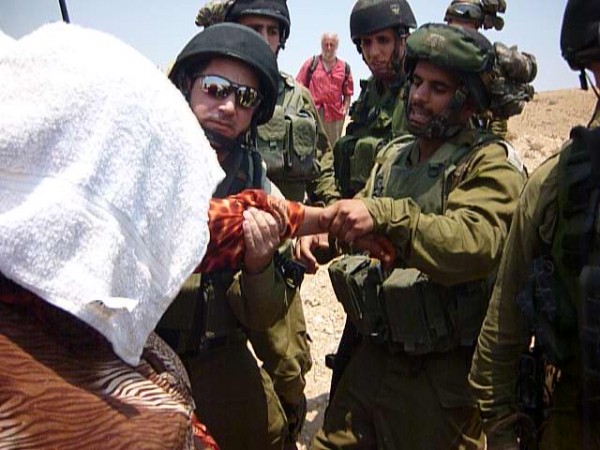
Israeli soldiers deal violently with a Palestinian woman peacefully protesting the theft of her water tank
The Jordan valley is a fertile area ideal for agricultural production. When Israel took control of the West Bank, it immediately took hold of water resources and began to target Palestinian communities and empty them from the Jordan Valley. The villages left are isolated from each other not only by distance but by Israeli checkpoints, closed military zones, and other restrictions on movement. The Israeli military performs military training in proximity to many communities, putting them at constant risk.The illegal occupation of water resources has made water access an urgent problem. The United Nations declares water a basic human right. The World Health Organization has declared that each individual needs access to 100 litres of water per day, but Palestinians use on average between 50 to 70 litres per day. Many Palestinians in the Jordan Valley however, receive as little as 10-20 litres per day. This is a figure lower than the absolute minimum daily consumption required to avoid ‘mass health epidemics.’ Families in the Jordan Valley are forced to buy water at incredibly inflated prices. Some households spend 40-50% of their income to buy water from Israeli companies.
“When we came to the Bedouin camp, children were crying and there were a lot of soldiers trying to drag them away from the tractor that they tried to block. There were no men, only women and children, and around 60 soldiers and policemen. The Bedouin men were scared to show any resistance because of the risk of administrative detention,” says Rosa Andersson, one of the women who was later arrested.
The Swedish women were released after 30 hours of arrest and they are now prohibited from being in the West Bank. No one, Palestinian or International, showed any violence. The Palestinian family dependent on the confiscated water tank now has no access to water as the driest season of the year has just begun.
Related articles
- 18 year old shepherd shot by Israeli soldiers in Jordan Valley (alethonews.wordpress.com)
- Palestinian farmland exploited for Israeli military exercises (alethonews.wordpress.com)
- The Forcible Transfer of the Palestinian People from the Jordan Valley (alethonews.wordpress.com)
- Israeli Forces Destroy Tents, Shacks in Jordan Valley (occupiedpalestine.wordpress.com)
- Susiya: Another Casualty of Israeli Occupation? (alethonews.wordpress.com)
- Bedouin Community Demolished, Thirty People Displaced (altahrir.wordpress.com)
- Israelis Stop Palestinians from Getting Drinking Water (altahrir.wordpress.com)
- IOA serves demolition notices in occupied Jerusalem, Jordan Valley (occupiedpalestine.wordpress.com)
Fasayil: Random arrests to induce people to leave their lands
A shepherd from Fasayil, in the Jordan Valley has been detained for three days, falsely accused of �theft of water�.
Said Muhammad J�dea Rashaidi from Fasayil has spent his life as a shepherd in the hills surrounding his village. This kind of repression is part of the Occupation�s policies to intimidate and bar Palestinians from their land.
Every day Said sends his animals to the hills and he has continued to do so even after the Occupation declared these areas of Palestinian grazing land to be off limits. The lands around Fasayil are part of the 96% of the Jordan Valley that are under full control of the Occupation. Around midday, Said brings the cattle to the village's natural spring. The people of Fasayil carry all the documentation proving their ownership over the spring, yet a few months ago the Occupation told the people that the spring in Fasayil is now part of a natural reserve and that they were not to access it anymore. This would mean depriving the people of the only water resource for them and their animals as Fasayil � like all villages in the Jordan Valley that have been categorized �C area� under Oslo and hence under full administrative control of the Occupation � has not been allowed to build a water and sewage system. The villagers have defied all those prohibitions to access their land and resources.
Makarot, the Israeli company that controls the water resources in the Jordan Valley and large parts of the West Bank has dug a well in the area which it uses to steal Palestinian water. On the 24th July, two gunmen from Makarot stopped Said while he was grazing his cattle close to the well and called the border police, claiming that he had entered a fenced off area surrounding it. After two hours the police arrived with a military expert specialized in analysing foot prints. He took Said's footprints and compared them with the ones found near the well. The Occupation forces soon realized that the footprints they had found were not Said�s, so they told him that they would keep him in prison until he led them to the person responsible.
They took Said with them and since then, his younger brother - the only one for whom the family is able to afford the costs to go to university - has had to drop his studies to take care of the sheep.
Yesterday, Said�s father received a phone call from one of Said�s cellmates in Ariel prison; the first time his family had received any notice of his whereabouts since his arrest. The only other thing Said's father knows is that the family will be forced to pay a huge fine to ensure their son's release.
Said's case is the third arrest in Fasayil since the beginning of the year and all have followed a similar pattern.
In other places in the valley, such as Bardala and Ein el Beida there are similar stories.
The dispossessed and impoverished families of Haddidiye are being punished for resisting on their land, attacked with trumped up charges resulting in large fines. The ever expanding �military zones� and other areas designated as off limits to Palestinians are part of a deliberate policy of colonizing land in the Jordan Valley.
Fasayil lies in the shadow of the settlements of Tomer and Bet Syel which have been built on its land, and is under constant threat of house demolitions. Family homes as well as the core infrastructure of the village is systematically targeted.
For the villagers, remaining in Fasayil to defend lands, lives and and livelihoods has become a daily act of resistance.
 Members of Said's family waiting for his release.

Said Muhammad J�dea Rashaidi from Fasayil has spent his life as a shepherd in the hills surrounding his village. This kind of repression is part of the Occupation�s policies to intimidate and bar Palestinians from their land.
Every day Said sends his animals to the hills and he has continued to do so even after the Occupation declared these areas of Palestinian grazing land to be off limits. The lands around Fasayil are part of the 96% of the Jordan Valley that are under full control of the Occupation. Around midday, Said brings the cattle to the village's natural spring. The people of Fasayil carry all the documentation proving their ownership over the spring, yet a few months ago the Occupation told the people that the spring in Fasayil is now part of a natural reserve and that they were not to access it anymore. This would mean depriving the people of the only water resource for them and their animals as Fasayil � like all villages in the Jordan Valley that have been categorized �C area� under Oslo and hence under full administrative control of the Occupation � has not been allowed to build a water and sewage system. The villagers have defied all those prohibitions to access their land and resources.
Makarot, the Israeli company that controls the water resources in the Jordan Valley and large parts of the West Bank has dug a well in the area which it uses to steal Palestinian water. On the 24th July, two gunmen from Makarot stopped Said while he was grazing his cattle close to the well and called the border police, claiming that he had entered a fenced off area surrounding it. After two hours the police arrived with a military expert specialized in analysing foot prints. He took Said's footprints and compared them with the ones found near the well. The Occupation forces soon realized that the footprints they had found were not Said�s, so they told him that they would keep him in prison until he led them to the person responsible.
They took Said with them and since then, his younger brother - the only one for whom the family is able to afford the costs to go to university - has had to drop his studies to take care of the sheep.
Yesterday, Said�s father received a phone call from one of Said�s cellmates in Ariel prison; the first time his family had received any notice of his whereabouts since his arrest. The only other thing Said's father knows is that the family will be forced to pay a huge fine to ensure their son's release.
Said's case is the third arrest in Fasayil since the beginning of the year and all have followed a similar pattern.
In other places in the valley, such as Bardala and Ein el Beida there are similar stories.
The dispossessed and impoverished families of Haddidiye are being punished for resisting on their land, attacked with trumped up charges resulting in large fines. The ever expanding �military zones� and other areas designated as off limits to Palestinians are part of a deliberate policy of colonizing land in the Jordan Valley.
Fasayil lies in the shadow of the settlements of Tomer and Bet Syel which have been built on its land, and is under constant threat of house demolitions. Family homes as well as the core infrastructure of the village is systematically targeted.
For the villagers, remaining in Fasayil to defend lands, lives and and livelihoods has become a daily act of resistance.
Members of Said's family waiting for his release.